

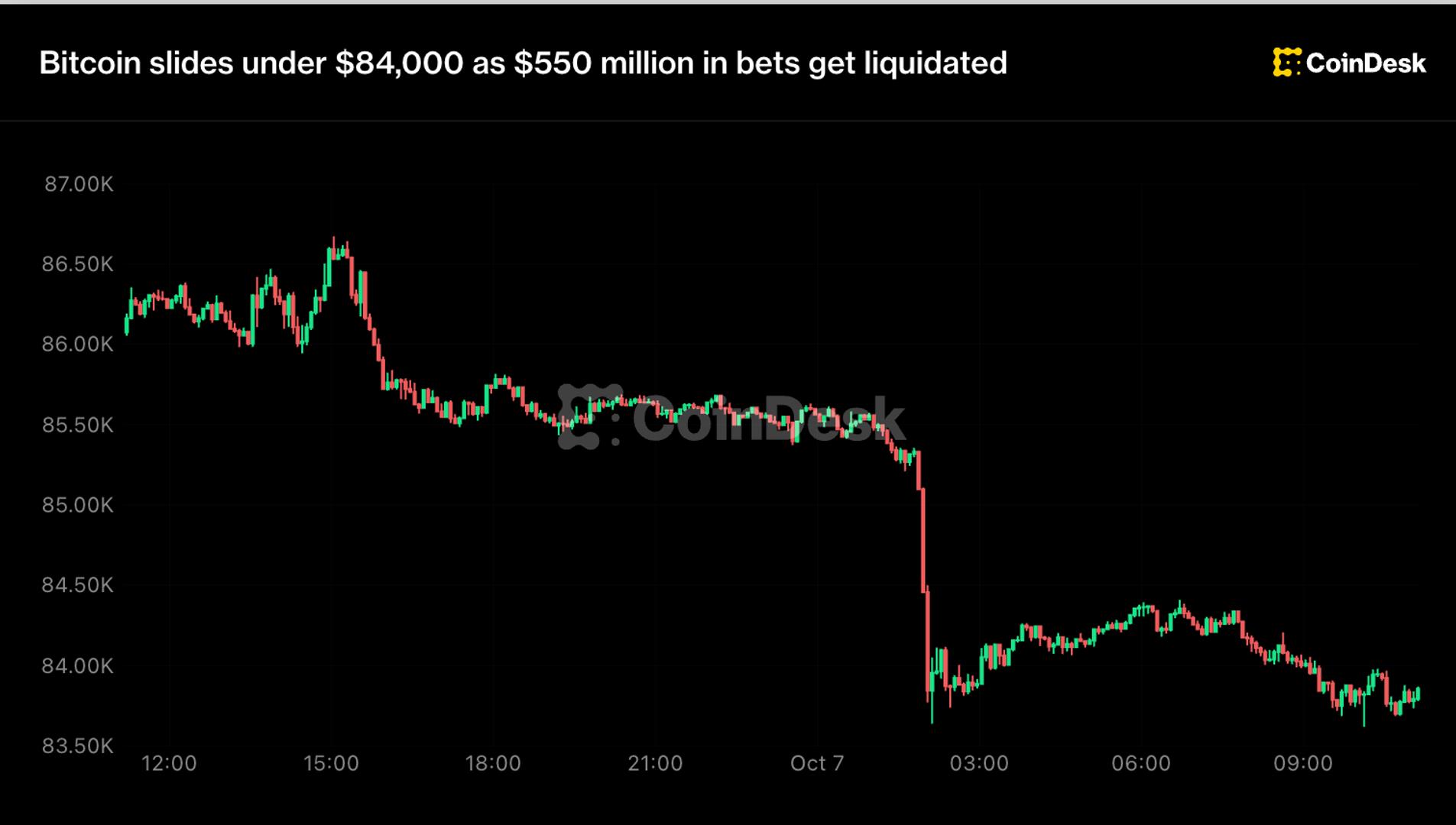
As Bitcoin price slid toward $83,800, $4000 million in leveraged crypto longs were liquidated within one hour. This is a sharp reminder of the risk-off phase, which Arthur Hayes believes could precede an AI-credit bailout and eventual liquidity boost for crypto.
The central tension is that a multitrillion-dollar data-center boom could first pressure risk assets and, if it triggers government intervention, create the excess liquidity that Hayes expects Bitcoin to absorb.
The scale of the buildout makes the financing question consequential. Estimates cited in the report put US AI infrastructure costs between $2.8 trillion by 2030 and $10.3 trillion by 2032, while credit platform Atrium estimates developers have already raised at least $1.3 trillion in debt.
Hayes’s concern is not simply that companies are spending heavily. He argues the buildout may leave computing power cheap and plentiful while saddling infrastructure providers with large commitments that depend on AI customers ultimately paying for reserved capacity.
SpaceX, OpenAI, and Anthropic are among the demand sources. Hayes said none makes money, while Columbia economist Stijn van Nieuwerburgh estimated that earning a 10% return on the spending would require $3.7 trillion in annual revenue by 2032.
That gap between infrastructure commitments and customer economics is the hinge in Hayes’s thesis. Providers are expected to test those commitments when capacity is delivered, which he places in late 2027 or 2028; until then, abundant demand for compute does not prove that every project can generate returns sufficient to support its financing.
The potential consequence for Bitcoin liquidity comes later in the chain. Hayes expects a credit crash to prompt a bailout, with the resulting excess liquidity flowing into crypto; that outcome depends on both financial stress materializing and policymakers responding in a way that expands liquidity.
Earn $50 and Enter $300K Prize Draw on EdgeXBitcoin Price and Leverage Shakeout
The report placed Bitcoin about 33% below its October 2025 all-time high of $126,000. The $403.58 million in one-hour-long liquidations as BTC approached $83,800 show how quickly leverage can amplify a decline, but they do not establish a technical floor or predict the scale of any future sell-off.

A credit shock could initially trigger the same kind of broad risk reduction: falling prices, forced position closures, and further liquidation pressure. Bitcoin would not be insulated merely because Hayes sees it as a potential beneficiary of a later bailout. Crypto’s sensitivity to leverage and changing macro expectations is also visible in sell-offs tied to liquidations.
Trade Bitcoin on Bybit and Get a Chance to Win Our $1,000 USDT AirdropHayes’s Test or Market Deadline?
If AI customers can pay for committed compute and infrastructure spending that produces sustainable revenue, the overbuild thesis would be weakened. If customers cannot meet those obligations as new capacity arrives in late 2027 or 2028, Hayes expects credit stress, a crash, and a bailout sequence.
NEW: $15 trillion BlackRock says AI agents may choose to save in #Bitcoin for "long-term value preservation"
— Bitcoin Magazine (@BitcoinMagazine) October 6, 2026
"These findings … point to a potential AI-native monetary architecture in which stablecoins serve as transactional money and bitcoin as a store of value."pic.twitter.com/utJHYuTkGJ

Even in that second case, the Bitcoin thesis has two separate conditions: the downturn must provoke intervention, and the intervention must create liquidity that supports crypto rather than merely stabilizing credit markets.
Federal Reserve expectations and inflation readings can also shift liquidity pricing and risk appetite, adding another variable to the path between policy response and Bitcoin price action.
For now, Hayes’s argument is best read as a macro framework, not a near-term trading signal. The AI credit bubble could become a Bitcoin liquidity catalyst if overbuilding produces financial stress and a liquidity-heavy rescue; until those conditions appear, the immediate implication is more modest: leverage remains vulnerable.
Discover: The Best Token Presales
The post Bitcoin Price Set for a Boost: Arthur Hayes Bets on an AI Boom Bust appeared first on Cryptonews.

Comments (0)
Please sign in to comment.
No comments yet. Be the first to comment.