Bullski Expands Beyond Meme Coin Presale With Free-to-Play Ski Game, Weekly Skill Leaderboards and $BULLSKI Rewards
September 22, 2026 | Source: Bullski
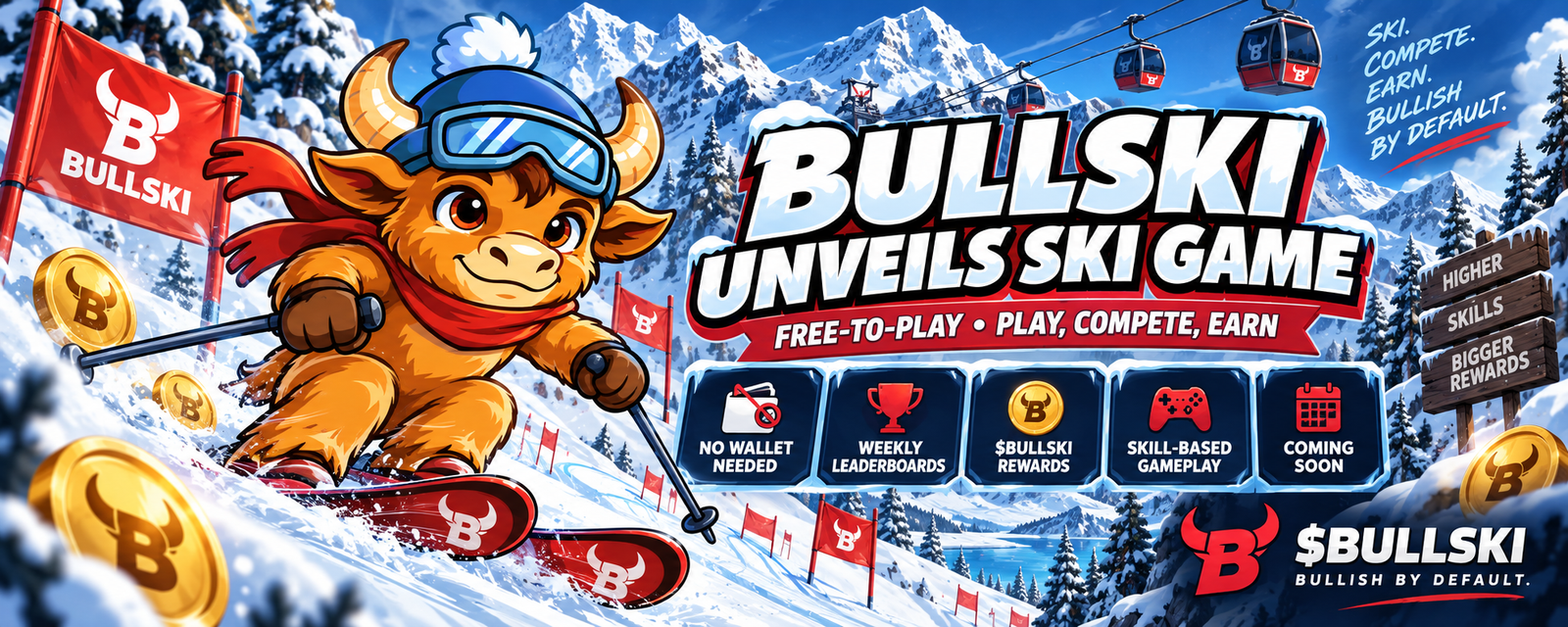
LONDON, Sept. 22, 2026 — Bullski ($BULLSKI), the Ethereum-based community meme coin, is expanding its ecosystem into gaming with the development of a free-to-play downhill ski game built around skill-based competition, weekly leaderboard seasons and $BULLSKI rewards.
The game, announced by Bullski on September 17, is designed as a fast downhill runner in which players dodge obstacles, jump, slide and compete for distance and leaderboard position.
Unlike many crypto games that require players to own tokens or connect a wallet before participating, Bullski says its ski game will be open to everyone with no $BULLSKI ownership requirement to play.
The project is also separating competitive ranking from token ownership: holding more $BULLSKI may influence the size of certain economic rewards, but it will not improve a player's position on the leaderboard.
That distinction puts gameplay — rather than wallet size — at the center of Bullski's planned gaming model.
Bullski Turns Its Mountain Story Into a Playable Product
Skiing has been part of Bullski's identity since the project launched.
The project's storyline follows its bull mascot across a mountain-themed journey through historical crypto bear markets. Its roadmap and website use skiing, mountain stages and the descent from Everest as recurring elements of the Bullski brand.
The upcoming game turns that narrative into an interactive product.
Instead of limiting the Bullski character to artwork, memes and marketing, players will be able to take the mascot downhill in a game built around reaction time, obstacle avoidance and distance.
Bullski describes the gameplay loop as a fast downhill runner involving dodging, jumping and sliding, with performance determining a player's leaderboard position.
By the Numbers
| Game Detail | Announced Structure |
|---|---|
| Game type | Downhill ski runner |
| Entry cost | Free to play |
| Wallet required to play | No |
| $BULLSKI required to play | No |
| Leaderboard ranking | Skill/performance based |
| Leaderboard cycle | Weekly |
| Token holdings affect ranking | No |
| Staking affects ranking | No |
| Presale stage affects ranking | No |
| Reward type 1 | $BULLSKI token rewards |
| Reward type 2 | Presale bonus codes |
| Bonus code transferability | Non-transferable |
| Bonus code usage | Single use |
| Bonus code expiration | Time limited |
| Game status | In development |
| Launch date | Not yet announced |
The game is expected to arrive during upcoming Bullski presale stages, but the company has not published a specific release date.
No Wallet Required to Start Playing
One of the more notable design decisions is what players do not need before starting the game.
Bullski says users will not need to purchase $BULLSKI to play and will not need token ownership simply to access the gameplay experience.
That creates a separation between the gaming product and the crypto transaction layer.
A player can discover Bullski through the game, compete and experience the core product before deciding whether to interact with the token ecosystem.
The approach is significant because onboarding has remained a recurring challenge across blockchain gaming. Crypto games have historically experimented with wallets, NFTs, tokens and other blockchain interactions as part of their user experience.
Bullski is taking a different route at the entry point: game first, token second.
Skill — Not Wallet Size — Determines the Ranking
Bullski is also drawing a firm line between financial participation and competitive advantage.
According to the project's announced rules, leaderboard position will be based entirely on game performance.
Holding more $BULLSKI will not move a player higher in the rankings. Neither will staking more tokens or entering the Bullski presale at a particular stage.
That means a player with no $BULLSKI can, in principle, outperform a large token holder on the leaderboard.
The economic layer operates separately.
Bullski says token ownership may increase some rewards available to a player, but it cannot increase that player's competitive ranking.
The model can be summarized simply:
Money may influence reward size. Skill determines leaderboard position.
That separation is one of the defining features of the announced game architecture.
A New Competition Every Week
Bullski's leaderboard will operate in weekly seasons rather than as one permanent ranking.
At the end of each cycle, the leaderboard closes, winners are determined and the rankings reset to zero.
The next season then begins with every player starting again.
The structure is intended to prevent early high-scoring players from permanently occupying the top positions.
It also creates recurring competitive events instead of concentrating attention around a single game launch.
For Bullski, every leaderboard reset effectively creates another opportunity for the community to compete for rewards.
Two Reward Layers
Bullski currently plans two different reward mechanisms for high-ranking players.
The first is a direct $BULLSKI token reward.
The second is more closely linked to the project's ongoing presale: selected winners can receive a bonus multiplier code that can be applied to a Bullski presale purchase.
The bonus system is designed with several restrictions.
Codes will be tied to the winning wallet, meaning they cannot be transferred or sold to another participant. Each code will be usable once, will have an expiration period and will operate within a predefined maximum limit.
Bullski says rarer codes will offer larger multipliers, while all codes will remain subject to hard ceilings.
This creates a second competitive layer without allowing leaderboard rewards themselves to become freely tradable assets.
Reward Codes Are Designed to Stay With the Winner
Making the codes wallet-bound changes how they can function inside the ecosystem.
A transferable reward could potentially develop its own secondary market, allowing users to win codes and immediately sell them rather than use them.
Bullski's announced system prevents that.
The bonus belongs to the wallet that earned it.
According to the project:
- codes are single-use;
- they cannot be transferred;
- they expire;
- rarer codes can carry larger multipliers;
- and each bonus has a fixed maximum ceiling.
The model ties the reward back to participation in the Bullski ecosystem instead of creating an unrestricted second token-like asset.
Bullski Says It Wants to Avoid the Old Play-to-Earn Trap
Perhaps the most important part of Bullski's gaming announcement concerns token economics.
The project explicitly contrasts its proposed structure with earlier play-to-earn models that relied heavily on continuing token emissions.
Bullski says its reward pools will scale with the size of the player base and that bonuses will operate under hard caps. The team is also working on bot and abuse detection intended to protect leaderboard competition from automated scripts.
That matters against the wider 2026 Web3 gaming backdrop.
The sector continues to experiment with sustainable game economies after earlier play-to-earn models struggled with player retention, token inflation and business sustainability. In August 2026, for example, blockchain game developer Proof of Play announced it would cease operations after saying it had been unable to build a sustainable business around its decentralized gaming thesis.
Earlier in 2026, Axie Infinity and Ronin co-founder Jeff Zirlin also warned that additional Web3 gaming teams could disappear as projects struggle to build viable products and sustainable businesses.
Bullski's proposed model is not proof that those economic challenges have been solved. The game has not yet launched, so player retention, reward sustainability and resistance to bots cannot yet be evaluated in practice.
But the design indicates that Bullski is approaching those problems before launch rather than building an uncapped token-emission loop.
From “Play-to-Earn” Toward “Play, Compete, Earn”
That distinction also explains Bullski's choice of language.
The project describes the game around “Play, Compete, Earn” rather than presenting earning as the sole reason to participate.
The gameplay itself remains open without a token purchase.
Competition is based on player performance.
Rewards sit on top of that system.
It represents a different order of operations from a model where users first acquire an asset and only then gain access to the game.
In Bullski's planned structure:
Play → Compete → Rank → Earn
rather than:
Buy → Enter → Earn
Whether that structure translates into sustained player activity will only become measurable after the game becomes publicly available.
Anti-Bot Protection Could Become Critical
A reward-based leaderboard introduces another challenge: automation.
Once a game attaches tokens or financially relevant rewards to high scores, there is a financial incentive for users to automate gameplay, manipulate scores or exploit weaknesses in scoring logic.
Bullski acknowledges that issue in its announcement and says bot and abuse detection is under development.
Technical details of that protection have not yet been released.
That leaves anti-cheat implementation as one of the important areas to watch before launch.
For a system where Bullski says “skill decides the leaderboard,” the effectiveness of score verification and anti-bot controls will ultimately determine whether that principle can be maintained once rewards become available.
Gaming Becomes Another Part of the Bullski Ecosystem
The game also connects with a broader expansion of the Bullski project.
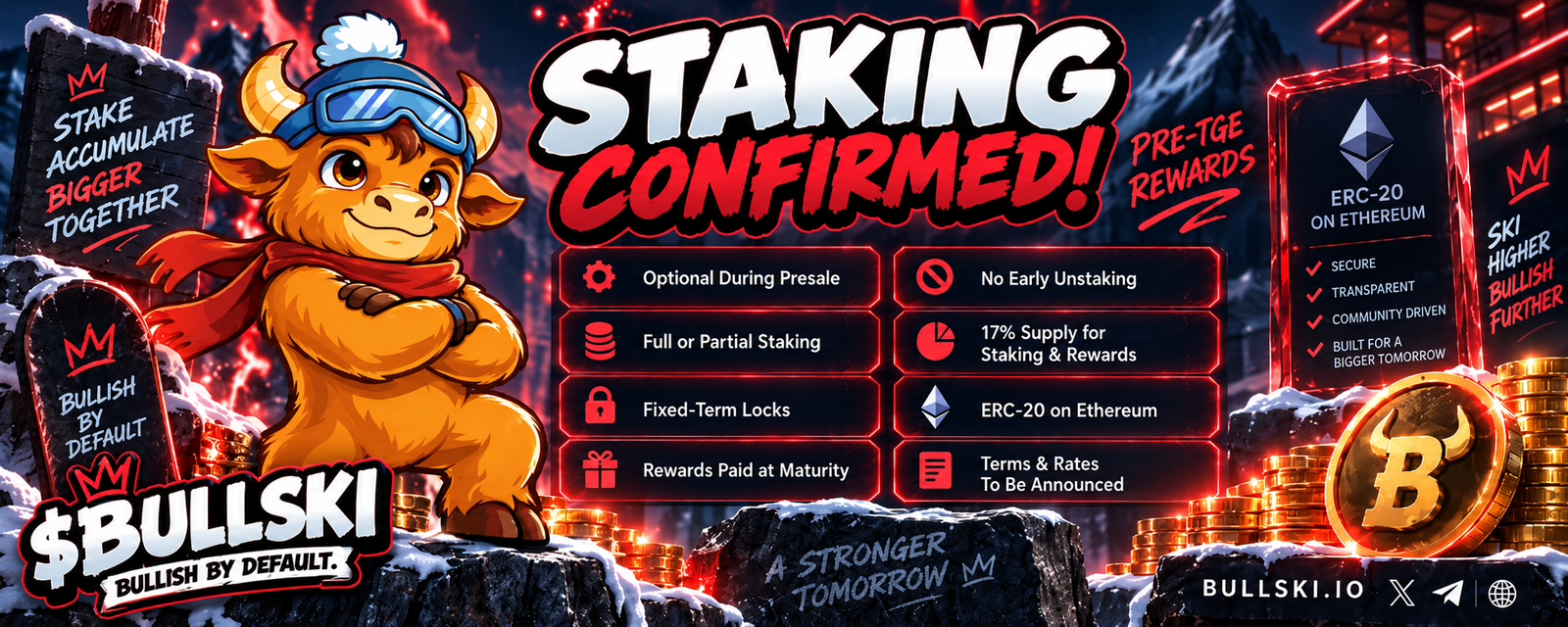
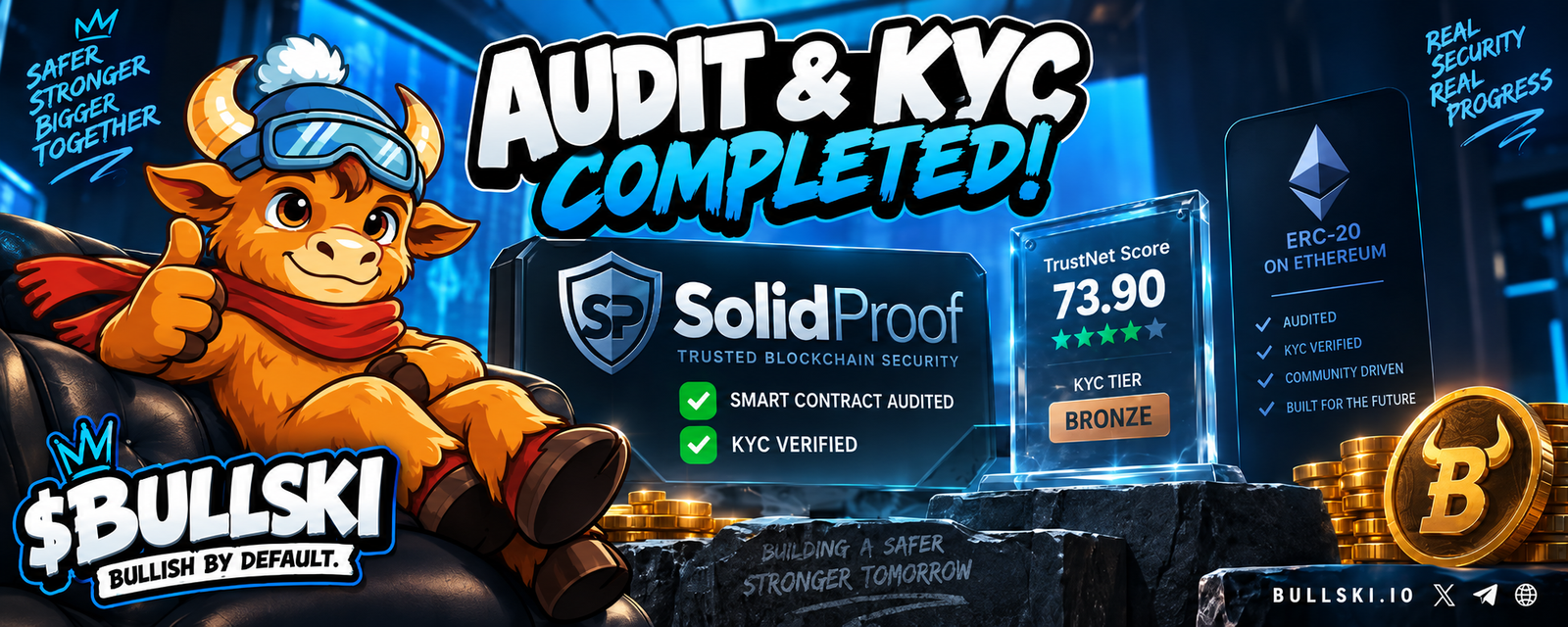
Bullski began with its Ethereum-based $BULLSKI token and 16-stage presale but has since outlined several interconnected components including staking, referrals, security infrastructure and the Ski2Earn game. The project's white paper presents these as parts of a wider ecosystem centered around the Bullski community.
Its published tokenomics set the maximum $BULLSKI supply at 120 billion tokens, allocated across presale, liquidity, staking and rewards, burns, referrals, marketing and the team.
The ski game adds a consumer-facing product to that structure.
Rather than $BULLSKI existing solely as an asset that users buy, stake or refer others to, the game is intended to create another environment in which the Bullski brand and token economy can interact with the community.
 Bullski's Mascot Moves From Meme to Game Character
There is also a branding strategy behind the development.
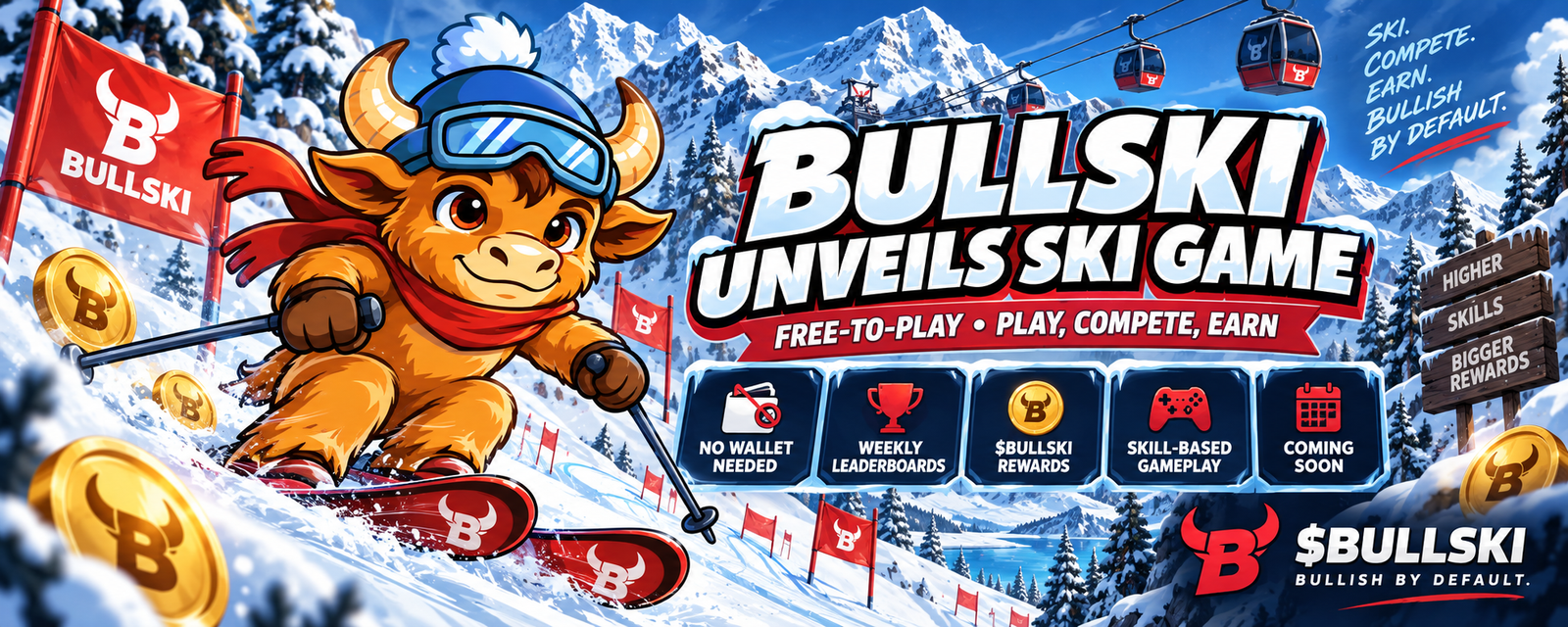
Bullski's bull mascot has served as the project's central character across its website, story and marketing.
The upcoming game turns that mascot into a playable piece of intellectual property.
That gives Bullski an opportunity to build its identity around more than token price or presale milestones.
The project's main website already frames the Bullski universe around an Everest descent in which the character confronts sixteen historical “bears,” corresponding with the project's 16-stage presale narrative.
The game effectively extends that narrative from something users read and view into something they can actively play.
What Is Confirmed — and What Is Still Unknown
Several major parts of the game have now been confirmed.
Free access, weekly leaderboards, performance-based ranking, $BULLSKI rewards and wallet-bound bonus codes are all part of the published design.
Other important details remain open.
Bullski has not yet announced a precise public release date. The project has also not published final reward amounts, the number of weekly winners, exact scoring formulas, bonus multiplier values or the technical implementation of its anti-bot system.
Those details will be important when evaluating the finished product.
For now, the project describes the game as under development and says it is planned to arrive during upcoming presale stages.
Web3 Gaming Is Entering a More Demanding Era
Bullski is entering gaming at a time when simply adding a token to a game is increasingly insufficient to guarantee adoption.
Historical DappRadar data illustrates both the scale and volatility of blockchain gaming. The sector reached 7.4 million daily unique active wallets by the end of 2024, but DappRadar later reported activity falling to 4.8 million daily unique active wallets in April 2025 as competition for Web3 user attention intensified. Those figures describe earlier periods rather than current September 2026 activity, but they illustrate how quickly engagement can change.
More recent 2026 industry developments have reinforced the importance of sustainable game design and player retention.
Against that backdrop, Bullski's biggest test will not simply be whether the game can distribute token rewards.
It will be whether players continue skiing when rewards are not the only reason to play.
A Different Utility Test for a Meme Coin
For Bullski, the ski game creates an unusual test.
Many meme coins build communities primarily through social content, trading activity and online culture.
Bullski is attempting to convert part of that identity into an actual playable experience.
The project's no-wallet entry model potentially opens that experience to users outside the existing $BULLSKI holder base, while its competitive and reward systems provide a route back into the token ecosystem for players who choose to engage with it.
That makes the game more than a reward mechanism.
If delivered as announced, it becomes another distribution channel for the Bullski character, community and ecosystem.
But because the product remains in development, the ultimate quality of the gameplay, anti-cheat system and reward economy can only be assessed after release.
What Happens Next
The next significant milestone will be a playable release and publication of the remaining game rules.
Bullski says the ski game is planned to arrive during upcoming presale stages, with launch information to be announced through its official channels.
Key details still expected include final reward tables, leaderboard payout positions, bonus multiplier ranges, anti-bot mechanics and a confirmed launch date.
Until then, the project has established the framework:
free to play, skill to rank, compete weekly and earn through performance.
About Bullski
Bullski ($BULLSKI) is a community-driven meme coin built on Ethereum as an ERC-20 token.
The project has a fixed total supply of 120 billion $BULLSKI and operates a 16-stage presale. Its expanding ecosystem includes staking, referral rewards, community initiatives and the upcoming Bullski ski game.
The game is being developed as a free-to-play downhill experience featuring weekly skill-based leaderboards and $BULLSKI-linked rewards. Token ownership is not required to play and does not determine competitive ranking.
BULLISH BY DEFAULT.
For More Information
Official Bullski Website
Bullski Ski Game Announcement
Telegram: t.me/BullskiCoinOfficial
X: @bullskicoin

Comments (0)
Please sign in to comment.
No comments yet. Be the first to comment.