
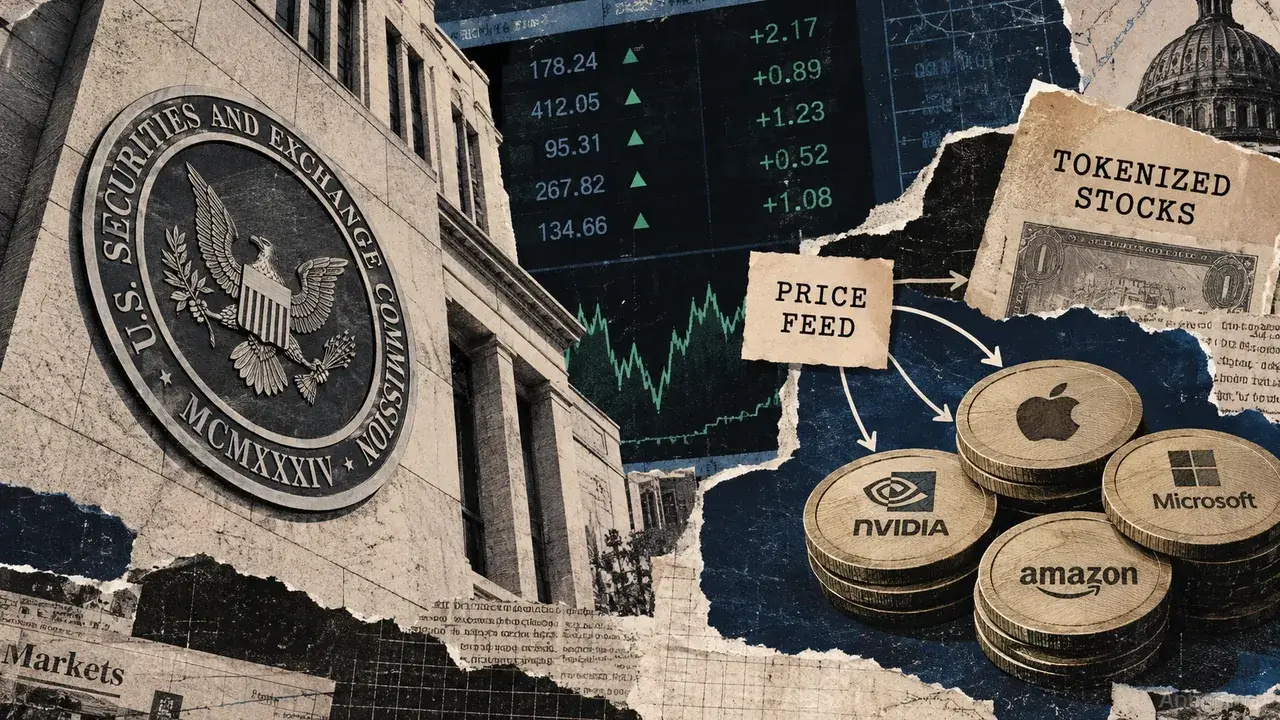
Tokenized stocks eligible for the SEC’s September exemption must carry equivalent shareholder rights, yet their trading venues can operate outside key Regulation NMS protections. Investors therefore need to examine both what the share represents and how their order is priced and handled.
Market-data provider Douro Labs asked SEC staff in an October 9 submission for provider-neutral principles to assess external price feeds and use them for dollar reporting. Douro contributes to Pyth Network and develops and operates Pyth Pro, giving it a commercial interest in the standards under discussion.
The order requires venue disclosures and safeguards. FINRA-member brokers retain applicable best-execution duties when they handle covered customer transactions.
The September 17 order grants temporary, conditional relief from the definition of an exchange to venues offering permissioned automated market maker pools for eligible tokenized National Market System (NMS) stock. These pools use software to let approved participants trade against committed assets. The order also provides separate dealer-definition relief for certain liquidity providers using their own capital.
Its scope is narrower than the tokenized-stock label. Third-party securities providing synthetic exposure, including tokenized linked securities and security-based swaps, are excluded, as are rights and warrants. Eligibility depends on the defined security and the venue’s compliance with the order.
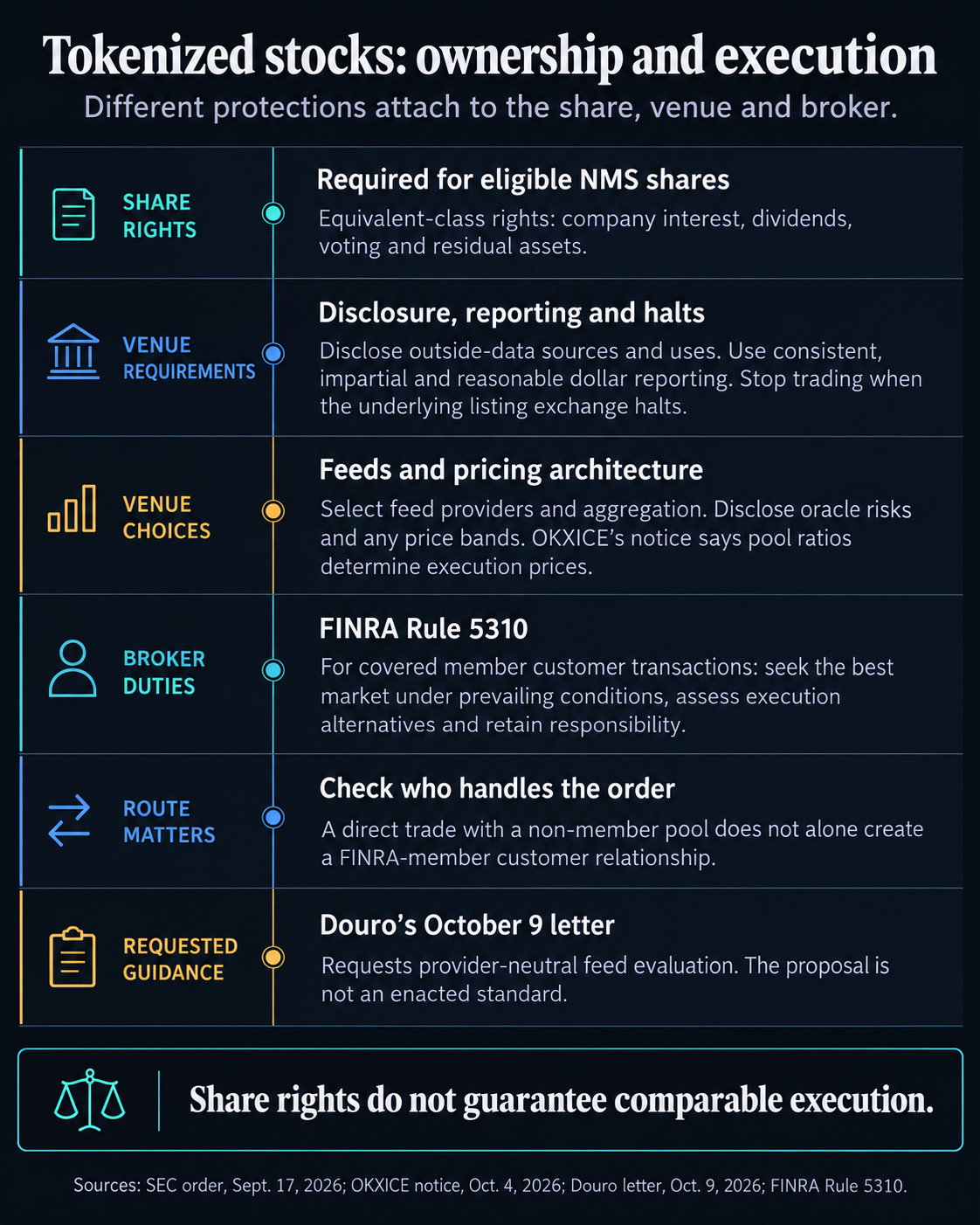
For eligible shares, the venue must verify the same rights and privileges as traditional stock of an equivalent class. Those include an interest in the company, dividends, voting rights and a share of residual assets on liquidation. A claim to those rights concerns what the investor owns; execution concerns the terms on which the investor buys or sells it.
A venue meeting the exemption’s conditions is outside the exchange, alternative trading system and trading-center framework for the relevant Regulation NMS rules. That includes Rule 611’s protection against venue trades at prices worse than certain protected quotations elsewhere. Those protections and a broker’s best-execution duty are separate, however, and the order preserves applicable anti-fraud and anti-manipulation laws and participants’ separate regulatory obligations.
Tokenized stocks: what external price data controls
The order’s market-data provision requires a venue to explain whether and how it uses external data or oracles, the services that bring outside information to blockchain applications. Its public notice must identify providers and sources, explain the purposes of the data and describe oracle use. Other items cover known material risks, including oracle manipulation, and any reference-price bands or other risk controls.
The order also requires concurrent stoppages when the underlying stock halts on its primary listing exchange, participant notifications, operational-event remediation, accessible records, trading limits and restrictions on venue credit.
The order does not prescribe a single provider, minimum contributor count, common aggregation method, confidence threshold or uniform response to stale prices.
Douro wants staff to supply a framework for assessing those choices. Its proposed criteria emphasize independent contributors involved in price formation, aggregation designed to resist manipulation, public contributor identities and calculation methods, and comparison with external market benchmarks. The letter also proposes disclosures about confidence, staleness and responses when data becomes uncertain or unavailable.
There already are binding conditions around reporting. Venues must publish free, machine-readable dollar-denominated data covering transactions in the preceding 30 days, updated within ten minutes of each transaction. Conversion must use consistent, impartial and reasonable methods commonly applied by market participants. Trading-interest and transaction records also must state dollar prices.
An existing SEC staff FAQ uses similar dollar-conversion language for pairs trading on exchanges and alternative trading systems. Douro’s request addresses a different issue: how venues should evaluate feed quality.
How venue notices describe different feed roles
OKXICE’s October 4 notice illustrates why identifying an external provider is only the start. It describes AMM execution prices determined by pool asset ratios, while external price data serves other functions: displaying stock values, detecting underlying-market trading halts and reporting stablecoin-paired transactions in dollars.
The notice identifies Massive.com for stock prices and trading-halt data and affiliated OKX INC for stablecoin price indices. It also says OKXICE applies no additional circuit breakers or reference-price bands beyond the stoppages it describes.
The notice lists Circle’s dollar-pegged USDC among its payment assets. A stablecoin-price input converts the trade into dollars for reporting; pool ratios determine the execution price.
The notice separately describes outside volume data submitted to the venue’s smart contracts for trading-limit checks. Price information and volume inputs therefore control different parts of the trade.
TSV LLC’s September 23 notice provides a different kind of disclosure. It says operations had not commenced as of that notice, outlines intended external-data uses including halt detection and price-divergence monitoring, and says a production market-data provider had not yet been selected. The disclosed functions are prospective as of that notice.
Best execution for tokenized stocks remains a broker duty
For a FINRA member handling a covered customer transaction, Rule 5310 requires reasonable diligence to find the best market and obtain a price as favorable as possible under prevailing conditions. It applies when the firm acts as an agent and when it trades as principal.
The assessment considers the market’s character, transaction size and type, the markets checked, quotation accessibility and the customer’s order terms. The rule’s execution review also considers speed, the likelihood of executing limit orders, costs and customer needs. It is broader than checking whether a pool price matches one external reference.
A member cannot transfer that duty to another person. Automated, non-discretionary order routers and internalizers using regular and rigorous review instead of individual order reviews must conduct the relevant reviews at least quarterly, by security and order type, and compare current arrangements with competing markets. Material execution-quality differences require changes to routing or a justification for retaining it.
Sparse pricing information calls for particular diligence, written procedures and documented compliance under Rule 5310.
Who handles the customer’s order matters
The customer’s instructions and the firm’s role matter. An unsolicited instruction to route an order to a particular market limits the best-execution determination beyond that instruction, while prompt processing and compliance with the order terms remain required. The duty also covers applicable customer orders routed from another broker for handling and execution. Merely filling another broker’s customer order against the member’s quote falls outside that routed-order duty.
Investors interacting directly with a non-member pool should establish whether a FINRA member is handling a covered customer transaction before relying on those broker protections. The venue’s exemption conditions and applicable anti-fraud protections continue to matter in either route.
FINRA’s Regulatory Notice 26-15 sought comments on modernizing guidance under the existing principles-based standard. Its distinction between best execution and trade-through protection helps explain why venue relief and a member’s customer duties operate separately.
What tokenized-stock investors can compare
Investors can read a venue notice for more than a provider’s name. Does outside data set the execution price, support a displayed valuation, convert a transaction for reporting or trigger a halt? Does a disclosed price band actually constrain trading, and what happens if its reference becomes stale or unavailable? Where a broker handles the order, how does it compare the execution with alternatives?
Douro’s October 9 request gives SEC staff a concrete framework to consider. For investors comparing tokenized stocks, the practical test is whether the venue’s data, pricing controls and any broker’s execution review support the trade they expect.
The post Tokenized stocks can carry the same rights without the same trading protections appeared first on CryptoSlate.



Comments (0)
Please sign in to comment.
No comments yet. Be the first to comment.