

Money-market mutual funds absorbed approximately 85% of the US government's latest Treasury-bill surge, giving traditional cash managers the clearest claim to the marginal demand behind the summer issuance wave.
The Treasury Department said net bill supply grew by more than $550 billion in July and August, an increase of about 8% in two months. Money funds took down most of that additional supply, according to remarks delivered Sept. 22 by Deputy Treasury Secretary Francis Brooke.
Stablecoin providers remain important holders of short-dated government debt. Treasury puts their holdings at nearly $200 billion. Yet that number measures a stock of Treasury bills and other close-to-maturity securities, while the money-fund figure measures purchases associated with a specific two-month supply increase. The categories can also overlap because stablecoin reserves may be invested through government money-market funds and repurchase agreements.
The result is a more precise picture of crypto's role in government finance. Stablecoins are already material Treasury-linked investors and could become a larger source of demand as regulation takes shape. The documented incremental buying in 2026, however, has come primarily from money funds and the Federal Reserve, with foreign investors returning in July.
What Treasury's buyer breakdown shows
Four figures frame the market, but they use different clocks and measure different things. They are context for one another, not amounts that can be added into a single buyer total.
| Buyer or holder | Reported amount | Measurement window | What the figure establishes |
|---|---|---|---|
| Money-market mutual funds | About 85% of more than $550 billion | July-August 2026 | Share of additional bill supply absorbed |
| Stablecoin providers | Nearly $200 billion | Holdings stock; date not specified | Bills and other near-maturity Treasuries owned |
| Federal Reserve | More than $300 billion | 2026 through Sept. 22 | Bill purchases through two portfolio channels |
| Foreign residents | $38.8 billion increase | July 2026 | One-month change in foreign bill holdings |
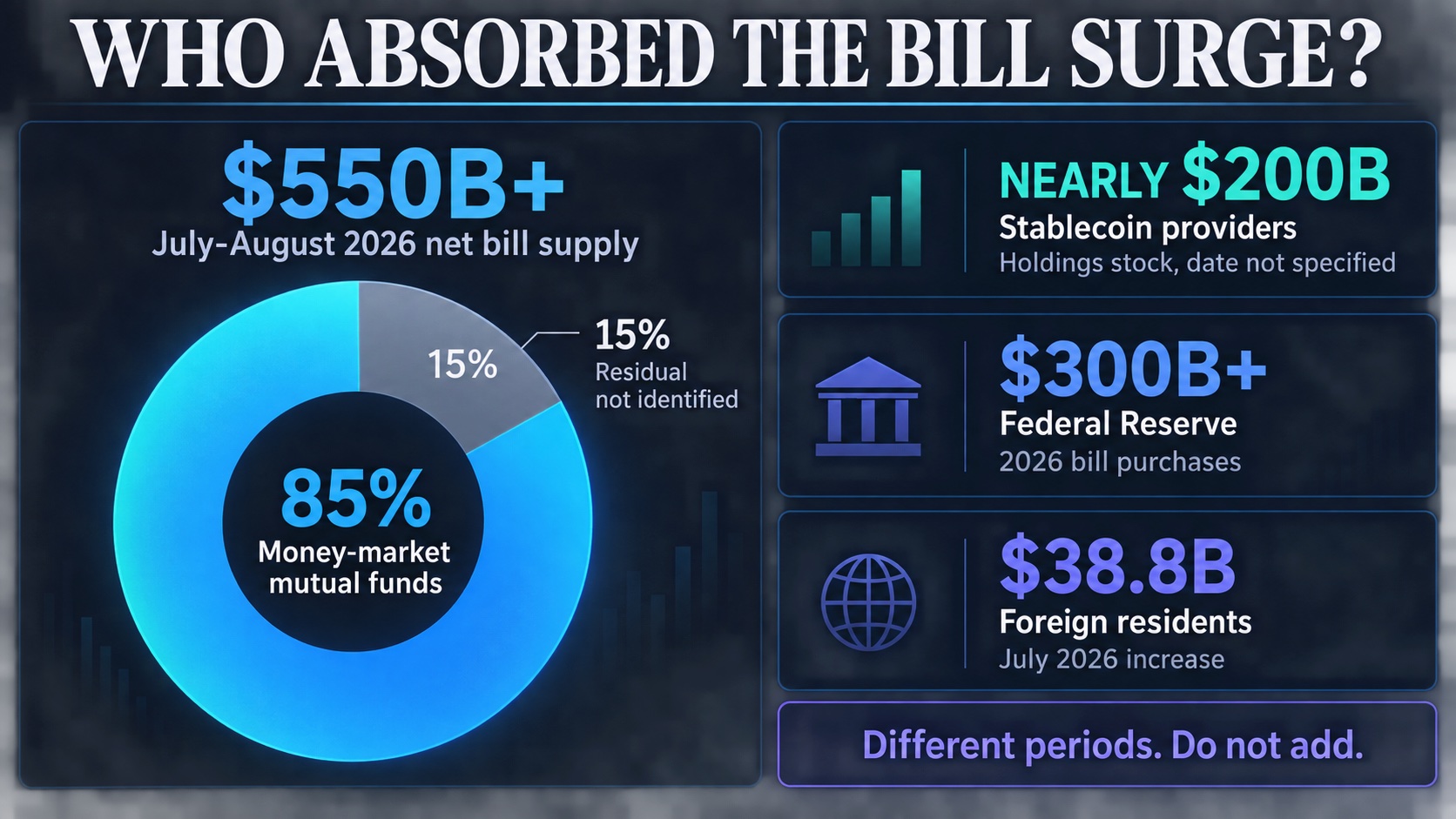
Treasury's 85% estimate directly addresses the latest increase in supply. It applies to the additional bills issued during July and August rather than the entire bill market. The remaining share was not allocated among other buyers in the speech.
The stablecoin total serves a different purpose. It shows that issuers have become a meaningful source of demand for short-dated government assets. Treasury described the nearly $200 billion as bills and other close-to-maturity Treasury securities, without splitting the total by security type or specifying how much was acquired during the summer.
Issuer disclosures show why stablecoins and money funds are not always cleanly separated. Circle said in its second-quarter filing that approximately 84% of USDC reserves were held in the Circle Reserve Fund at June 30. The company describes the vehicle as a Rule 2a-7 government money-market fund.
USDC reserve demand can therefore appear inside the money-fund category. Circle is one issuer, so its allocation does not describe the whole stablecoin market, but it demonstrates the accounting overlap behind the broad buyer labels.
The fund's assets also show that Treasury exposure is broader than direct bill ownership. Its annual shareholder report listed $19.111 billion of direct Treasury obligations and $46.998 billion of repurchase agreements at April 30. The repos were collateralized by Treasuries, but remained a separate asset category. The portfolio date precedes Circle's June reserve disclosure and the mix can change, so the filings establish the structure rather than an exact June allocation.
Treasury presented stablecoin demand as a source of potential growth. Brooke said providers may continue expanding and add to their Treasury holdings as rules implementing the GENIUS Act are finalized. That conditional language makes the regulatory channel an option for future demand, rather than a quantified forecast or an explanation for the July-August absorption.
The Fed and foreign buyers add demand on different timelines
The Federal Reserve has also become a major bill buyer in 2026. Treasury said the Fed purchased more than $300 billion through reserve-management purchases and reinvestment of principal payments from agency securities.
The Fed's July monetary policy report had recorded nearly $250 billion of bill purchases through July 1. About $160 billion came from reserve-management purchases and roughly $90 billion from the reinvestment of agency mortgage-backed security principal. The later Treasury figure reflects a more recent cutoff.
These purchases occur in the secondary market, rather than directly at Treasury auctions. The operations are designed to maintain ample reserves and manage the composition of the System Open Market Account, which separates them from both direct government financing and conventional quantitative easing.
The Fed's published balance sheet corroborates the scale of the expansion. Bill holdings were $233.592 billion on Dec. 31, 2025 in the Jan. 2 H.4.1 release and $550.482 billion on Sept. 16 in the Sept. 17 release. The change is a net stock movement rather than a gross-purchase figure, and it does not allocate the July-August issuance. It does show how quickly bills became a larger part of the Fed's portfolio.
Foreign demand turned positive before Treasury published its buyer breakdown. Foreign residents increased their bill holdings by $38.8 billion in July, according to the Treasury International Capital release. That followed declines of $20.0 billion in April, $43.5 billion in May and $29.0 billion in June.
Private foreign holdings rose by $45.0 billion in July, while foreign official holdings fell by $6.3 billion. The rebound shows overseas buyers returning after three monthly declines, but it covers July alone and tracks foreign holdings rather than every buyer class. Treasury also cautions that custody-based TIC data can obscure the beneficial owner when securities are held through third countries or managed by foreign portfolio managers.
Together, the data show broad demand for short-term government debt without making each buyer measure interchangeable. Money funds dominate Treasury's account of the July-August supply increase. The Fed supplied substantial year-to-date secondary-market demand, and foreign holdings rebounded in July. Stablecoin issuers sit inside that market as large holders whose reserve structures can channel demand through money funds and repo.
The regulatory outlook could make stablecoins a bigger force in future Treasury financing. The latest issuance surge arrived before that possibility could be measured as a distinct flow, leaving traditional money funds as the buyer class Treasury identified most clearly.
The post Stablecoins hold nearly $200 billion in US debt, but money funds bought the surge appeared first on CryptoSlate.




Comments (0)
Please sign in to comment.
No comments yet. Be the first to comment.