
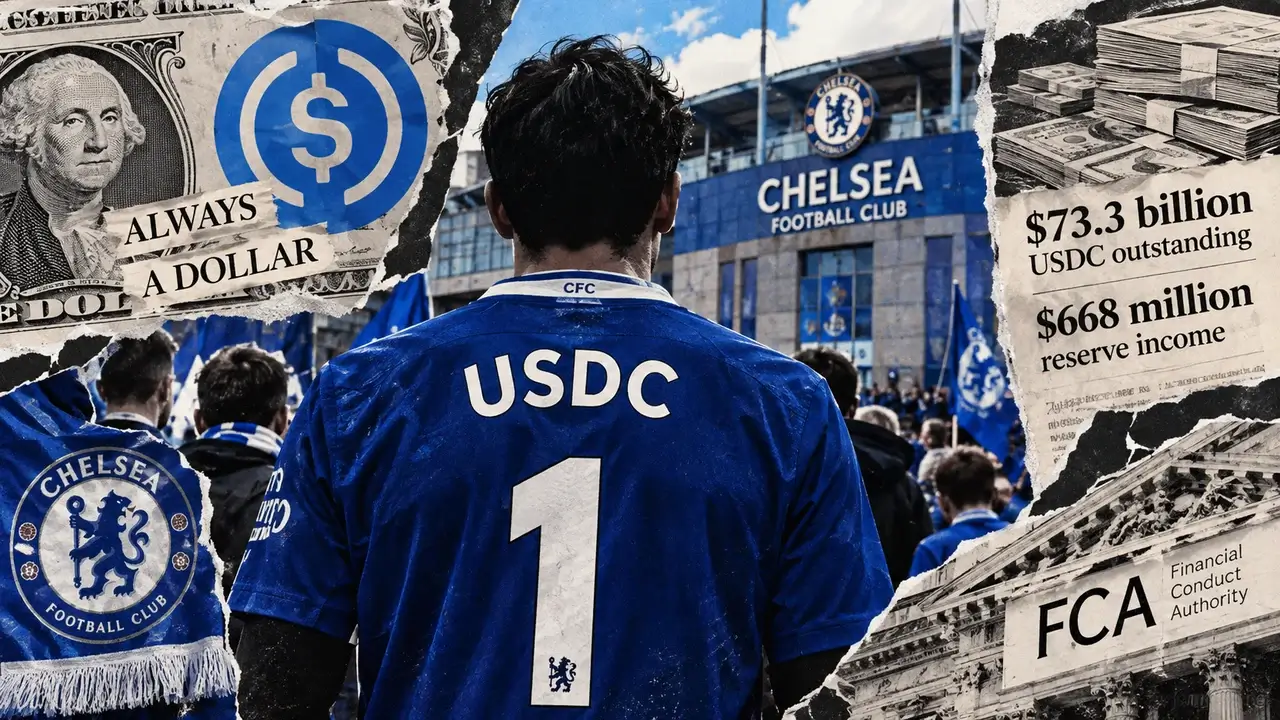
Chelsea has found a cool new shirt sponsor whose main product is…a stablecoin?
USDC is designed to be worth one dollar. Today, tomorrow, next Tuesday: one dollar. If everything is working properly, absolutely nothing should happen to its price, so there is not much room for a victory parade.
And yet Circle, the company behind USDC, has decided that this extremely uneventful financial product belongs on the front of one of the most famous shirts in football. Circle announced the deal on Aug. 28. Circle and USDC branding will appear as Chelsea's principal front-of-shirt sponsor across the men's, women's, and academy teams for the 2026/27 season.
The agreement puts a digital dollar in front of an audience that spends its weekends caring very deeply about things considerably more exciting than reserve assets.
Which raises a pretty good question: why does a stablecoin need football fans?
The answer gets to the heart of Circle's business.
The world's most boring crypto product still needs a brand
All stablecoins have a marketing problem. It's not Bitcoin, whose promise of absolute scarcity propelled it to the absolute top of crypto and tradfi markets. It's also not an exchange, which can sell you on the dynamic and exciting world of trading. USDC promises to remain worth about what it is now.
But that's the point. USDC is designed to track the US dollar. Circle backs it with cash and cash-equivalent assets, with most of the reserve held in a government money market fund that can hold short-term US Treasury securities and Treasury-backed lending.
The key point is that those reserves can earn interest, but USDC holders don't get that interest.
Circle's USDC terms explicitly state that the token pays no interest and gives holders no claim on returns earned from the reserves.
That gap is a very important part of Circle's business. At the end of June, $73.3 billion of USDC was outstanding. Circle reported $668 million in reserve income for the second quarter, compared with $701 million in total revenue and reserve income.
In other words, using those rounded numbers, reserve income accounted for roughly 95% of the total reported in Circle's second-quarter results.
Now the football shirt makes more sense.
Circle benefits when more USDC exists and remains in circulation. The exact economics also depend on interest rates and what the reserves earn, but broadly speaking, a bigger USDC reserve base means a bigger pool of interest-earning assets.
So Circle has a reason to want USDC to become the digital dollar people recognize. And football is extremely good at producing recognition.
You don't need to understand USDC to recognize USDC
Imagine someone who knows nothing about stablecoins. They watch Chelsea every weekend and see USDC on the shirt. They see it during matches, in highlights, in photos. They see players wearing it on social media, the same four letters over and over again for an entire season.
Then, six months later, some financial app asks them whether they want USDC or another dollar stablecoin, and only one of those names looks familiar.
That's advertising. The fan doesn't have to rush out after Chelsea-Arsenal and open a crypto wallet. Circle doesn't need everyone watching the match to become a customer that afternoon, just the name to stop looking strange.
This is especially useful for something like a stablecoin because the product itself isn't particularly easy to advertise emotionally. Nobody is standing in the Shed End singing about short-duration Treasury securities.
Football is a very emotional sport with a lot of emotionally invested fans. Circle gets to attach itself to something people already care about rather than trying to convince them to care about digital dollars.
Chelsea is becoming a pretty good crypto marketing experiment
But Circle isn't Chelsea's only crypto partner: the club also renewed its partnership with BingX for the 2026/27 season.
BingX is a crypto exchange and Chelsea's training-kit partner. So Chelsea can now introduce supporters to two very different crypto businesses simply through clothing.
One helps people trade financial assets, and the other issues a token designed to sit at one dollar.
BingX gets training-kit branding and campaigns built around performance, preparation, and “Trained on Greatness,” and Circle gets the match shirt.
Different businesses, same badge that does something neither financial company can easily do by itself: it makes the brand feel familiar.
This is hardly unique to crypto. Football shirts have been doing this for airlines, banks, betting companies, electronics brands, and various businesses you vaguely remember from the Champions League for decades.
Now we have to see what happens when increasingly complicated financial products occupy that space.
There's another reason the timing is interesting. Premier League clubs agreed to remove gambling companies from the front of matchday shirts beginning with the 2026/27 season under a voluntary agreement.
That doesn't mean betting advertising disappears from football, and it doesn't mean the rule caused Chelsea to sign Circle. But it does mean the most valuable piece of advertising real estate on a Premier League shirt is changing at exactly the moment financial and crypto companies are competing for global attention.
Circle now gets one of those spots for USDC, and unlike a betting company, it's not trying to convince the average Chelsea supporter to make a wager before kickoff. Its main and only goal for now is to get people to remember the name.
Of course, knowing the name isn't the same as knowing the product
This is where football sponsorship gets slightly weird.
Football shirts are great at telling you a company exists, but terrible at explaining what it actually does.
The UK's Financial Conduct Authority (FCA) has already been looking at financial-company sponsorships in football. In a July freedom-of-information response, the FCA said it had written to 21 clubs, including all 20 then in the Premier League. It identified 18 arrangements involving 13 clubs and financial providers without FCA authorization.
However, there are important caveats. The numbers included financial companies beyond crypto, included former sponsorships, and predated the Circle-Chelsea announcement.
The FCA also said that lack of authorization did not automatically mean anything illegal had happened and that, for most of the arrangements it reviewed, it found no evidence of illegality or breaches of UK regulatory requirements.
So this isn't evidence of a problem with Circle's deal, but it does illustrate the broader problem with financial advertising in football.
The badge tells you almost nothing about the protections attached to the product. Someone who discovers USDC through Chelsea still needs to know where they are buying it, who holds it for them, how they can redeem or sell it, what fees apply, and what protections exist where they live.
Circle itself makes a similar distinction in the sponsorship announcement, which says the release is not an invitation to buy, hold, or trade crypto or use a financial service.
It is an invitation to remember four letters, and that may be plenty.
Circle doesn't need you to chant about USDC
Circle's job here isn't to make Chelsea supporters passionate about USDC. The goal is to make USDC boring because everybody has seen it.
The ideal outcome for Circle may be that someone encounters USDC in an app two years from now and reacts the same way they react to Visa, Mastercard, or PayPal: “Oh yeah, I know that.”
They might not know how the reserves work. They might not know who can redeem directly with Circle. They definitely won't be thinking about the yield on short-term Treasuries: they'll just recognize the name.
That's what Chelsea can sell Circle that a blockchain can't: cultural familiarity.
USDC already knows how to stay near a dollar. Now Circle has to make people remember which digital dollar is theirs.
The post Circle wants you to love USDC a little like you love Chelsea appeared first on CryptoSlate.


Comments (0)
Please sign in to comment.
No comments yet. Be the first to comment.