

U.S. indictment alleges two Uranium Finance crypto exploits moved through Tornado Cash before being used to buy Pokemon cards and other collectibles. The charges against Jonathan Spalletta remain allegations, not a court finding of guilt.
The U.S. Department of Justice indictment announcement, issued on March 30, 2026, describes the alleged hacks, laundering route, and purchases.
Uranium was a decentralized cryptocurrency exchange that let users deposit and exchange assets through liquidity pools. Prosecutors allege that Spalletta exploited its smart contracts twice in April 2021, turning weaknesses in withdrawal and rewards logic into substantial losses for the exchange and its users.
A Maryland cybersecurity consultant who allegedly stole nearly $55 million in hacked cryptocurrency and spent some of it on rare Pokemon and Magic: The Gathering cards went on trial in New York https://t.co/hf26ohZRJP
— Bloomberg (@business) September 29, 2026
The first alleged attack took place on April 8. The indictment says a deceptive sequence of smart-contract transactions let Spalletta withdraw more rewards tokens than he was entitled to receive, extracting cryptocurrency worth approximately $1.4 million. It further alleges that he repeated the transactions until he had drained nearly all the rewards tokens in the pool.
On April 28, prosecutors allege, he exploited a separate error affecting withdrawals across 26 Uranium liquidity pools, resulting in the theft of approximately $53.3 million in crypto. The exchange shut down after the second hack because it lacked funds. Those figures are the DOJ’s account of two distinct attacks; the release does not establish a separate, definitive combined total beyond describing the charges as involving more than $50 million.
The case has moved well beyond the original exploit. The DOJ said Spalletta surrendered after the indictment was unsealed on March 30, 2026, and was due to appear before U.S. Magistrate Judge Ona T. Wang. Separately, law enforcement seized cryptocurrency worth approximately $31 million on February 24, 2025, under a judicially authorized seizure warrant.
That long gap between the alleged 2021 attacks and the later seizure is familiar in crypto enforcement: transactions can remain visible even when the identity behind an address is not immediately established.
Earn $50 and Enter $300K Prize Draw on EdgeXFrom an Alleged Crypto Exploit to Pokemon Cards
The indictment describes a route from contract exploitation to spending, not merely a large balance in a wallet. Prosecutors allege that after obtaining the cryptocurrency, Spalletta moved it through a complex series of transactions across wallets and blockchains, including through Tornado Cash. The release does not provide a complete transaction-by-transaction tracing account.
The alleged purchases make the case unusually tangible. The DOJ says the proceeds funded a Black Lotus Magic: The Gathering card for approximately $500,000 and 18 sealed Alpha booster packs for approximately $1.51 million. It also lists a sealed first-edition Pokémon booster box priced at approximately $257,500 and a complete first-edition Pokémon base set for approximately $750,000.
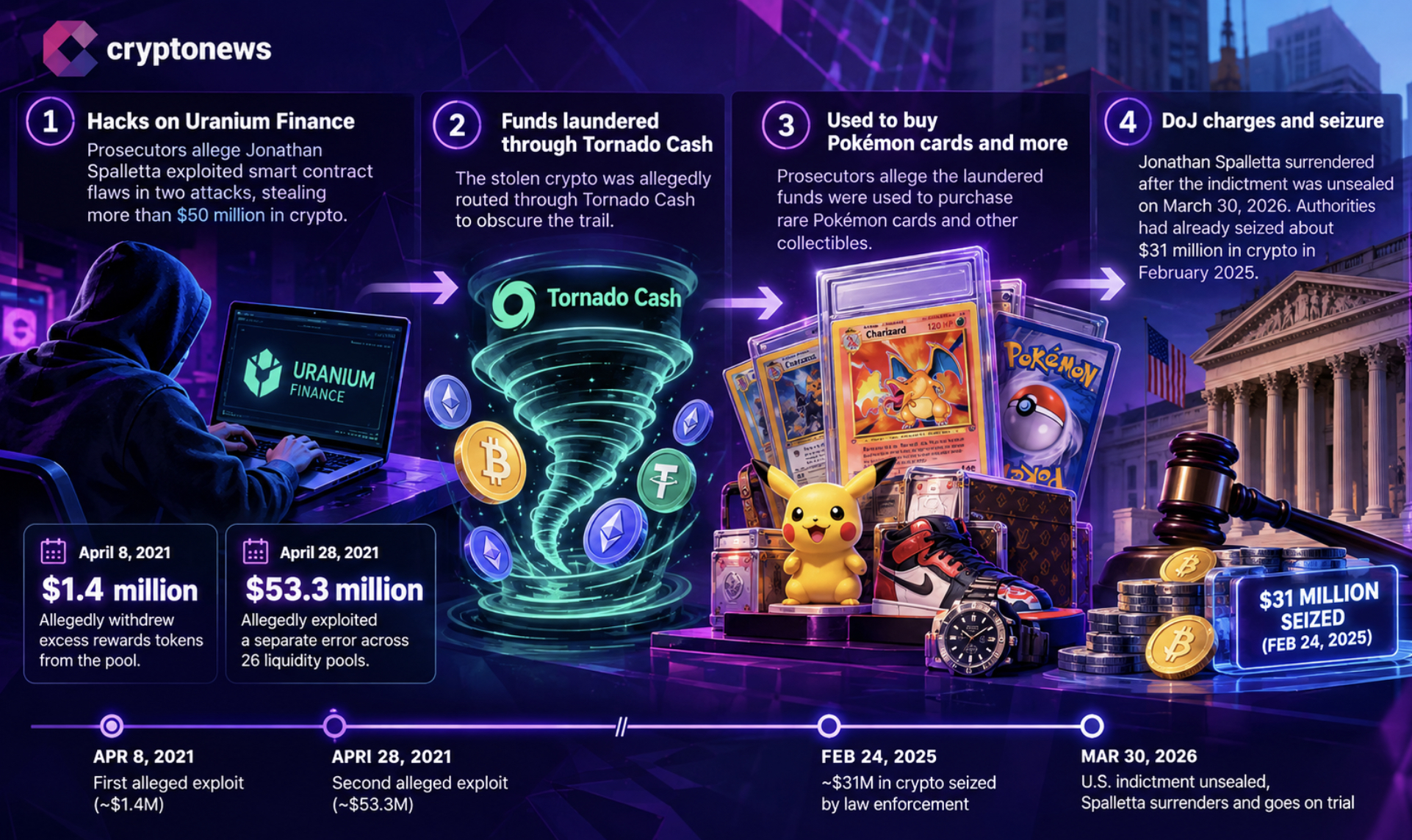
The alleged crypto spending extended beyond Pokemon cards. The indictment identifies a piece of fabric from the Wright brothers’ original airplane, later taken to the moon by astronaut Neil Armstrong, purchased for approximately $137,500, and an Eid Mar Denarius commemorating Julius Caesar’s assassination, purchased for approximately $601,545.
The release says photographs of the Black Lotus card, the fabric, and certain coins were associated with items seized from Spalletta’s residence under a judicially authorized search warrant.
Those details describe the government’s allegations, not a proven account of who paid for every item or which wallet funded each purchase. The DOJ release does not state that approximately $26 million passed through Tornado Cash, a figure appearing in supplementary reporting. That number should not be treated as established by the indictment announcement itself.
The route matters to investigators because conversion into collectibles can create records and counterparties outside the blockchain. On-chain transfers may identify a pattern of movement, while purchase records, seized property, and other evidence can potentially help connect that pattern to a person. The evidentiary force lies in the combined chain, not in any single transfer or high-value object.
That makes the case relevant beyond Uranium Finance. Crypto assets can move quickly between addresses, while the consequences of a DeFi hack persist through exchange failures, enforcement actions and recovery efforts years later. Tracing stolen assets after other exchange breaches presents the same problem: following movement is not identical to proving ownership or intent.
Discover: The Best Token Presales
The post Pokemon Crypto Case: Collector Faces Trial Over $55 Million Hack appeared first on Cryptonews.



Comments (0)
Please sign in to comment.
No comments yet. Be the first to comment.