
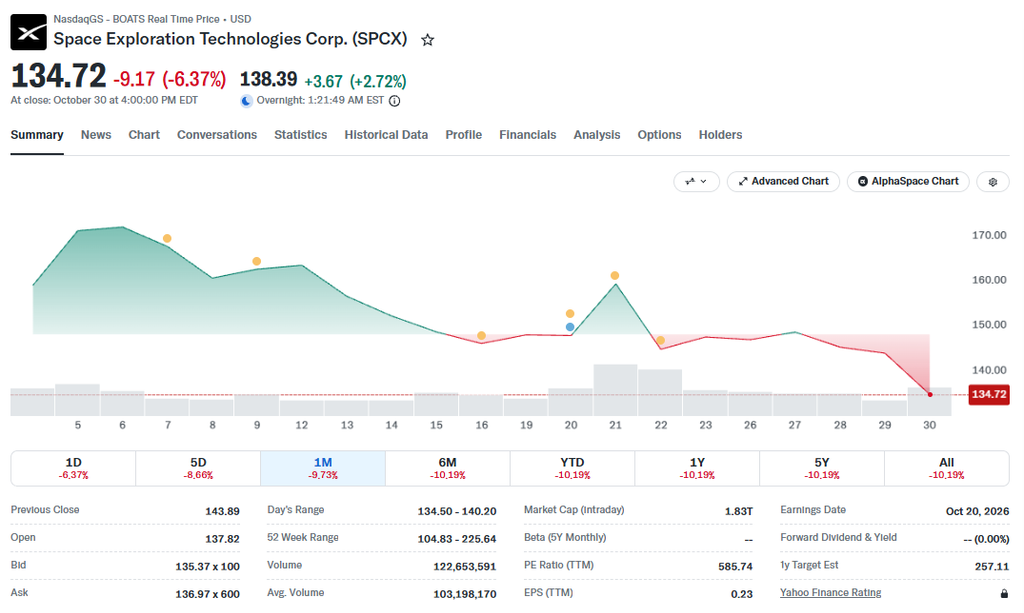
Musk’s fortune decline reached more than $48.5 billion on Friday, after Elon Musk’s net worth slid to $865 billion, according to Bloomberg data. The hit came from a SpaceX stock drop to $134.72, about 40% below the post-IPO high, as AI bubble fears spread across a broad US selloff. Anyone checking SpaceX stock today will find it at its lowest level since August, just weeks after Musk got back his trillionaire status.
Also Read: Should I Sell MU Stock as NAND Prices Slow Despite Record Revenue?
SpaceX Stock Decline Raises AI Bubble Fears as Musk’s Wealth Falls

SpaceX listed on Nasdaq under the ticker SPCX on June 12, 2026, at $135 a share, and it hit a record of $225.64 four days later. Last month the shares climbed back to $176.56, and then the slide started again. That fast round trip explains why Musk’s fortune decline feels so sharp.
Source: Yahoo Finance
Right now, a quick look at SpaceX stock today shows shares just under the IPO price. The stock lost $9.17, or 6.37%, on Friday alone, and it is down 9.73% over the past month. Musk’s fortune decline mirrors that chart, since most of his wealth sits in SpaceX.
The $40 Billion Lease That Spooked The Market
On Oct. 26, SpaceX disclosed an approximately $40 billion lease with an entity that Apollo Global Management runs. That entity will buy Nvidia’s next-generation Vera Rubin chips and lease them back to SpaceX over roughly five years, starting in 2027. Musk’s fortune decline picked up speed in the days after the deal.
Chief Financial Officer Bret Johnsen stated:
“This lease diversifies our funding sources and addresses a notable portion of the funding required to deliver on our growth plans.”
He also guided fourth-quarter capital spending to $35 billion to $40 billion, up from $19.6 billion in the third quarter.
AI Revenue Beats Starlink, But The Bill Keeps Growing
The Oct. 20 results looked strong on paper. Total revenue rose 161% to $14.58 billion, and AI revenue reached $7.56 billion, ahead of Starlink’s $5.24 billion. The AI unit also spent $16.4 billion, more than the space and connectivity segments combined, and that bill is a big reason behind Musk’s fortune decline.
Musk himself has warned about smaller cloud players. He had this to say on X:
“As of the past few weeks, debt markets have almost entirely shut off access to money for any company that doesn’t have substantial revenue independent of AI data centers.”
He added:
“That means the 200+ neoclouds are going to see guppy-level death and consolidation. Some will make it through, but not many.”
Peers CoreWeave, Nebius and IREN have each lost more than half their value from record highs, and that sector pain feeds both AI bubble fears and Musk’s fortune decline.
Also Read: 5 Wall Street Firms Cut Google Stock Price Target After Crash
Tesla Merger Talk Softens Musk’s Fortune Decline
Tesla gave Musk some relief, ending the week at $400 after he confirmed he is weighing a merger of the two companies. Dan Ives of Yorkville Ives puts the odds of a deal by the end of 2027 at 80% to 90%. Musk owns about 49% of SpaceX, so every SpaceX stock drop hits Elon Musk’s net worth far harder than his roughly 12% Tesla stake can offset.
For now, Musk’s fortune decline depends on whether the AI trade finds a floor. Another SpaceX stock drop would pull Elon Musk’s net worth lower again, and AI bubble fears will likely decide whether SpaceX stock today marks a bottom once the $35 billion to $40 billion spending plan starts to show results.
Comments (0)
Please sign in to comment.
No comments yet. Be the first to comment.