

GOLD: A Superposition at $4,400 — Which State Collapses First?
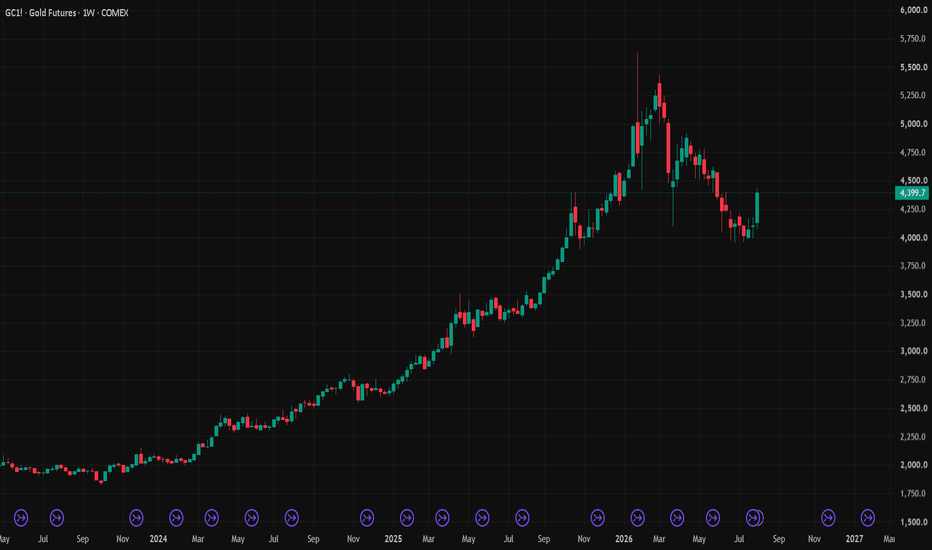
My own system is printing Sell on the weekly right now. On the monthly, the same
system prints Strong Buy with a first target near 5,195. Same indicator, same
data, opposite conclusions.
My indicators are private, so the chart here is clean price action and I am
quoting their readings instead of showing them. Every number below is a reading,
not a promise.
I am not going to hide one to make the other look smarter. Both states are alive
until something is measured.
ONE RULE ABOVE EVERYTHING: THE MARKET IS ALWAYS RIGHT
The market is not an opinion I get to argue with. It is the measurement. When
price closes, that is the observation, and the observation is never wrong. Only
my model can be wrong. Every rule below exists to make my model cheap to update
and expensive to defend.
WHAT 10,000 TICKS ACTUALLY MEANS
I say this on stream constantly: anything under 10,000 ticks is scalping.
That is not a price target. It is a unit of measurement. On COMEX GC one tick is
$0.10 per ounce, so 10,000 ticks is about $1,000 per ounce of travel. Below that
distance I am not looking at a trend - I am looking at noise with good lighting.
Above it, structure has to exist, because price cannot travel that far without
leaving evidence of who was buying and where.
So when I say gold has a 10,000-tick move in it, I am not promising a number. I
am naming the class of move I am measuring. Anything smaller does not qualify for
the thesis. Part of that distance has already printed, which does not make the
rest certain - it makes the rest a fresh decision.
NON-COMMUTING OBSERVABLES: WHY MY OWN TIMEFRAMES DISAGREE
In physics, measuring position precisely destroys precision in momentum. They
cannot both be sharp at once. Charts behave the same way, and today my own panel
demonstrates it better than any explanation I could write:
Monthly: Buy, strong reading, first target near 5,195, reward-to-risk about 1.5.
Weekly: Sell, first target below current price.
Daily: Buy - but reward-to-risk about 0.4.
Look at that daily line again, because it is the whole lesson. The direction is
right and the trade is still garbage. A 0.4 reward-to-risk means I am putting up
more than twice what I stand to make. Correct and unprofitable are not opposites.
That is what a shorter measurement window costs you. It sharpens timing and
destroys the distance you need for the payoff to exist. The longer window has the
payoff and cannot tell you when. Monthly up, weekly down, daily up is not a
contradiction. It is three measurement bases returning three valid answers.
The monthly carries the thesis. The weekly decides the entry. The daily is noise
until the weekly close agrees. A long-term view is allowed to sit through a
weekly pullback. What it is not allowed to do is rewrite its story afterwards and
pretend it always said that.
SUPERPOSITION: ALL DIRECTIONS STAY OPEN UNTIL SOMETHING IS MEASURED
Before the weekly close, gold is not going up or down in my model. It holds both,
with different weights. Almost every large loss I have watched, including my own,
came from collapsing that early - picking one branch because holding two felt
uncomfortable, then spending weeks defending the pick.
So I hold the distribution, not the conclusion, and I let the close do the
collapsing. My discomfort is not information.
ENTANGLEMENT: NEVER READ GOLD ALONE
Gold, silver, copper, platinum, palladium - I read the whole metals complex.
Correlated systems share information, so measuring one tells me something about
the others. When the complex moves together, the move has a body behind it. When
gold runs while silver and copper refuse, the correlation has broken, and that is
the earliest warning available. It arrives before any indicator says a word.
I read gold across five independent axes: price structure, macro, correlation,
news flow, and technicals. On the macro side for metal it is the dollar, long-end
yields, crude, and volatility. If I could keep one macro input and throw the rest
away, I would keep rates - metal is priced against the cost of holding money.
Here is the part most people will not like. My engine refuses to give a
directional call unless enough of those axes are fresh and agreeing. If several
inputs go stale, it returns neutral on purpose. It is built to be able to say "I
do not know."
A system that always has an opinion is not confident, it is lying to you. No
measurement means no collapse, and no collapse means no trade.
MEASUREMENT: WHAT ACTUALLY COUNTS AS AN OBSERVATION
Not a touch. A close.
I mark where price actually turned, repeatedly, and I never buy the first touch of
a level - a touch is a rumour. I wait for the reclaim close: price closing back
above the level is buyers proving they won, not hoping. Then at least 2:1 reward
to risk, or I pass. That single filter is why the daily setup above does not get
my money today.
I also do not trust a level only one source can see. A weekly level on the chart,
the same area in order-book depth from my domestic broker feed, and whether I
said it out loud on stream before it happened. Three independent looks. If two of
the three disagree, it is an opinion, not a level.
THE ANSWER TO THE QUESTION I GET MOST
Every stream, someone asks the same thing: when does it move?
My answer has not changed: it moves once you cut your loss.
That sounds harsh. It is mechanical. Price travels toward where positions have to
be closed, and the last cluster of stops sitting under an obvious level is fuel.
If you place your stop where everybody else placed theirs, you are not managing
risk - you are supplying it.
This is also the honest version of the quantum framing. You are not standing
outside the system observing it. You are part of what gets measured. Your
capitulation is one of the inputs. Size and stop placement are the only parts of
that you control.
THE STATE THAT ENDS THIS THESIS
A weekly close that loses the level the move launched from, or the metals complex
splitting apart while gold pushes alone. Either observation and the thesis is
gone - I stand down and re-mark. A thesis with no exit condition is not a thesis,
it is a wish.
Same long-term logic on my board: NQ 26,000 remains valid.
One honest note: this is a thinking framework, not a claim that quantum physics
moves price. I use it because it forces the two habits that actually pay - holding
several outcomes at once, and letting the measurement decide instead of me.
So here is what I want to hear, because I think it separates the people who last
from the people who do not: when your own system disagrees with your thesis,
which one do you obey - and what is your written rule for it? Put it in the
comments. I read all of them.
Educational content only. Not financial advice. Every entry, exit and outcome is
your own judgement, not mine. I publish the framework, never instructions.