ARM: The AI Architecture Breakout
📋 ARM (Arm Holdings plc)
Price: ~$281 | August 8, 2026
Just a month ago, it looked as though the ARM story had ended in a sharp disappointment — the stock had fallen 46% from its June highs to around $199. However, the company’s July 29 earnings report was strong enough to reverse almost the entire decline within days, with the stock surging 18–24%.
The question now is no longer whether the business is growing — it clearly is, and at a rapid pace — but whether that growth is sufficient to justify a P/E multiple of roughly 250x, especially with an FTC investigation and the long-running dispute surrounding its Chinese subsidiary still hanging over the company.
🏛️ FUNDAMENTAL ANALYSIS
🏢 Business Overview
ARM does not manufacture chips itself. Instead, it licenses processor architecture and intellectual property (IP) that underpin the vast majority of smartphones worldwide. The company generates revenue primarily through royalties — a percentage of each chip sold — as well as licensing fees paid by customers for the right to use its architecture.
One of the most important recent shifts has been the migration of customers from older architectures to Armv9 and Compute Subsystems (CSS), which carry significantly higher pricing and structurally improve ARM’s margins.
On top of this, the company has launched a new business initiative: its own AGI CPU for AI data centers. The order pipeline for this product has already exceeded $2 billion.
This potentially changes ARM’s positioning fundamentally. The company is moving from being a pure IP licensor toward becoming a player that competes with some of its own chipmaking customers. This shift is also one of the reasons behind increased regulatory scrutiny.
💰 Financial Position
ARM’s Q1 FY2027 results, released on July 29, were record-breaking. Revenue reached $1.29 billion, up 22% year over year and above the $1.27 billion consensus estimate.
Royalty revenue from the data-center segment doubled, while total royalty revenue increased 22% to $715 million.
For FY2026 as a whole, revenue reached $4.92 billion, up 23% year over year, while net income increased 14% to $904 million. Operating margin declined slightly to 18% from 20% a year earlier, primarily due to higher R&D spending and investment in the AGI business.
Full-year EPS stood at approximately $0.85, while consensus estimates for the following year are around $0.92.
ARM also has a very strong balance sheet. The company has essentially no meaningful debt burden and holds nearly $4 billion in net cash. There are currently no significant liquidity or solvency concerns.
Traditional valuation metrics such as P/E are difficult to apply here. At a share price of around $281, the trailing P/E is approximately 245–285x, depending on the data source.
This means that a substantial portion of ARM’s current valuation is based not on current earnings, but on expectations for AI data centers and the AGI CPU opportunity several years into the future — essentially a classic "paying for the future" story.
📰 RECENT DEVELOPMENTS
Record Earnings and Trend Reversal
Following the 46% decline from its June highs, ARM surged above $280 on August 4 after reporting strong results and raising its guidance.
On August 6, the stock gained another 5%, as investors continued to respond positively to strong demand for the v9 architecture and Neoverse chips across cloud and AI infrastructure.
Diverging Analyst Views
Wall Street’s reaction to the earnings report has been far from unanimous.
Morgan Stanley raised its price target from $202 to $212 while maintaining an Equal Weight rating. RBC Capital, on the other hand, cut its target from $475 to $340. New Street initiated coverage with a Buy rating.
The wide range of opinions highlights how difficult it is to determine what ARM is actually worth following its recent rally.
Negative Developments
ARM currently faces three separate sources of legal and regulatory pressure.
First, the U.S. Federal Trade Commission (FTC) has opened an investigation into ARM over potential anticompetitive behavior. Regulators are examining the company’s licensing model and whether its move into its own AGI CPU could allow it to restrict competitors’ access to its architecture.
Second, there is the long-running dispute surrounding Arm China. Former CEO Allen Wu has refused to leave his position and continues to litigate against executives appointed to replace him. This creates additional corporate-governance uncertainty in one of ARM’s most strategically important markets.
Third, ARM previously lost its legal battle against Qualcomm over the Nuvia licensing dispute. The ruling weakened ARM’s position regarding its licensing model and was followed by antitrust complaints from Qualcomm in multiple jurisdictions, including a regulatory inspection of ARM’s Seoul office by Korean authorities.
⚖️ VALUATION
The market is currently pricing in the assumption that ARM will continue aggressively increasing royalty revenue through the migration of customers toward v9 and CSS, while its AGI CPU becomes a meaningful long-term business rather than simply an announced product.
That is a demanding set of assumptions.
Some analysts, including those cited by Seeking Alpha, estimate fair value at around $240, below the current market price. Simply Wall St’s valuation is even lower, at approximately $167.
At the same time, ARM is growing faster than the broader semiconductor sector, with projected revenue growth of roughly 27% annually versus around 22% for the semiconductor industry. This faster growth provides some justification for ARM’s premium valuation.
The average analyst price target is approximately $287, implying only around 2–4% upside from the current price. However, the range is extremely wide, with estimates spanning roughly $125 to $500.
Such a wide range does not represent a strong consensus — it shows that the market remains deeply divided over how much ARM’s future growth is worth today.
Verdict
ARM is objectively expensive by conventional valuation standards. The premium reflects the company’s AI optionality, strategic position in processor architecture, and expectations for continued royalty growth rather than its current earnings power.
At current levels, ARM cannot be described as conventionally undervalued. Instead, the stock represents a "growth continuation" bet — investors are effectively betting that ARM’s growth will remain stronger and last longer than the market currently expects.
💵 DIVIDENDS
ARM does not pay a dividend and has never paid a dividend as a Nasdaq-listed ADR.
For a growth company at this stage, reinvesting available capital into R&D, AI infrastructure, and the AGI initiative is a reasonable capital-allocation strategy.
⚠️ TOP 3 RISKS
1. FTC Investigation
U.S. regulators are investigating whether ARM’s business practices could restrict competitors’ access to its architecture following the company’s entry into the AGI CPU market.
This risk is particularly important because it directly affects the licensing model that underpins ARM’s royalty economics.
2. Arm China Governance Dispute
The ongoing conflict involving former Arm China CEO Allen Wu creates additional corporate-governance uncertainty.
China remains one of the most important markets for semiconductor IP licensing, meaning any deterioration in ARM’s ability to effectively manage its Chinese operations could create a material risk to future revenue.
3. Elevated Valuation and AI Cyclicality
With a P/E of roughly 250–285x, ARM is highly sensitive to any disappointment surrounding AI investment, data-center spending, or future earnings growth.
A slowdown in AI capital expenditure could trigger a much sharper multiple contraction than in many other semiconductor stocks. This risk was already demonstrated during the June–July sell-off, when ARM lost approximately 46% before rebounding sharply following its latest earnings report.
📈 TECHNICAL ANALYSIS
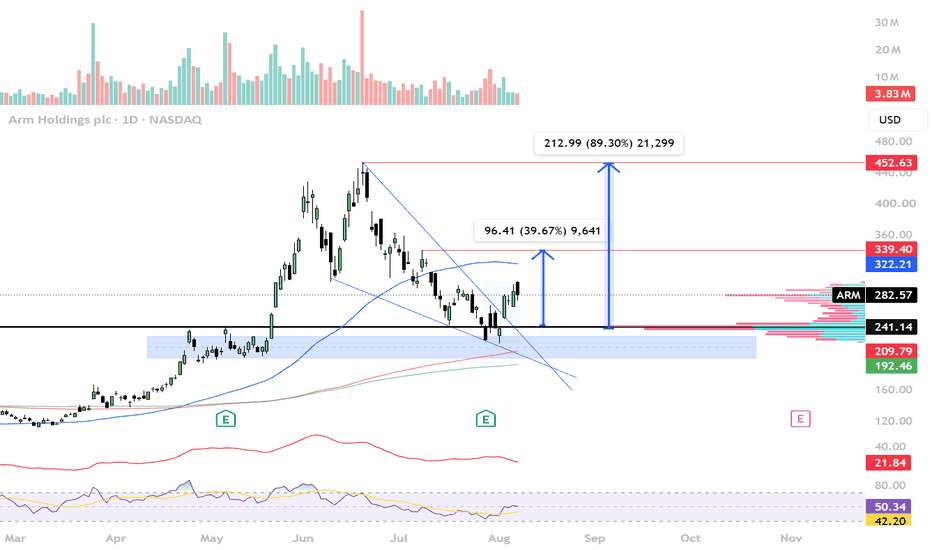
On the daily timeframe, ARM has formed a falling wedge pattern as the stock declined into a broader consolidation zone.
During this move, the price tested both the 150-day and 200-day SMAs, from which it rebounded strongly. The reaction from these major moving averages is technically constructive and suggests that the longer-term trend structure remains intact.
The current setup provides a potential entry around the gap and Point of Control (POC) zone, which is expected to act as a key support area. If the price successfully holds this zone, it could provide the basis for another upward move.
The primary upside targets are:
Target 1: $339.40
Target 2: $452.60
The RSI remains neutral, leaving room for further upside without the stock currently being in an obviously overbought condition.
At the same time, the ADX is beginning to strengthen, indicating that directional momentum may be developing and that the market could be transitioning from consolidation into a more defined trend.
Trade Invalidation
The bullish setup is invalidated if ARM breaks below and establishes itself beneath the 200-day SMA.
A sustained close below the 200 SMA would weaken the current bullish structure and invalidate the thesis for the anticipated upward move.
🧠 OVERALL VIEW
ARM remains one of the most strategically important companies in the semiconductor ecosystem, with strong exposure to smartphones, cloud computing, AI infrastructure, and the broader transition toward Arm-based computing.