

Tether has disclosed exposure to EQIBank as the bank fights a US seizure involving payment processor Capstone Limited, raising a question about access to assets that might back USDT. On Sept. 25, the stablecoin issuer told PYMNTS the exposure was less than 0.034% of the Tether group's assets. It gave no dollar balance or indication that the money is part of USDT reserves.
The government filed a civil forfeiture complaint in July. A court record lists about $83.03 million in three bank balances and roughly 1.18 million USDT at two addresses. Combined at a $1 value for each USDT, that is about $84.2 million. A subsequent court order identifies the bank accounts as held in Capstone's name. It does not identify the listed property as Tether's.
EQIBank sought the return of seized property in a separate but related action. A court record shows that its motion was denied. That denial did not decide the ultimate forfeiture case or establish who owns the property. The government's claim to the assets remains distinct from Tether's undisclosed exposure to the bank.
The USDT reserve link is unproven
The denominator in Tether's statement matters. Its less-than-0.034% figure concerns group assets, while its published USDT reserve figures describe Tether International, an issuer entity, on a different date. Tether has not supplied a figure that bridges the two.
As of June 30, Tether International reported $187.75 billion in assets and $183.64 billion in liabilities, an excess of $4.11 billion. Its underlying attestation describes the issuer's position at that point in time and does not identify an EQIBank balance. The June excess is useful context for the scale of the issuer's reported backing, but it cannot tell holders how much the Tether group had at EQIBank in September or whether those funds remain accessible.
A bank dispute becomes a redemption issue if it prevents an issuer from using funds needed to meet requests. The Capstone filing does not trace any of the seized balances into Tether International's USDT reserves, and Tether's exposure statement does not say that minting or redemptions have been interrupted. That leaves a counterparty-access question, not an established shortfall or halt.
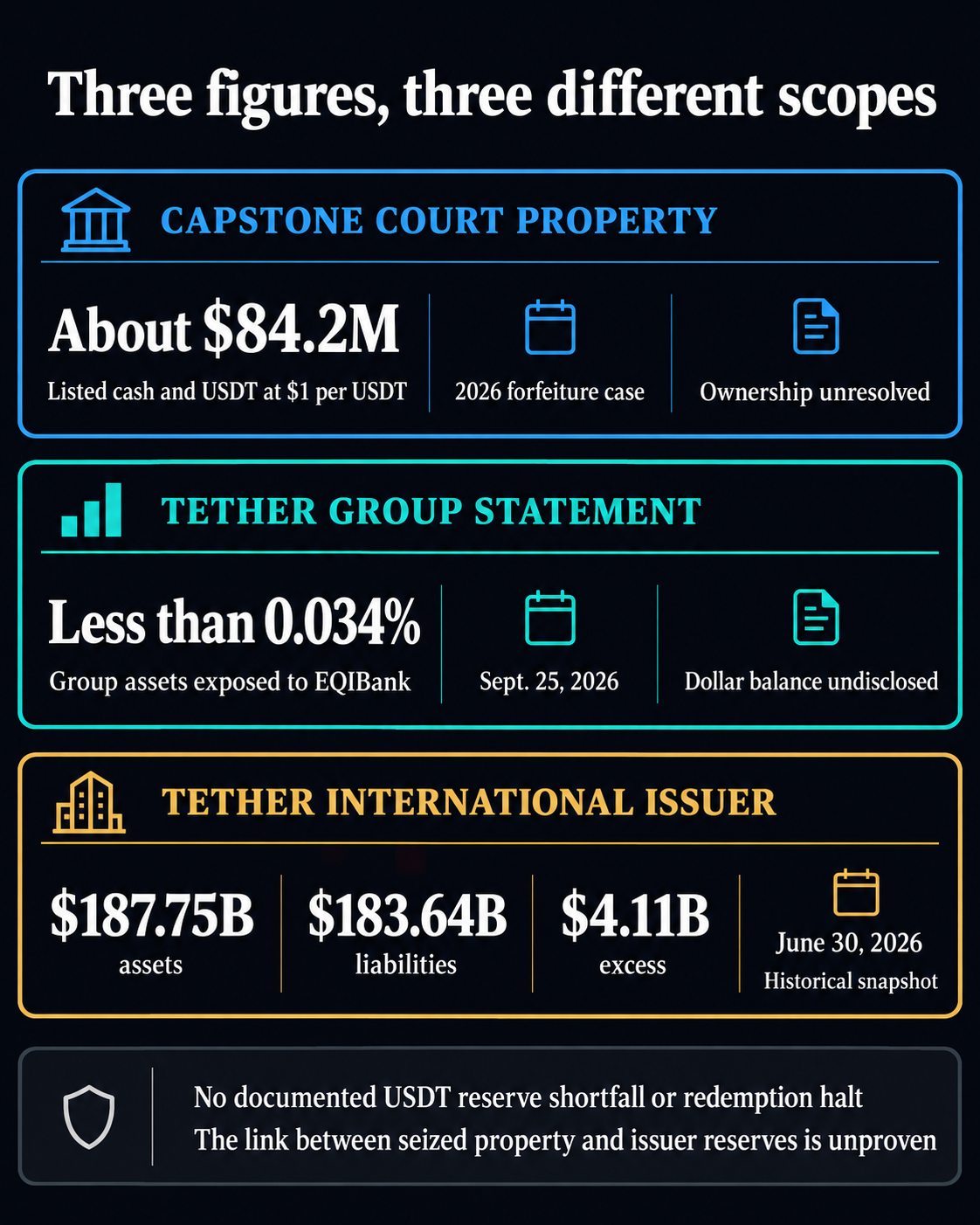
For holders, the decisive facts are the size and legal owner of Tether's EQIBank balance, whether any of it belongs to USDT reserves, and whether Tether can use it. The $84.2 million in the forfeiture case should not be treated as a measured loss to USDT holders.
The post An $84 million US asset seizure just sparked a massive question for Tether appeared first on CryptoSlate.



Comments (0)
Please sign in to comment.
No comments yet. Be the first to comment.