
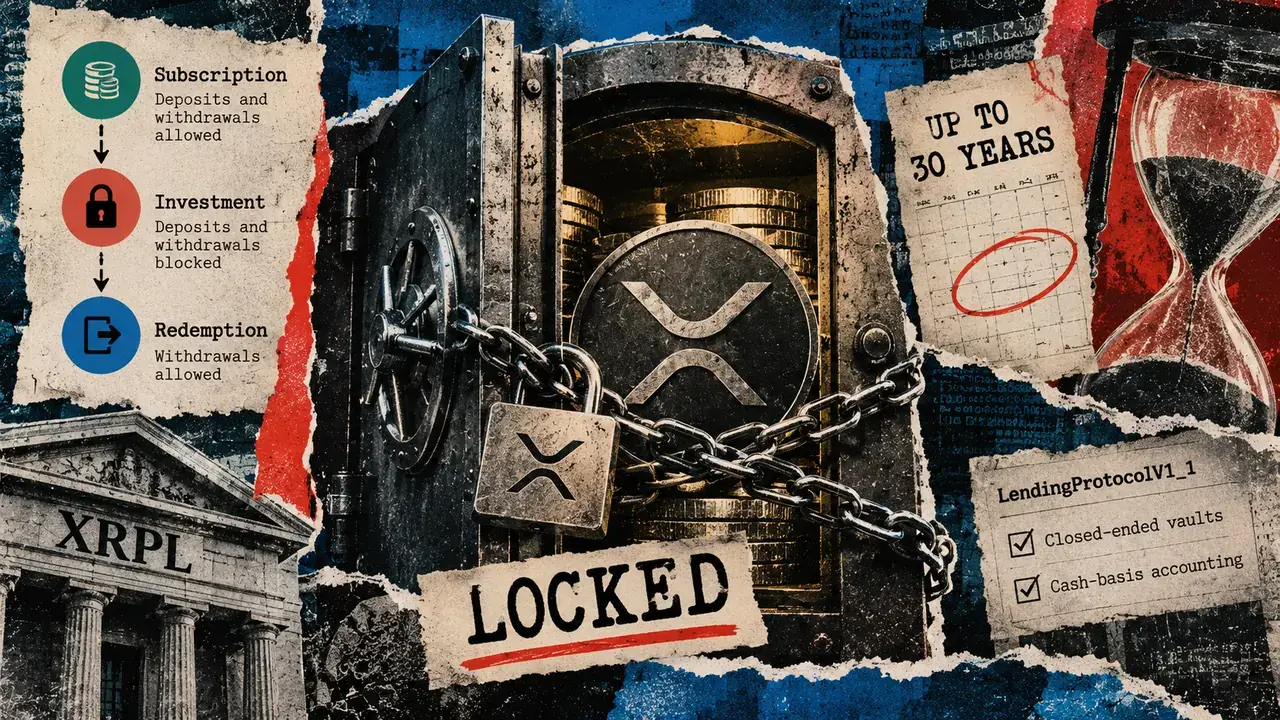
XRP Ledger's (XRPL) newest server release defines a future lending market in which depositors could commit assets to a vault for a fixed term and wait until a set redemption date to withdraw. For XRP holders, the design introduces a possible liquidity lock that can last from minutes to years.
The XRP Ledger Foundation released xrpld 3.4.0 on Sept. 16 with LendingProtocolV1_1 code for closed-ended vaults and cash-basis accounting.
The first feature fixes the period during which deposited capital can fund loans, and the second recognizes interest when a borrower pays it.
Availability still depends on the amendment process and the rest of XRPL's lending stack. A live dashboard snapshot fetched Sept. 17 did not surface LendingProtocolV1_1 in the responding node's feature feed or show a V1.1 activation countdown.
The same snapshot placed the base LendingProtocol amendment at 13 of 35 trusted-validator votes and SingleAssetVault at 16 of 35, below the displayed threshold of 28.
Single-asset vaults can use XRP, an issued trust-line token, or a Multi-Purpose Token. Any claim that the system will create lasting XRP demand therefore depends on later choices by applications, borrowers and depositors.
A fixed calendar determines when depositors can leave
A closed-ended vault moves through subscription, investment, and redemption. Its SubscriptionDate and RedemptionDate are set when the vault is created and stay fixed, according to the closed-ended-vault implementation.
During subscription, depositors can add assets and redeem their shares. The investment phase starts at the subscription boundary, blocks new deposits and withdrawals, and allows the vault's capital to fund loans.
Redemption begins at the second boundary, when depositors can again withdraw their share of the proceeds.
The schedule creates a visible commitment before money enters the loan pool. A depositor can inspect the dates and decide whether the term fits their liquidity needs. Once investment begins, the protocol enforces the advertised lock even if the depositor wants the assets back early.
| Phase | Depositor access | Lending activity |
|---|---|---|
| Subscription | Deposits and withdrawals allowed | New loans blocked |
| Investment | Deposits and withdrawals blocked | Loans can be originated |
| Redemption | Withdrawals allowed | New loans blocked |
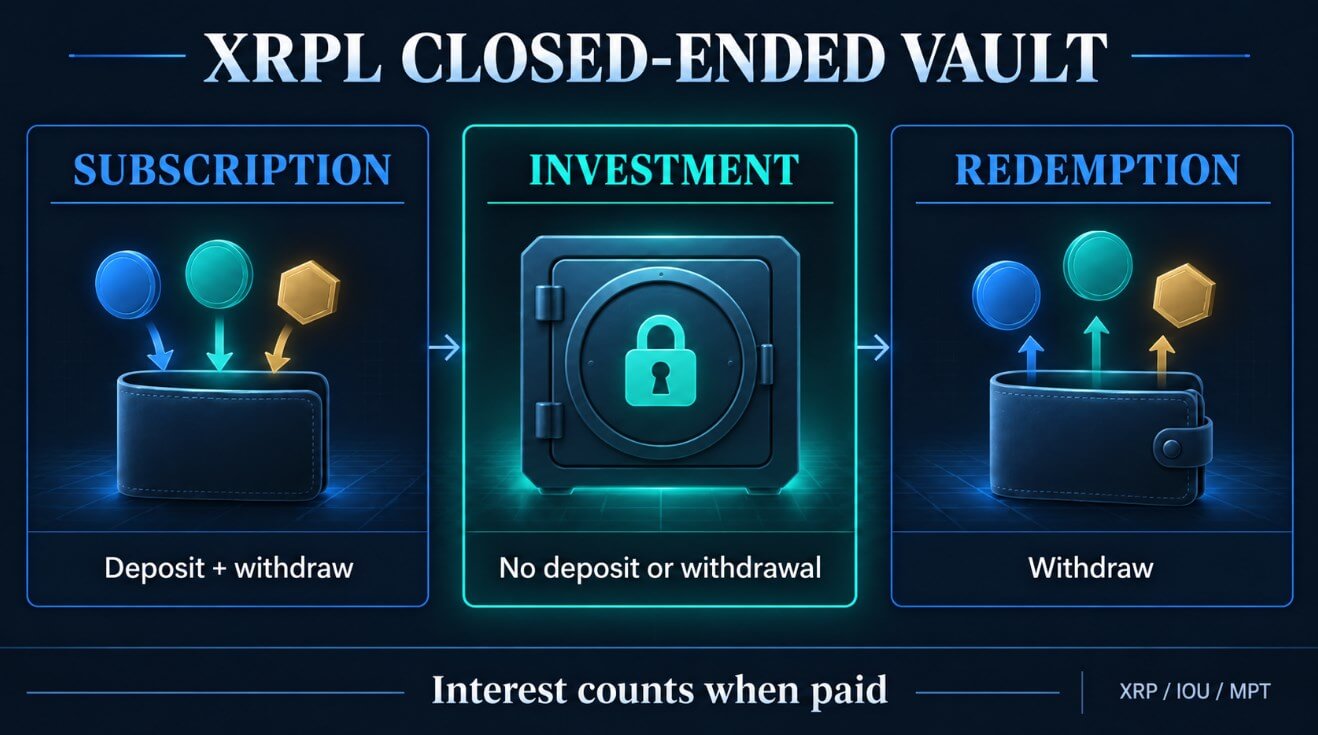
The implementation permits an investment period of at least 60 seconds and strictly less than 30 years, which is the encoded ceiling.
LendingProtocolV1_1 would also limit newly created loan brokers to closed-ended vaults after activation. Open-ended lending objects created under the earlier rules remain manageable, preserving their original behavior instead of forcing a retroactive conversion.
For an XRP-denominated vault, the investment phase can make the deposited XRP unavailable to that depositor until redemption. XRP held elsewhere in the same user's wallet, or by holders who never enter the vault, remains outside this lifecycle. The mechanism is a voluntary term commitment tied to a specific pool.
That boundary is central to the demand question. Moving already-owned XRP into a vault can produce a visible locked balance without requiring a market purchase. Applications could also build lending pools around issued assets, leaving XRP outside the principal flow.
Cash basis makes paid interest visible
The accounting change addresses when a vault reports income from the loans it funds. Under the earlier whole-life model, scheduled interest could enter the vault's accounting when a loan was originated, before the borrower delivered the cash.
A missed payment could then force the system to unwind income that had already appeared in the vault's value.
The cash-basis implementation stamps new post-activation vaults with the new accounting version. Those vaults recognize interest as borrowers pay it, and vaults created under the earlier model permanently retain legacy whole-life accounting.
For depositors, the practical change is a cleaner separation between expected and realized returns. A scheduled payment remains a claim on a borrower, and paid interest becomes vault income. That makes the reported asset value less dependent on money that has not yet arrived.
Cash-basis accounting leaves the underlying credit risks in place. XRPL's native lending design relies on off-chain underwriting, while the ledger handles origination, payments, and defaults. Borrowers can miss payments, brokers can underwrite poorly, recoveries can fall short, and first-loss capital may be insufficient to absorb every loss.
The accounting can also change how much debt a broker appears to have against a limit because future interest no longer enters the total at origination. That may create room for additional loans under the protocol's measurements. Utilization still depends on real borrowers and funding, while realized yield depends on successful repayment.
For XRP holders, this distinction prevents scheduled interest from being presented as already earned. The economic outcome emerges from loan performance over the term and the amount recovered after defaults.
The combination of locked withdrawals and cash-basis reporting makes the trade-off more legible: depositors supply liquidity for a known period, then evaluate payments.
That structure can support an XRP use case only where applications select XRP as the asset and borrowers create recurring demand for XRP-denominated credit.
Activation is only the first demand test
The next measurable event is network governance. The relevant amendments must become visible to the live network, attract sufficient validator support, and complete the activation process. Applications would then need to create closed-ended vaults, recruit depositors, and originate loans.
Adoption can be tested with on-chain and product-level evidence. The first indicators are the number of XRP-denominated vaults and the amount of XRP deposited. Loan counts and principal originated would show whether borrowers use that capital. Repayments, defaults, and realized interest would reveal the quality of the resulting credit activity.
Redemption data matters as much as deposits. Withdrawals after the fixed redemption dates would demonstrate that the liquidity schedule works through a full cycle. Renewed deposits and repeat borrowing would provide stronger evidence of a durable market.
Those measures separate three effects that can otherwise be conflated. A vault balance shows that tokens entered a pool, loan originations show that capital was put to work, and repeated repayments and renewed funding show continuing economic demand.
Only the last two begin to support a case that lending has created more than a temporary XRP sink.
For now, the strongest holder takeaway is contractual. A future XRP vault could exchange immediate liquidity for exposure to loan repayments over a fixed term, with income recorded only after payment.
Evidence of lasting XRP demand would come later in XRP-denominated deposits, borrowing, repayments, and repeat participation.
The post XRPL’s new lending tool could lock up your XRP from minutes to decades appeared first on CryptoSlate.


Comments (0)
Please sign in to comment.
No comments yet. Be the first to comment.