
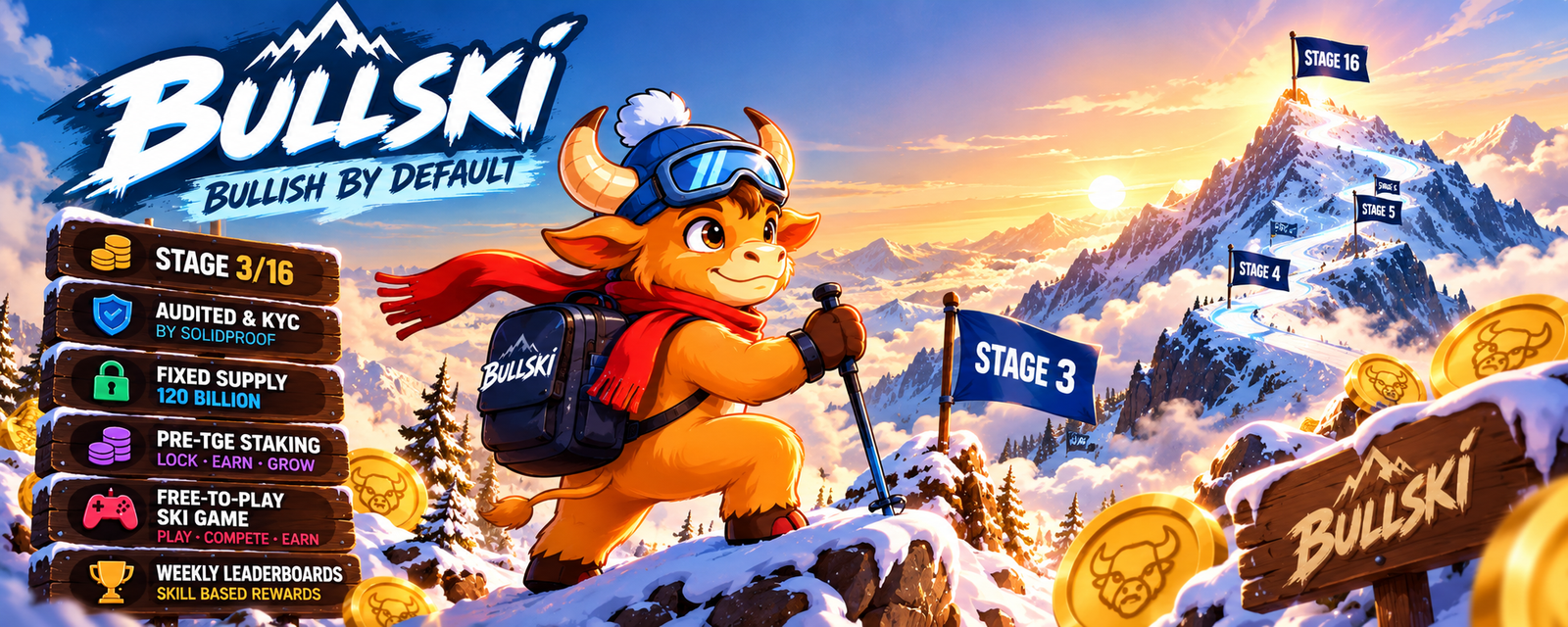
LONDON, Oct. 10, 2026 - Bullski ($BULLSKI), the Ethereum-based community meme coin currently in Stage 3 of its 16-stage presale, is placing greater emphasis on fixed-supply tokenomics after an independent SolidProof review confirmed that no additional $BULLSKI tokens can be created after deployment.
Bullski's maximum supply was set at 120 billion tokens when the ERC-20 contract was deployed on Ethereum. Of that total, 40% is allocated to the presale, while the remaining supply is divided between liquidity, staking and rewards, burns, referrals, marketing and the team. Bullski
The important distinction is that the 120 billion figure is not simply a target written into the project's marketing material.
SolidProof's technical assessment states that the supply was minted once at deployment and that the contract owner cannot create additional tokens later. The auditor also says the contract is not upgradeable, meaning its underlying logic cannot later be replaced through a proxy upgrade mechanism. SolidProof TrustNet
That gives Bullski's tokenomics a technical constraint that can be checked independently on-chain.
It does not guarantee the future price of $BULLSKI, nor does it eliminate the risks associated with a presale token. But it establishes an important boundary around one of the most fundamental variables in any token economy: how many tokens can exist.
Bullski's Supply Was Created Once
Bullski's token contract follows a relatively simple supply model.
At deployment, the full 120 billion $BULLSKI supply was created.
There is no mechanism allowing the owner to return later and mint another 10 billion, 50 billion or 100 billion tokens.
SolidProof's review states directly that new tokens cannot be minted after deployment and that the project's supply can only move in the opposite direction through burning. SolidProof TrustNet
That creates a clear distinction between Bullski and token models where administrators retain an active minting function.
The theoretical maximum supply is already known.
It cannot be expanded later to fund additional rewards, marketing campaigns, ecosystem incentives or other expenses.
By the Numbers
| $BULLSKI Detail | Published / Verified Structure |
|---|---|
| Blockchain | Ethereum |
| Token standard | ERC-20 |
| Total initial supply | 120 billion $BULLSKI |
| Additional minting | Not possible |
| Presale allocation | 40% |
| Presale tokens | 48 billion |
| Liquidity allocation | 18% |
| Liquidity tokens | 21.6 billion |
| Staking & rewards | 17% |
| Staking/reward tokens | 20.4 billion |
| Burn allocation | 10% |
| Burn allocation tokens | 12 billion |
| Referral allocation | 8% |
| Referral tokens | 9.6 billion |
| Marketing allocation | 5% |
| Marketing tokens | 6 billion |
| Team allocation | 2% |
| Team tokens | 2.4 billion |
| Current presale stage | Stage 3 of 16 |
| Stage 3 published price | $0.00002 |
| Listing reference | $0.0025 |
| Contract audit | SolidProof |
| TrustNet score | 73.90 |
| Team KYC | Verified through SolidProof |
| Contract upgradeable | No |
| Transfer tax | No |
| Reflection mechanism | No |
| Rebasing mechanism | No |
Bullski's allocation percentages are published in its white paper, while the fixed-supply and no-minting characteristics are independently described in SolidProof's contract assessment. Bullski
40% of the Entire Supply Is Reserved for the Presale
The largest individual allocation is the presale.
Bullski has designated 40% of the entire supply, equal to 48 billion $BULLSKI, for distribution through its 16-stage sale. Bullski
The presale began with Stage 1 at $0.00001 per token.
Stage 2 followed at $0.000015.
The official Bullski website now displays Stage 3/16, while the previously published Stage 3 price is $0.00002. Bullski
Unlike timed token sales where the price changes automatically after a countdown, Bullski's stages advance when the allocation assigned to the current stage is sold.
That means the 16-stage structure is simultaneously a pricing system and a distribution mechanism.
Each stage releases another portion of the 48 billion-token presale allocation at a predetermined price.
The Other 60% Has Separate Ecosystem Roles
The remaining 72 billion tokens, representing 60% of the initial supply, are not part of the presale allocation.
Instead, they have been divided across six categories.
Liquidity receives 18%.
Staking and rewards receive 17%.
Burns account for 10%.
Referrals receive 8%.
Marketing accounts for 5%.
The team receives 2%. Bullski
The distinction matters because looking only at the 48 billion presale tokens does not describe Bullski's complete supply structure.
The other allocations are intended to support trading liquidity, rewards and ecosystem activity after or around the token's launch.
18% Is Allocated to Liquidity
Bullski reserves 21.6 billion $BULLSKI, or 18% of total supply, for liquidity.
Liquidity becomes particularly important once a presale token begins public trading.
A decentralized exchange needs a pool containing $BULLSKI and another asset, such as ETH, so that buyers and sellers can trade against available liquidity.
Bullski says liquidity will be locked at launch, preventing the corresponding liquidity-provider position from being immediately withdrawn by the project. Bullski
However, there is an important timing distinction.
A planned liquidity lock should not be treated as the same thing as a completed post-launch lock.
Bullski remains in presale and has not yet reached public token trading, so the final liquidity deployment and lock will need to be verified on-chain when launch occurs.
That transaction will become an important post-TGE checkpoint.
17% Goes to Staking and Rewards
The second-largest non-presale allocation is staking and rewards.
Bullski has reserved 17% of total supply, equivalent to 20.4 billion tokens, for this category. Bullski
This pool has become more relevant following Bullski's September confirmation of its pre-TGE staking model.
Participants will be able to decide during the presale how much of their eligible $BULLSKI allocation they want to commit to staking.
Tokens selected for staking are intended to move directly into the chosen lock at TGE rather than first arriving as a freely transferable wallet balance. Bullski
The reward allocation is therefore finite.
Because the contract cannot mint additional tokens, Bullski cannot simply create new $BULLSKI indefinitely to continue financing staking rewards.
Rewards must ultimately come from tokens already included within the original 120 billion supply.
That makes the staking allocation an economic resource with a defined upper boundary.
Fixed Rewards Avoid One Form of Token Inflation
That distinction is particularly relevant to staking systems.
Some cryptocurrency reward models generate new tokens continuously through emissions.
If newly issued supply grows faster than demand, holders can experience dilution even while their nominal token balances increase.
Bullski's contract does not provide that option.
SolidProof says no additional tokens can be minted after deployment. SolidProof TrustNet
As a result, staking rewards may redistribute part of the existing $BULLSKI supply, but they cannot increase the original amount created by the contract.
This does not automatically make staking economically sustainable.
Reward rates, lock periods, participation levels and market demand still matter.
But it prevents one specific scenario: financing rewards by continuously expanding the token supply beyond 120 billion.
10% Has Been Assigned to Burns
Bullski's tokenomics also allocate 10% of total supply, or 12 billion tokens, to burns. Bullski
This section requires another important distinction.
An allocation for burns does not mean all 12 billion tokens have already been destroyed.
Bullski is reserving that portion of supply for its burn strategy.
When tokens are actually burned, they are permanently removed from usable supply.
SolidProof's detailed contract analysis says the token contains burn functionality and that supply can decrease through burning, while additional issuance is not possible. SolidProof TrustNet
That creates a one-directional supply model:
120B initial supply → potential burns → lower supply
What cannot happen is:
120B initial supply → new minting → larger supply
The difference could become increasingly relevant as Bullski begins implementing its burn strategy.
Actual burns, however, should be measured through completed on-chain transactions rather than projected allocations.
The Supply Can Fall but Cannot Return to 120 Billion
This creates an unusual detail in the way Bullski's maximum supply should be interpreted.
SolidProof notes that the contract's 120 billion figure is more accurately understood as the fixed initial supply rather than a reusable minting ceiling.
If 1 billion tokens were permanently burned, for example, the supply could fall to 119 billion.
The owner would not then be able to mint another billion tokens to restore the original figure.
There is no post-deployment mint function that allows the supply to climb back toward 120 billion. SolidProof TrustNet
That makes burns permanent at the smart-contract level.
Referrals Have Their Own 8% Allocation
Bullski has also separated referral incentives from staking rewards.
The referral allocation represents 8% of supply, or 9.6 billion $BULLSKI. Bullski
Under Bullski's referral system, users can receive a unique referral code after connecting a wallet, with eligible referrals generating bonus tokens from the dedicated allocation.
The relevant point from a tokenomics perspective is where those rewards originate.
They do not require new tokens to be minted.
Bullski says referral bonuses are funded from the predetermined referral pool included in the original supply. Bullski
That keeps referral incentives inside the same fixed-supply framework as staking rewards.
Marketing Receives 5% and the Team 2%
Bullski allocates 5%, equivalent to 6 billion tokens, to marketing.
The team allocation is considerably smaller at 2%, or 2.4 billion tokens. Bullski
Bullski's documentation says the team allocation is subject to vesting rather than becoming fully liquid at launch.
Vesting is important because the size of a team allocation alone does not describe its immediate market impact.
The release schedule determines how quickly those tokens can become transferable.
Bullski's 2% team share is the smallest category in its published allocation structure.
The execution of the vesting arrangement will nevertheless be another item that can be checked as the project approaches TGE.
SolidProof Confirms More Than the Supply
The SolidProof assessment provides additional information about the structure of the $BULLSKI contract.
According to the auditor, the live Ethereum contract matches the source code submitted for review.
The contract has:
- no additional minting mechanism;
- no transfer tax or fee;
- no reflection mechanism;
- no rebasing;
- no upgrade mechanism;
- and no post-launch ability for the owner to seize or freeze ordinary holder balances.
Once public trading is activated, SolidProof says the trading restriction is permanently removed. SolidProof TrustNet
The project's TrustNet listing currently displays a 73.90 score, while Bullski's team has also completed identity verification through SolidProof. SolidProof TrustNet
Fixed Supply Does Not Mean Zero Risk
A fixed token supply solves one specific question.
It answers whether administrators can later expand supply by minting additional $BULLSKI.
In Bullski's case, SolidProof says they cannot.
It does not answer every other risk question.
The auditor's current public assessment also lists two pending medium findings related primarily to pre-launch administrative control. SolidProof TrustNet
The contract owner currently controls the one-time trading activation and pre-launch pair registration.
SolidProof also notes that ownership is currently concentrated in a single externally owned account rather than a multi-signature wallet.
The auditor recommends moving ownership to a multi-signature structure and potentially introducing additional safeguards around administrative changes. SolidProof TrustNet
A second medium finding concerns the ability to designate addresses as trading pairs before trading is enabled, which can temporarily restrict transfers involving those addresses.
SolidProof notes that this effect disappears after public trading is permanently enabled. SolidProof TrustNet
The broader conclusion is therefore more nuanced than simply calling the contract "safe."
Bullski has a fixed supply, no post-deployment minting and an independently reviewed contract.
But administrative and launch-related considerations remain relevant until public trading begins.
The Contract Is Also Immutable
Another important feature is that $BULLSKI is not built around an upgradeable proxy.
SolidProof says the contract logic cannot later be replaced or modified through an upgrade system. SolidProof TrustNet
That means the same restrictions preventing additional minting cannot simply be bypassed later by upgrading the token into a different contract implementation.
For holders, immutability creates predictability about the rules encoded in the deployed token.
It also creates a trade-off.
If developers later want to add functionality directly to the token contract, they cannot simply upgrade the existing implementation.
New ecosystem functions would need to operate through separate contracts or infrastructure.
Those additional contracts would need to be assessed separately.
SolidProof explicitly notes that its existing audit covers the main $BULLSKI contract and does not automatically cover every future contract associated with the ecosystem. SolidProof TrustNet
That will become particularly relevant as Bullski expands into staking and other token-connected products.
Stage 3 Gives the Tokenomics a New Context
Bullski's move into Stage 3 of 16 makes these supply mechanics increasingly relevant.
During the earliest phase of a presale, much of the project exists as a roadmap.
As additional stages are completed, attention gradually moves toward how those promises will operate at launch.
For Bullski, several questions can already be answered.
The initial token supply is known.
The distribution percentages are published.
The contract address is public.
The deployed contract has been independently reviewed.
The owner cannot mint more tokens.
And the contract cannot later be upgraded to introduce an arbitrary mint function. SolidProof TrustNet
Other questions remain for later.
The final amount of supply committed to staking is unknown.
Future burn amounts and timing remain to be observed.
The final liquidity lock needs to be verified after deployment of launch liquidity.
And market demand cannot be known before $BULLSKI begins public trading.
Tokenomics Are Becoming a Test of Execution
The next phase for Bullski will therefore be less about publishing allocation percentages and more about demonstrating how those allocations are used.
The 40% presale allocation can be tracked through the remaining stages.
The 18% liquidity allocation can eventually be compared with the liquidity actually deployed and locked.
The 17% staking and rewards pool can be compared with the final staking terms.
The 10% burn allocation can be measured against real burn transactions.
Referral distributions can be monitored against their dedicated pool.
And the team's 2% allocation can be evaluated against the promised vesting structure.
The fixed contract supply makes those categories more significant because there is no additional issuance available to compensate for changes later.
Every token ultimately has to come from the original 120 billion.
What Is Confirmed and What Is Still Unknown
Several parts of Bullski's supply structure can now be independently verified.
The Ethereum contract exists.
The supply was minted once.
No further minting is available.
The contract is non-upgradeable.
The published supply is 120 billion $BULLSKI.
Bullski has published the percentage allocated to each major ecosystem category.
And SolidProof has publicly documented its assessment of the contract. SolidProof TrustNet
Other factors remain dependent on future execution.
The complete staking reward schedule has not yet been finalized publicly.
Future burn transactions have not yet established a long-term reduction pattern.
Launch liquidity has not yet entered its final post-TGE configuration.
The project's remaining audit observations have not all been marked as resolved.
And the token has not yet reached public exchange trading, meaning there is no open-market valuation against which the tokenomics can be tested.
What Happens Next
Bullski remains in Stage 3 of its 16-stage presale, with the next pricing milestone arriving when the current stage allocation is completed. Bullski
But several upcoming events may matter more than the movement from one presale stage to another.
The final staking terms will determine how much supply participants choose to lock before TGE.
Future burn activity will show whether the project's 10% burn allocation results in meaningful permanent reductions to supply.
Launch liquidity will allow the project's locking commitments to be checked on-chain.
And public trading will remove the pre-launch transfer gate described in the SolidProof assessment. SolidProof TrustNet
That makes Bullski's current tokenomics relatively straightforward to summarize:
120 billion tokens were created once. No additional $BULLSKI can be minted. Rewards must come from existing allocations, while burns can permanently push supply lower.
The harder test begins when those allocations move from tokenomics tables into real ecosystem use.
About Bullski
Bullski ($BULLSKI) is a community-driven meme coin built on Ethereum as an ERC-20 token.
The project has an initial fixed supply of 120 billion $BULLSKI and operates a 16-stage presale.
Its published ecosystem includes staking, referral rewards, liquidity allocation, token burns, community initiatives and a free-to-play downhill ski game with planned weekly skill-based leaderboards.
The $BULLSKI smart contract has been independently reviewed by SolidProof, while the project team has completed KYC verification through the security provider.
SolidProof's assessment states that no additional $BULLSKI can be minted after deployment and that the token contract is not upgradeable. SolidProof TrustNet
BULLISH BY DEFAULT.
For More Information
Official Bullski Website: bullski.io
Bullski White Paper: bullski.io/white-paper
Bullski Staking: bullski.io/staking
SolidProof BullskiCoin Assessment: SolidProof TrustNet
Telegram: t.me/BullskiCoinOfficial
X: @bullskicoin



Comments (0)
Please sign in to comment.
No comments yet. Be the first to comment.