
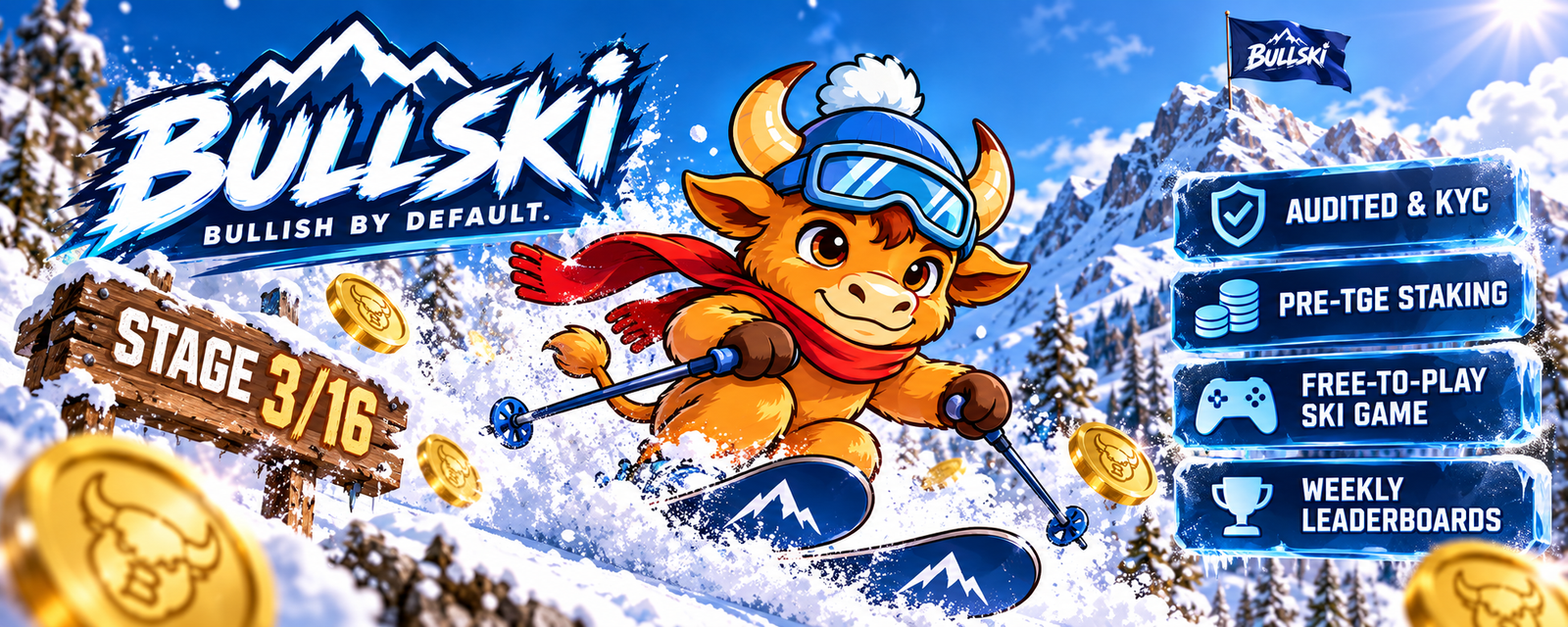

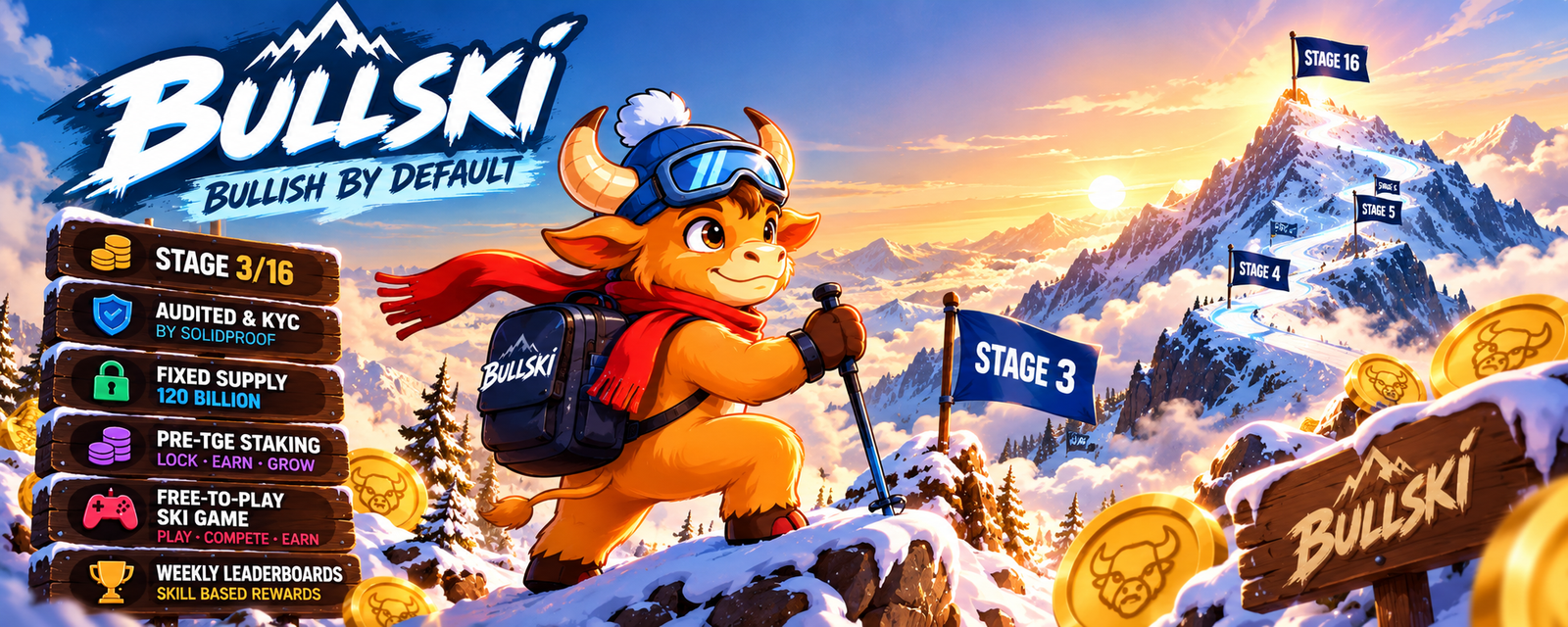
LONDON, Oct. 10, 2026 — Bullski ($BULLSKI), the Ethereum-based community meme coin, has advanced to Stage 3 of its 16-stage presale as the project expands beyond token distribution with a completed smart contract audit, a finalized pre-TGE staking model and a free-to-play ski game currently under development.
Bullski's official website currently displays Stage 3/16, marking another step forward from the opening stage of the presale that launched on July 10. The project's previously published pricing schedule set Stage 3 at $0.00002 per $BULLSKI, following Stage 1 at $0.00001 and Stage 2 at $0.000015.
But the presale stage is only part of the development.
Since September, Bullski has announced three significant additions to the project: an independent smart contract review and KYC verification through SolidProof, a pre-TGE staking system and a free-to-play downhill ski game built around weekly skill-based competition.
Together, those developments indicate that Bullski is attempting to build a broader ecosystem around $BULLSKI rather than leaving the project as a standalone presale token.
Bullski Reaches Stage 3 of Its 16-Stage Presale
Bullski's presale was designed around 16 predetermined stages, with each stage introducing a new allocation of tokens at a higher published price.
The project began its public presale on July 10, 2026.
Stage 1 was priced at $0.00001, Stage 2 at $0.000015, and Stage 3 was scheduled at $0.00002.
Bullski's website now identifies the presale as Stage 3/16.
The structure is allocation-based rather than calendar-based. A stage advances after its allocated tokens are sold rather than automatically moving forward on a specific date.
The final published listing reference remains $0.0025, although that figure is a project reference price rather than a guarantee of the token's future market value after trading begins.
By the Numbers
| Bullski Detail | Current / Published Structure |
|---|---|
| Token | $BULLSKI |
| Blockchain | Ethereum |
| Token standard | ERC-20 |
| Current presale stage | Stage 3 of 16 |
| Stage 1 price | $0.00001 |
| Stage 2 price | $0.000015 |
| Stage 3 published price | $0.00002 |
| Listing reference | $0.0025 |
| Maximum supply | 120 billion $BULLSKI |
| Presale allocation | 40% |
| Liquidity allocation | 18% |
| Staking & rewards | 17% |
| Burn allocation | 10% |
| Referral allocation | 8% |
| Marketing allocation | 5% |
| Team allocation | 2% |
| Smart contract audit | SolidProof |
| SolidProof TrustNet score | 73.90 |
| KYC | Verified through SolidProof |
| Staking model | Pre-TGE fixed-term commitment |
| Game | Free-to-play downhill ski runner |
| Game leaderboard | Weekly, skill based |
| Game launch date | Not yet announced |
Bullski's published tokenomics maintain a fixed maximum supply of 120 billion tokens, with no additional minting planned after deployment.
The Project Has Changed Since Stage 1
When Bullski's presale opened in July, the project was primarily centered around its Ethereum token, staged sale, staking plans, referral system and mountain-themed meme coin identity.
The structure has become more developed since then.
In September, Bullski released three consecutive ecosystem updates.
On September 12, the project announced the completion of its SolidProof smart contract audit and KYC verification.
On September 15, Bullski confirmed the structure of its staking program.
Two days later, on September 17, the project revealed that a free-to-play ski game was in development.
Bullski now highlights those three developments together on its main website under security, rewards and gaming.
That makes Stage 3 different from the opening phase of the sale.
The project is no longer presenting only a future roadmap. Several components originally associated with that roadmap have moved into published specifications or active development.
SolidProof Audit Adds a Verifiable Security Layer
Security is one of the more important changes since Bullski's earlier presale stages.
SolidProof's public TrustNet page lists BullskiCoin with a 73.90 TrustNet score, Ethereum Mainnet deployment information and team KYC verification.
The auditor says the deployed $BULLSKI contract matches the code it reviewed and confirms that the contract does not allow the owner to create additional tokens after deployment.
SolidProof also reports that the contract has no transfer tax, reflection or rebasing mechanism and does not give the owner conventional post-launch minting powers.
That is relevant to Bullski's published claim that its 120 billion token maximum supply is fixed.
The audit therefore provides an external technical reference that users can compare with Bullski's own documentation.
The Audit Does Not Mean the Contract Is Risk-Free
An audit should not be interpreted as a guarantee.
SolidProof's own Bullski page makes that distinction important.
The TrustNet assessment states that no crucial issues were found and describes several positive security characteristics, but the detailed findings section also lists two pending medium findings and additional lower-severity observations.
One medium finding concerns the concentration of pre-launch administrative control in a single owner account rather than a multi-signature wallet.
The second relates to the contract's pre-launch pair-management functionality, which SolidProof says could temporarily restrict transfers involving addresses registered as pairs while public trading remains disabled.
SolidProof notes that these capabilities become substantially less relevant once trading is permanently enabled, while recommending additional controls around ownership and pre-launch administration.
This distinction matters.
Bullski has an independently reviewed contract and verified KYC status, but those measures reduce specific categories of risk rather than eliminating technical, operational or market risk entirely.
The audit also covers the main $BULLSKI contract rather than every future component of the Bullski ecosystem.
Staking Is Moving From Roadmap to Defined Product
Staking has also become more specific.
Bullski confirmed its pre-TGE staking model on September 15.
Instead of buyers receiving tokens at launch and then manually moving them into a staking contract, participants who choose to stake will make that decision during the presale.
The committed tokens are then intended to move directly into the selected lock when the Token Generation Event occurs.
The system is voluntary.
Presale participants will be able to choose whether to stake all, part or none of their eligible balance.
Bullski also says several fixed lock durations will be available, with longer commitments associated with larger total rewards.
Principal and rewards are designed to remain locked together until maturity.
There is no planned early unstaking mechanism.
Once the selected term ends, participants can claim their principal and reward or voluntarily enter another staking term.
Bullski Is Using Staking as a Launch-Supply Mechanism
The staking design has another purpose beyond holder rewards.
Bullski says tokens committed before TGE will enter their lock directly rather than first becoming a liquid balance in the participant's wallet.
That means those tokens would not immediately become part of the freely transferable supply available around launch.
The project describes this as a way to reduce the amount of presale supply potentially reaching the market simultaneously at TGE.
That does not remove price volatility.
Locked tokens cannot be sold during their term, while rewards are themselves denominated in $BULLSKI.
The economic value of those rewards will therefore still depend on the token's market value after launch.
Bullski has not yet published the complete set of final staking rates, lock durations, tier thresholds and minimum commitment amounts.
Those figures remain among the project's outstanding details.
Gaming Adds a Consumer Product to the Ecosystem
The second major expansion is gaming.
Bullski announced on September 17 that it is developing a free-to-play downhill ski game.
The planned gameplay involves taking the Bullski mascot downhill while dodging obstacles, jumping, sliding and competing for distance.
Players will not need to own $BULLSKI simply to play the game. A wallet will also not be required as a basic entry requirement.
That creates an important separation between access to the product and participation in the token economy.
Someone could discover Bullski through the game, compete without purchasing the token and only later decide whether to interact with the crypto component.
It effectively creates a second onboarding path into the project.
Instead of:
Token → Community → Product
Bullski could potentially attract some users through:
Game → Community → Token ecosystem
Weekly Leaderboards Will Reset Competition
Bullski plans to organize its game around weekly leaderboard seasons.
Player performance determines ranking.
According to the project's published structure, token ownership, staking amount and presale stage will not improve a player's competitive position.
At the end of each weekly season, winners are determined and the leaderboard resets.
Bullski has summarized the distinction by separating economic rewards from competitive ranking.
Owning $BULLSKI may influence certain rewards, but it cannot buy a higher leaderboard position.
That allows a player with no token holdings to theoretically outrank a significantly larger $BULLSKI holder.
The structure is intended to keep the competitive element based on gameplay rather than capital.
$BULLSKI Rewards Connect the Game Back to the Token
Although ownership is not required to play, crypto remains part of the reward system.
Bullski plans two reward categories for qualifying leaderboard participants.
The first is direct $BULLSKI token rewards.
The second is a presale bonus-code system.
Selected players may receive single-use multiplier codes that can be applied to eligible Bullski presale purchases.
Those codes are expected to be bound to the winning wallet, expire after a specified period and remain subject to maximum bonus limits.
They cannot be transferred or sold to another participant.
The result is a game that can function independently at the entry point while still providing routes back into the broader Bullski economy.
Anti-Bot Protection Remains an Important Open Question
The addition of financial rewards also introduces a technical challenge.
Once leaderboard performance is connected to tokens or economically valuable bonuses, high scores potentially acquire financial value.
That creates incentives for automated gameplay, manipulated scores and exploitation of scoring systems.
Bullski says bot and abuse detection is under development, but detailed technical specifications have not yet been released.
That makes anti-cheat infrastructure one of the important areas to evaluate when the game goes live.
A skill-based leaderboard only works as intended if the system can reliably distinguish legitimate player performance from automation or exploitation.
Until a public version of the game becomes available, that part of the model cannot be tested independently.
The 120 Billion Token Supply Remains Fixed
Bullski's broader ecosystem continues to operate around a maximum supply of 120 billion $BULLSKI.
According to the project's published tokenomics, that supply is divided into seven principal categories:
40% for the presale,
18% for liquidity,
17% for staking and rewards,
10% for burns,
8% for referrals,
5% for marketing, and
2% for the team.
The allocation means 40% of the maximum supply, or 48 billion tokens, is designated for the entire 16-stage presale.
The remaining 60% supports liquidity and the broader ecosystem rather than the public sale itself.
SolidProof's contract analysis states that the token supply cannot be increased through additional owner minting after deployment.
Bullski Is Becoming More Than a Presale Narrative
The broader significance of Stage 3 is therefore not simply the change in token price.
Bullski began with a recognizable meme coin formula: a mascot, a community narrative, a staged presale and token incentives.
It is now attempting to connect several additional components around that foundation.
The security layer includes a third-party smart contract review and team KYC.
The economic layer includes pre-TGE staking, referrals and planned liquidity arrangements.
The consumer layer adds the free-to-play ski game.
The branding layer connects all of those products through Bullski's mountain narrative and bull mascot.
Whether those components ultimately generate sustainable adoption remains unknown, but the project architecture is becoming broader than a token sale alone.
The Wider Web3 Gaming Market Is Also Shifting Toward Competition
Bullski's gaming plans arrive as Web3 gaming projects continue experimenting with models that place gameplay and recurring competition ahead of unrestricted token emissions.
October's blockchain gaming calendar already includes projects using seasonal resets, competitive leaderboards and prize pools.
RavenQuest, for example, is preparing an extraction mode with recurring seasonal leaderboards, while other Web3 titles are using monthly prize pools and rotating game seasons to bring players back repeatedly rather than relying on one-time launches.
That broader trend is relevant to Bullski's planned weekly format.
Instead of attempting to keep one permanent leaderboard alive indefinitely, weekly resets can create repeated competitive cycles and new entry opportunities.
The question for Bullski will be whether those cycles remain engaging once the game moves from development into real player testing.
What Is Confirmed and What Is Still Unknown
Bullski now has several elements that can be independently or publicly checked.
The project is currently displaying Stage 3 of its 16-stage presale.
Its maximum supply and token allocation are published.
The Ethereum contract has undergone a SolidProof assessment.
SolidProof publicly displays its BullskiCoin listing, TrustNet score and KYC status.
The project's pre-TGE staking structure has been described publicly.
The ski game structure, weekly leaderboard model and free-to-play access policy have also been announced.
Several important details remain unresolved.
Bullski has not yet published a confirmed game release date.
Final game reward tables, scoring formulas, leaderboard payout positions and detailed anti-bot implementation remain undisclosed.
The complete staking rate table, final lock durations, minimum commitment requirements and reward tiers have also not yet been published.
And because $BULLSKI remains in presale rather than public exchange trading, its post-launch market price and liquidity conditions cannot yet be evaluated.
Stage 3 Becomes a Broader Test of Execution
Moving from Stage 1 to Stage 3 shows that Bullski's staged presale has progressed.
The larger question now concerns execution.
A roadmap can describe staking, security and gaming relatively easily.
Delivering each component under real-world conditions is more difficult.
For staking, the test will be whether the published lock and reward mechanics operate as described.
For security, attention will remain on how pre-launch owner controls and SolidProof's remaining findings are handled.
For gaming, the important questions will involve gameplay quality, anti-bot enforcement, player retention and reward sustainability.
For the token itself, attention will eventually turn toward liquidity and market behavior after TGE.
Those areas will provide more useful information about Bullski's development than the presale stage number alone.
What Happens Next
With Bullski currently showing Stage 3 of 16, the next presale milestone will be the completion of the current allocation and transition into Stage 4.
Beyond the presale, several larger milestones are still ahead.
The project is expected to publish the full staking terms before the staking commitment system opens, including final rates, lock periods, minimums and tier thresholds.
Development of the Bullski ski game is also continuing, with the public launch date and detailed leaderboard reward structure still to be announced.
Security remains another area to monitor, particularly any changes addressing SolidProof's outstanding pre-launch control observations.
Bullski has therefore moved into a phase where progress can increasingly be measured through delivered infrastructure rather than roadmap promises alone.
The project began as an Ethereum meme coin presale.
By Stage 3, it is attempting to combine that foundation with staking, audited smart contract infrastructure, recurring gaming competition and a recognizable character-driven ecosystem.
Whether those pieces ultimately work together will become clearer as Bullski moves through the remaining stages and begins shipping its planned products.
About Bullski
Bullski ($BULLSKI) is a community-driven meme coin built on Ethereum as an ERC-20 token.
The project has a fixed maximum supply of 120 billion $BULLSKI and operates a 16-stage presale with predetermined stage pricing.
Its ecosystem includes staking, referral incentives, planned locked liquidity, token burns, community initiatives and a free-to-play downhill ski game currently under development.
Bullski's smart contract has been reviewed by SolidProof, and the project has completed KYC verification through the security provider.
The ski game is being designed around free access, weekly skill-based leaderboards and $BULLSKI-linked rewards, with token ownership not required to play and not used to determine competitive ranking.
BULLISH BY DEFAULT.
For More Information
Official Bullski Website: bullski.io
Bullski White Paper: bullski.io/white-paper
Bullski Staking: bullski.io/staking
Bullski Ski Game Announcement: bullski.io/blog/bullski-ski-game-play-and-earn
SolidProof BullskiCoin Assessment: SolidProof TrustNet
Telegram: t.me/BullskiCoinOfficial
X: @bullskicoin


Comments (0)
Please sign in to comment.
No comments yet. Be the first to comment.