
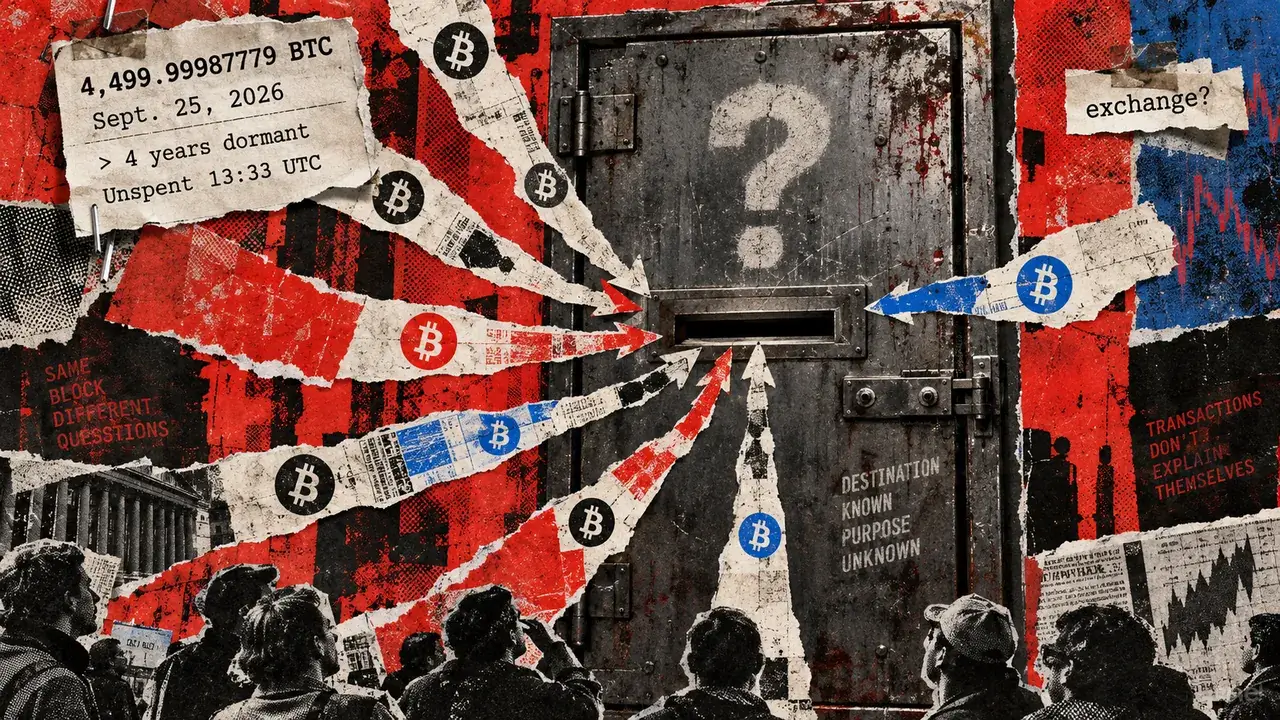
A Bitcoin address sent 4,499.99987779 BTC to a single destination in a transaction confirmed at 02:30:04 UTC on Sept. 25, 2026.
The output was still unspent at a 13:33 UTC check, leaving nearly 4,500 BTC visible at one address after the move.
At Coinbase's BTC/USD low and high of $84,152.88 and $84,882.18 during the 02:00-03:00 UTC hour that included confirmation, the Bitcoin output had an estimated value of about $379 million to $382 million. That price window helps size the transfer.
The transaction spent eight outputs from the source address and created one output at the destination. Its largest input was 4,499.99986261 BTC, received on April 21, 2022. That principal output had not moved for more than four years before the Sept. 25 transaction.
The address wasn't completely inactive during that period. Its transaction history shows seven later deposits, each worth only a few hundred satoshis, between Dec. 30, 2024 and Sept. 11, 2026.
Together they totaled 2,821 satoshis (0.00002821 BTC). The nearly 4,500 BTC principal was long held, while small later Bitcoin payments still reached the address.
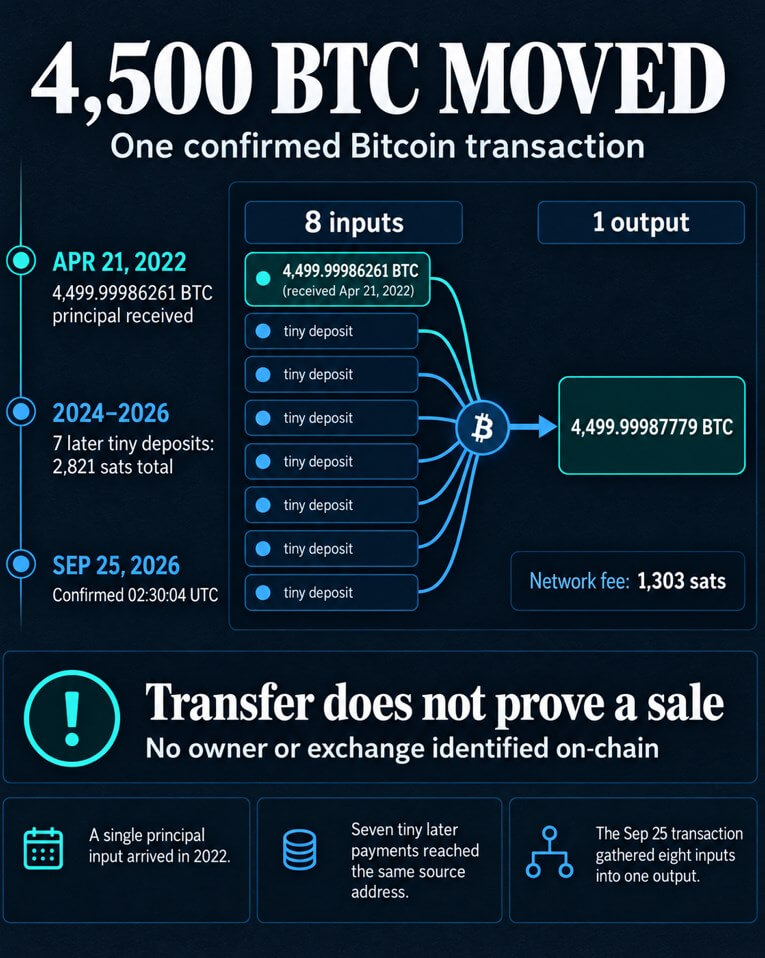
At the 13:33 UTC snapshot, the receiving address had one confirmed incoming Bitcoin output totaling 4,499.99987779 BTC, no spent output, and no mempool transaction. The source address's eight inputs were combined into that single output, with 1,303 satoshis paid as a network fee.
Those records show a confirmed on-chain transfer, but they do not identify who controls the destination. They also do not establish that the address belongs to an exchange, that Bitcoin was sold, that beneficial ownership changed or that an off-chain trade occurred.
A Bitcoin transfer can precede any of those events, yet this transaction alone follows from none.
The balance says nothing about the holder's other wallets or any trades elsewhere, and a later transaction could change it. That is why any claim about the coins' current location needs a time-stamped address check, while any claim about trading needs separate evidence.
Large movements of old coins can draw attention because traders watch for potential supply reaching exchanges. Here, the full output remained at one address at the time of the check, with no visible onward transfer.
A later spend would be observable on Bitcoin's blockchain, but its purpose would still need separate evidence.
The post Dormant whale moves $380M Bitcoin, leaving the sale question unanswered appeared first on CryptoSlate.

Comments (0)
Please sign in to comment.
No comments yet. Be the first to comment.