

On April 9, 2025, Donald Trump told his Truth Social followers that it was “a great time to buy,” then announced a 90-day pause on many of his new tariffs a few hours later. The S&P 500 finished the day 9.5% higher, Bitcoin gained more than 5%, and crypto traders holding short positions lost $374 million as markets repriced a policy change delivered through the president’s social-media account.
The chain of events drew calls for an investigation into whether anyone had traded with advance knowledge, but it also revealed a deceptively simple but potentially very lucrative commercial opportunity. When one account can change the expected prices of imports, oil, government bonds, public-company shares, and Bitcoin, financial companies have a reason to place their software as close to that account as possible.
Trump Media & Technology Group plans to sell that proximity through Truth API, a licensed data feed that the company expects to make available to institutional customers this weekend, Aug. 1. The company says the product will deliver posts from high-ranking Truth Social accounts around the clock, use standard financial-data systems to send the material in milliseconds, and provide an archive reaching back to 2022.
Reuters reported that Trump Media had discussed charging firms as much as $100,000 per month, or $60,000 per month for customers willing to commit for three years. The highest reported price works out to $1.2 million a year, which puts a huge value on the few seconds separating a direct machine feed from a normal phone notification.
Trump makes a post public, then Truth API routes a machine-readable version to paying customers faster than Truth Social’s regular push notifications. So subscribers are essentially buying faster distribution and automated processing rather than drafts, private messages, or advance notice of what Trump plans to say.
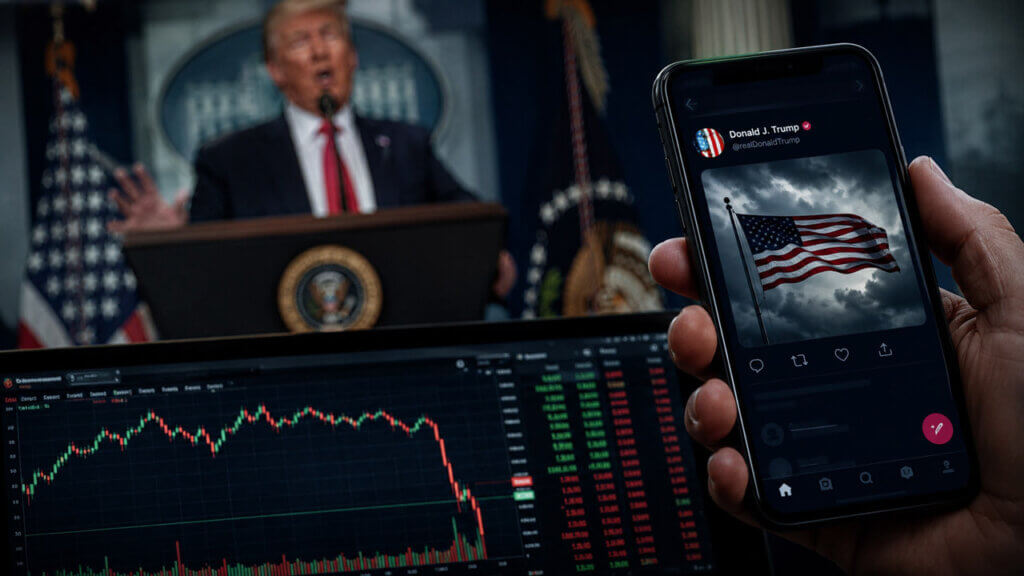
That distinction keeps the announced product within the business of premium financial data (think: Bloomberg). However, the source itself gives it a political and ethical dimension that exchange feeds and economic-data terminals don't usually carry.
A social-media account is the trading infrastructure
A standard Truth Social notification is built for a person who must notice the alert, open the application, read the post, understand its implications, and then decide what to do. An API, on the other hand, is built for software that can receive the text, classify its subject and pass the information to another system without waiting for human attention.
A post mentioning a tariff on China, for example, could reach a bank’s system and trigger several automated steps. Language software identifies the country, the proposed tariff rate and whether the wording describes a threat, a negotiation or a signed decision. A market model maps that information to companies with Chinese supply chains, the dollar, Treasury yields and commodities. Risk software checks the firm’s existing positions, and an execution program sends, changes or cancels orders according to rules established by the trader.
While all of these steps would occur anyway, an API can compress the entire process into milliseconds.
Trump Media says organizations affected by the cost of delayed information are its target customers, with high-frequency and algorithmic trading firms among the best candidates. Axios reported that the initial feed would cover ten accounts belonging to Trump, the White House, and senior administration officials, while the company said it had signed several customers drawn from financial news and high-frequency trading. The Wall Street Journal subsequently reported that at least five companies had subscribed, although none has been publicly identified.
Many large firms already monitor Trump’s posts through their own automated tools or third-party services, which means Truth API enters a market that already exists. Trump Media’s advantage comes from owning the platform and offering an authorized connection that it says will run faster and more reliably than existing software that merely scrapes the public website.
That authorized connection also gives Trump Media control over access, commercial terms, and the historical archive. A live post will certainly create the most visible trade, but older data could also become valuable because companies can use it to train models on how Trump communicates and how markets have reacted.
A useful model would need to distinguish between social media theatre and what amounts to settled policy, measure how frequently a threat becomes an executive action, and account for the market conditions surrounding each announcement. The word “tariff” carries one meaning during a calm market and another when investors are already selling.
Speed therefore becomes valuable only when the software can interpret the message, connect it to the right assets, and control the size of the trade.
Why public information can support a seven-figure contract
Markets move when new information changes expectations about corporate earnings, inflation, interest rates, energy supplies, or economic growth. The first traders to process that change can transact near the old price, while slower participants meet a market that has already adjusted.
Consider a retailer that depends heavily on imported goods. A surprise tariff announcement raises its expected costs, causing automated systems to lower their estimates for future margins and begin selling the shares. By the time ordinary investors receive an alert and understand which companies are exposed, much of the immediate price move may already have happened.
The early trader still faces the risk of misreading the president's post, because a threat could easily be just a negotiating tactic and an announced pause may collapse within hours. The advantage lies in reacting sooner with a controlled position, rather than knowing the final price in advance.
Speed also has defensive value here. A fund managing billions of dollars could use the feed to cancel an order, reduce an exposed position, or buy protection before a market move grows. Avoiding one large loss can justify years of subscription costs, particularly in leveraged markets where a small price change can force a much larger adjustment.
Competition can make the service valuable even when its direct profits are hard to measure. Once rival companies get a faster feed, relying on ordinary notifications creates a persistent delay around every covered account. A subscription then becomes part of the basic cost of remaining competitive, much like direct exchange data, specialist news services, and servers placed close to trading venues.
People familiar with Trump Media’s pricing discussions told Reuters that a timing advantage of only a few milliseconds could generate hundreds of thousands of dollars on sufficiently large trades. So the $100,000 monthly figure reflects the scale of the capital attached to the information, along with the fear of being slower than another firm trading the same headline.
Trump’s posts already behave like macroeconomic releases
Truth API’s pitch depends on Trump’s established ability to move several markets with one post, particularly when the message changes the direction of trade or foreign policy.
On April 7, 2025, Trump gave China one day to withdraw a 34% retaliatory tariff and threatened an additional 50% US levy if Beijing refused. Equity futures dropped, while Bitcoin fell by about $1,000 during the hour following the post and extended its decline from the previous weekend.
Two days later, Trump paused higher reciprocal tariffs on many countries for 90 days while raising the rate applied to China. The S&P 500 gained 9.5% in its strongest trading day since 2008, and CryptoSlate reported that Bitcoin rose more than 5% and briefly crossed $83,000. The crypto rally saw $589.4 million in liquidations, including $374 million from short positions.

The two posts gave traders completely opposite instructions. The first raised the probability of a much bigger trade war, weaker growth, and tighter financial conditions, while the second removed a huge part of that risk and forced investors to rebuild positions they had just reduced.
We saw an even larger cross-market reaction on March 23, 2026, when Trump said the US would postpone planned strikes against Iranian energy infrastructure for five days following what he described as “productive talks.” Oil dropped by more than 13%, US stock futures rose by more than 2%, and Bitcoin climbed from the upper $67,000s through $70,000 within minutes.
When Iran denied that such talks had taken place soon after, markets lost much of the initial move. That reversal is the central challenge for any machine trading presidential language: the first post can move trillions of dollars in implied value, while the response from another government can make the first interpretation obsolete minutes later.
The value of speed therefore extends beyond just receiving Trump’s words. Customers also need systems capable of following the diplomatic response, checking official documents, and deciding whether the market’s first response has gone too far.
Bitcoin makes these reactions especially visible because it trades continuously, including during evenings and weekends when US equities and Treasury markets are closed. A presidential statement released outside regular market hours can reach crypto first, giving Bitcoin the role of an early, volatile gauge of global risk appetite.
The signal is also sensitive to leverage and liquidity inside the crypto market. A modest political headline can produce a large Bitcoin move when derivatives positions are crowded, while a major announcement may fade when traders have already prepared for it. Historical data from the API could help companies estimate which version of the market they are dealing with.
The product depends on a political habit Trump Media can't guarantee
Trump Media owns Truth Social and will receive revenue generated by Truth API, while the president is the largest beneficial owner of the company through the Donald J. Trump Revocable Trust.
Trump Media’s latest annual filing says the trust owns about 41.1% of the company’s voting power and identifies Trump as its sole beneficiary. Donald Trump Jr. serves as the trust’s sole trustee and holds voting and investment authority over its securities.
A successful data business could improve Trump Media’s financial prospects and benefit its shareholders, including the trust. Subscription payments would go to the company rather than directly into Trump’s personal account, although the economic connection remains clear enough for critics to argue that the president is essentially selling a product whose value comes from his official statements.
Trump Media openly describes Truth API as a high-margin recurring revenue stream and says it expects the product to create lasting shareholder value. The commercial loop begins with Trump’s authority as president, runs through the market impact of his posts, and ends with his company charging institutions for faster access to them.
The SEC filing also places an important limit on that business model. Trump’s licensing agreement gives him broad freedom to publish posts he considers political on other social networks, and the company acknowledges that most of his presidential communications may fall within that category. Trump Media may therefore have little recourse if he announces major policy elsewhere.
Truth API’s most valuable source can choose another channel whenever he wishes, which leaves customers paying for speed on a platform whose central political figure is free to move the starting line.
That risk is what makes Trump’s continued behavior part of the product. The API becomes more valuable when he uses Truth Social for original tariff, war, and economic-policy announcements, while simultaneous publication on several platforms could narrow its timing advantage.
The company’s own filing says Trump’s popularity and continued association with Truth Social remain important to its success, reinforcing how closely the commercial product depends on one person’s political communication habits.
The legal issues begin after publication
The fastest route to a public post can feel unfair to ordinary investors, although the announced product fits more closely with paid market-data services than with an insider trading scheme.
Insider trading cases generally concern trading on material non-public information through a breach of duty or misuse of confidential access. Truth API is described as transmitting a post after it becomes public, with paying customers receiving a quicker machine-readable version than regular app users.
That legal analysis would change if selected customers received unpublished posts, if someone traded with advance knowledge of an announcement, or if publication times were manipulated for a favored participant. Public descriptions and reporting on the product have supplied no evidence that Truth API includes those practices.
Trump Media’s defense rests on this publication line. The company says it's licensing public information from its own platform and providing a faster, more reliable alternative to companies that already collect the same data through scraping. Professional investors routinely pay for superior infrastructure, so differences in speed alone rarely establish illegal conduct.
The ethical question is more important here, because the information comes from a serving president discussing government policy on a platform tied to his financial interests.
Rep. Ritchie Torres asked the SEC to examine Truth API before its launch and determine whether it raised securities-law, market-manipulation or investor-protection concerns. He also asked the SEC to coordinate with the CFTC and the Office of Government Ethics, although his letter establishes a request for review rather than an announced investigation or finding of wrongdoing.
Sen. Mark Warner separately urged financial institutions to reject the service, describing it as a troubling form of information asymmetry around government policy. Reuters reported limited interest among large banks, with one bank source saying that buying access to a public official’s policy statements would carry different political risks from purchasing ordinary financial data.
Trump Media responded that critics were pressuring businesses to boycott a lawful product and harm a publicly traded company. That exchange is probably the best way to capture the actual issue rather than loose claims of insider trading: Wall Street already sells speed, while Truth API connects that business directly to a president who generates the underlying information and retains an economic interest in the vendor.
The concern also fits a wider institutional problem that CryptoSlate has examined through Trump’s crypto disclosures. Political decisions and private financial interests have always overlapped, but globally traded digital assets and automated markets can convert an official statement into measurable private value within seconds.
Aug. 1 turns the sales pitch into a test
Trump Media anticipates making Truth API available to institutional customers on Aug. 1, when its promises about speed and commercial demand should become easier to examine.
The first question concerns latency: how much sooner does the API receive a post than the public website, mobile notifications, automated scrapers and major news organizations? A difference measured in milliseconds could matter to high-frequency firms, while a smaller or inconsistent advantage would make the reported price harder to justify.
The account list is also important because Axios described an initial feed covering ten high-ranking accounts rather than an unlimited stream from the whole platform. Customers will need to know how those accounts are selected, how frequently the list changes, and whether Trump’s account remains covered under the same terms.
The market will also provide evidence through order data. Researchers can compare authoritative publication times with the first moves in stocks, futures, currencies, oil and Bitcoin, then test how much price adjustment happens before ordinary notifications arrive. Any responsible analysis will need several events and controls for competing news, since markets can move for many reasons during the same minute.
Trump Media will face its own disclosure test as investors look for customer numbers, contract values, and revenue in future filings. The company says Truth API can become a meaningful recurring business, while its current claims reveal little about the size, duration or cancellation terms of the agreements already signed.
The product’s success will most likely be measurable through changes in behavior rather than technological advances.
Trump can widen the product’s advantage by continuing to make original policy announcements on Truth Social, or narrow it by publishing simultaneously through White House channels and competing platforms.
When the next market-moving post arrives, ordinary investors and institutional machines may eventually receive the same sentence, but they will encounter it through systems built for very different speeds. Truth API will turn the interval between publication and broad human understanding into a commercial product, and the president’s connection to both the message and the vendor will turn it into a question of public trust.
The post Donald Trump releases the $1.2 million data feed that lets Wall Street front-run his market-moving policy announcements appeared first on CryptoSlate.




Comments (0)
Please sign in to comment.
No comments yet. Be the first to comment.