

The Bank of England has committed to remove £368 billion of gilts held for monetary-policy purposes by September 2034, even as the first market response pointed toward easier conditions in long-dated UK debt.
The figure covers the portfolio left after the Bank separated £120 billion of longer-dated gilts to back banknotes. The Monetary Policy Committee said the remaining stock will fall by an average £46 billion a year through bond maturities and £20 billion of annual active sales.
Quantitative tightening shifts bonds from a central bank's balance sheet toward private investors. That can lift the extra yield investors demand to hold longer-dated debt, tightening financial conditions even when the policy rate stays unchanged.
The rate and balance-sheet decisions were separate votes. Six MPC members kept Bank Rate at 3.75%, while Megan Greene, Catherine Mann and Huw Pill preferred an increase to 4%. All nine members backed the multi-year gilt unwind.
Bitcoin and the slow-burn tightening channel
Implementation begins with fewer active sales to the market. The Bank's market notice said APF auctions will pause while it reviews a possible arrangement involving HM Treasury and the Debt Management Office. Operational details are due by April 2027, and the sales-to-Government model remains subject to a final decision. Gilts will continue to mature.
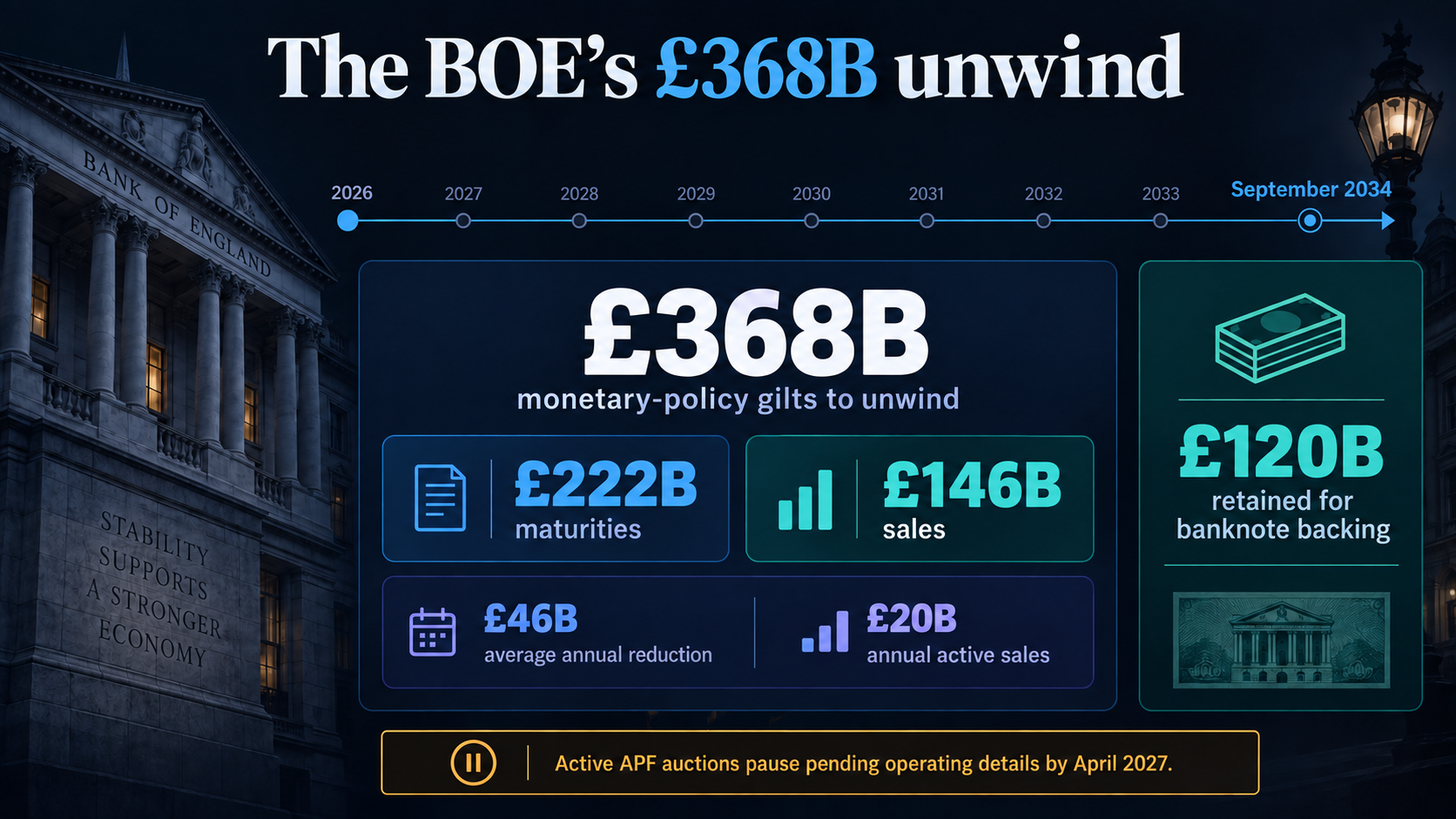
The planned sales pace is close to recent practice. The Bank sold £21 billion over the previous 12 months, compared with £20 billion a year under the new plan. Average total runoff, including maturities, falls to £46 billion from the previous year's £70 billion reduction.
Reuters reported that the 10-year gilt yield fell more than 7 basis points and the 30-year yield nearly 10 basis points by early Thursday afternoon. The Bank's yield-curve data provide the broader rates backdrop, though one trading session cannot identify how much each policy detail contributed.
The BOE also sees the cumulative QT effect as modest. Its July assessment estimated that QT accounted for 20 to 30 basis points of an approximately 200-basis-point rise in long-term gilt term premia since 2022. Global uncertainty, heavy sovereign issuance and structural changes in UK demand explained most of the increase.
Bitcoin's connection runs through the same broad rates and risk-appetite channel. IMF research found that US monetary tightening can depress a common crypto-market factor. The finding concerns US shocks, so it offers a limited analogy for the BOE plan rather than evidence of a UK-driven Bitcoin move. Earlier CryptoSlate analysis similarly described the opposing pressures from tighter liquidity and demand for assets outside sovereign finance.
Bitcoin traded near $78,000 on CryptoSlate on Friday, with Coinbase showing a similar level. Both were rolling snapshots and cannot isolate a reaction to Thursday's announcement.
The BOE's decision therefore creates a long-run test: whether predictable central-bank withdrawal adds enough pressure to global yields and risk appetite to reach Bitcoin, while the auction pause and falling gilt yields make the first response comparatively mild.
The post Bitcoin faces an eight-year rates test as the BOE unwinds £368 billion appeared first on CryptoSlate.




Comments (0)
Please sign in to comment.
No comments yet. Be the first to comment.