How One Interest Rate Decision Moves the Entire Economy?
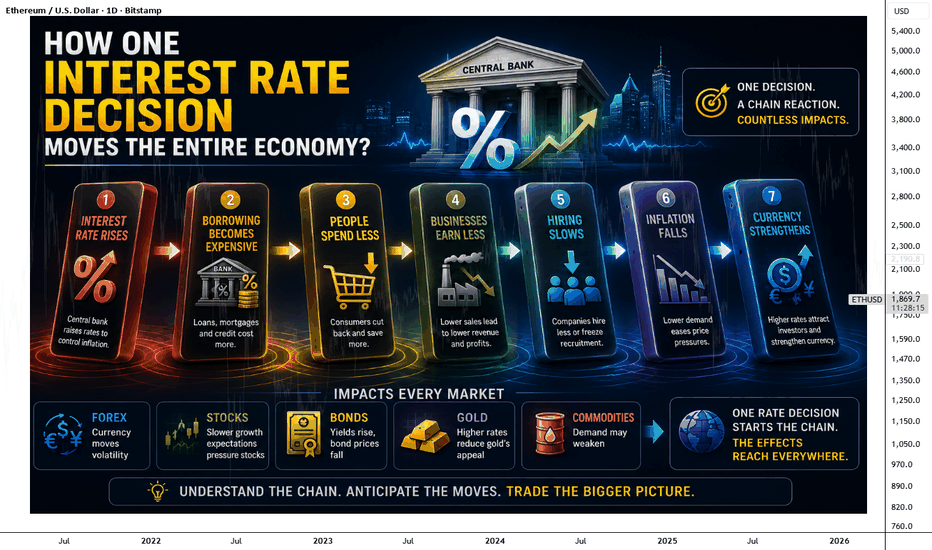
The Domino Effect of Interest Rates:
Most traders know that interest rate announcements can move the market, but very few understand why they have such a powerful impact. An interest rate decision does not only affect banks or currencies. It creates a chain reaction that spreads through the entire economy. Just like a row of dominoes, one small action can trigger a series of events, with each event leading to another. By understanding this chain reaction, traders can better understand why markets behave the way they do.
The First Domino
Every chain reaction begins with a single domino, and in the economy, that first domino is the central bank. Institutions such as the Federal Reserve or the European Central Bank change interest rates to keep the economy balanced. If inflation is rising too quickly, they usually increase interest rates to slow spending. If the economy is weak, they lower interest rates to encourage borrowing and investment.
Although changing an interest rate may seem like a simple decision, it is often the starting point of much larger economic changes. One announcement from a central bank can influence millions of people, thousands of businesses, and financial markets around the world.
Borrowing Becomes More Expensive
When interest rates rise, borrowing money becomes more expensive. Banks charge higher interest on mortgages, business loans, and personal loans, which means people have to pay more to borrow the same amount of money. Businesses also face higher financing costs when they want to expand or invest in new projects.
Because borrowing is no longer as affordable, both consumers and businesses become more cautious with their money. This is the second domino in the chain, and it begins slowing economic activity.
Consumer Spending Slows
As loans become more expensive, people naturally begin spending less. Some families delay buying a new home, others postpone purchasing a new car, and many reduce spending on non-essential items. Instead of taking on new debt, they focus more on saving and managing their finances carefully.
When millions of people make these decisions at the same time, overall demand in the economy starts to decline. Businesses begin noticing fewer customers and lower sales, even though nothing has changed about their products.
Businesses Feel the Impact
Businesses rely on consumer spending to generate revenue. When customers spend less, companies often experience slower sales and lower profits. Expansion plans may be delayed, investments may be reduced, and companies become more careful about their future decisions.
This slowdown is not because businesses suddenly become less efficient. It is simply a result of fewer people buying goods and services. The effects of higher interest rates have now spread from consumers to businesses.
Hiring Begins to Slow
As businesses earn less, they also become more cautious about hiring new employees. Instead of expanding their workforce, many companies decide to freeze recruitment until economic conditions improve. Some businesses may even reduce staff to lower their operating costs.
With fewer job opportunities available, income growth across the economy begins to slow. This causes consumers to spend even less, allowing the domino effect to continue.
Inflation Starts to Fall
One of the main reasons central banks raise interest rates is to reduce inflation. When borrowing decreases and spending slows, demand for goods and services begins to fall. Since fewer customers are competing to buy the same products, businesses find it harder to keep increasing prices.
This gradual reduction in demand helps bring inflation back under control. Although the process can take several months, it is the outcome central banks are trying to achieve when they increase interest rates.
The Currency Becomes Stronger
Higher interest rates often attract foreign investors because they can earn better returns on savings and government bonds. Before investing, these investors need to buy the country's currency, increasing demand for it in the foreign exchange market.
As demand for the currency increases, its value often rises against other currencies. This is one of the main reasons why Forex traders pay close attention to every interest rate decision made by central banks.
My Thoughts:
An interest rate decision is much more than a number announced by a central bank. It is the first domino in a long chain of economic events. Higher rates make borrowing more expensive; expensive borrowing reduces spending; lower spending affects businesses, businesses slow hiring, inflation begins to cool, and currencies often become stronger. Every step leads naturally to the next.
The next time you hear that a central bank has changed interest rates, don't just focus on the immediate market reaction. Instead, think about the entire chain of events that has just begun. Understanding the domino effect can help you understand not only today's market movement, but also the economic story that will continue unfolding in the weeks and months ahead.
By @BrightRally_Research on @TradingView