Adobe: Finally a Rebound for the Software Sector?
ADOBE shares have fallen by more than 70% from their all-time high reached in November 2021, making them one of the worst-performing stocks in the S&P 500. Yet Adobe remains a cash-generating powerhouse within the technology and software industry.
So, what happened? Has the stock suffered from investors rotating toward AI-related companies? And now, after a 70% decline, does the recent short-term rebound represent an investment opportunity?
To answer these questions, I will analyze the following aspects:
• Fundamentals, including the company's valuation.
• Technical analysis based on long-term charts.
The chart below shows the monthly Japanese candlesticks for ADOBE stock. The share price has fallen by more than 70% since its record high in November 2021. The monthly RSI indicator has returned to a major long-term support level.

In reality, Adobe has been the victim of a profound shift in investor sentiment. The explosion of generative artificial intelligence led the market to favor semiconductor giants, cloud infrastructure providers, and data center companies, to the detriment of highly profitable software publishers. Concerns about the emergence of new AI-powered competitors have also fueled doubts about Adobe's ability to maintain its long-standing leadership in digital creativity.
Nevertheless, the company's fundamentals remain exceptionally strong. Its subscription-based business model generates recurring revenue, high operating margins, and substantial free cash flow. More importantly, Adobe has progressively integrated artificial intelligence features across its Creative Cloud suite and enterprise solutions, aiming to turn this technological disruption into a growth driver rather than a threat.
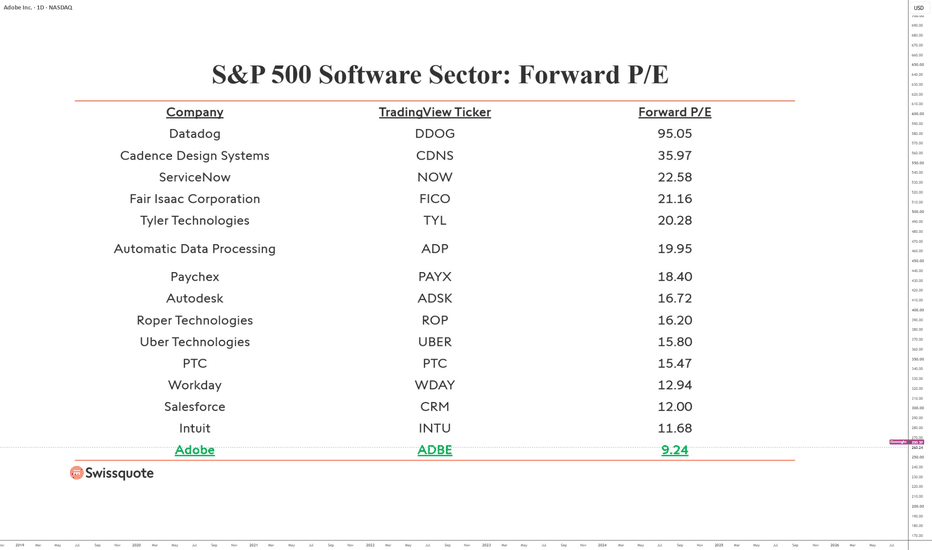
From a valuation perspective, Adobe's decline over the past five years clearly represents an opportunity, with the lowest forward P/E ratio in the software industry.
The table below ranks S&P 500 software companies based on their forward P/E valuation. Adobe is the cheapest stock in the sector according to this metric.
The key question now is whether the market is beginning to re-rate the software sector after several years of underperformance. If future earnings continue to confirm accelerating growth and AI monetization, Adobe could benefit from renewed investor interest in high-quality technology companies that have long been overlooked in favor of AI infrastructure plays.
From a technical analysis perspective, the stock would need to move back above the weekly Ichimoku Cloud to confirm the end of the bear market and validate a bullish trend reversal.
The chart below shows the weekly Japanese candlesticks for ADOBE, together with the Ichimoku system and the valuation indicators represented by the P/E ratio and the Price-to-Sales ratio. According to both valuation metrics, Adobe has returned to a major long-term valuation support level.
DISCLAIMER:
This content is intended for individuals who are familiar with financial markets and instruments and is for information purposes only. The presented idea (including market commentary, market data and observations) is not a work product of any research department of Swissquote or its affiliates. This material is intended to highlight market action and does not constitute investment, legal or tax advice. If you are a retail investor or lack experience in trading complex financial products, it is advisable to seek professional advice from licensed advisor before making any financial decisions.
This content is not intended to manipulate the market or encourage any specific financial behavior.
Swissquote makes no representation or warranty as to the quality, completeness, accuracy, comprehensiveness or non-infringement of such content. The views expressed are those of the consultant and are provided for educational purposes only. Any information provided relating to a product or market should not be construed as recommending an investment strategy or transaction. Past performance is not a guarantee of future results.
Swissquote and its employees and representatives shall in no event be held liable for any damages or losses arising directly or indirectly from decisions made on the basis of this content.
The use of any third-party brands or trademarks is for information only and does not imply endorsement by Swissquote, or that the trademark owner has authorised Swissquote to promote its products or services.
Swissquote is the marketing brand for the activities of Swissquote Bank Ltd (Switzerland) regulated by FINMA, Swissquote Capital Markets Limited regulated by CySEC (Cyprus), Swissquote Bank Europe SA (Luxembourg) regulated by the CSSF, Swissquote Ltd (UK) regulated by the FCA, Swissquote Financial Services (Malta) Ltd regulated by the Malta Financial Services Authority, Swissquote MEA Ltd. (UAE) regulated by the Dubai Financial Services Authority, Swissquote Pte Ltd (Singapore) regulated by the Monetary Authority of Singapore, Swissquote Asia Limited (Hong Kong) licensed by the Hong Kong Securities and Futures Commission (SFC) and Swissquote South Africa (Pty) Ltd supervised by the FSCA.
Products and services of Swissquote are only intended for those permitted to receive them under local law.
All investments carry a degree of risk. The risk of loss in trading or holding financial instruments can be substantial. The value of financial instruments, including but not limited to stocks, bonds, cryptocurrencies, and other assets, can fluctuate both upwards and downwards. There is a significant risk of financial loss when buying, selling, holding, staking, or investing in these instruments. SQBE makes no recommendations regarding any specific investment, transaction, or the use of any particular investment strategy.
CFDs are complex instruments and come with a high risk of losing money rapidly due to leverage. The vast majority of retail client accounts suffer capital losses when trading in CFDs. You should consider whether you understand how CFDs work and whether you can afford to take the high risk of losing your money.
Digital Assets are unregulated in most countries and consumer protection rules may not apply. As highly volatile speculative investments, Digital Assets are not suitable for investors without a high-risk tolerance. Make sure you understand each Digital Asset before you trade.
Cryptocurrencies are not considered legal tender in some jurisdictions and are subject to regulatory uncertainties.
The use of Internet-based systems can involve high risks, including, but not limited to, fraud, cyber-attacks, network and communication failures, as well as identity theft and phishing attacks related to crypto-assets.