
Why Breakouts Need a Retest
One of the most common mistakes traders make is believing that a breakout is the signal to chase the market.
Price finally breaks above resistance, momentum accelerates, and buyers rush in, expecting the trend to continue without looking back. While that sometimes happens, experienced traders know that the breakout itself is often only the beginning of the story.
The real test usually comes afterward.
Markets frequently return to the breakout level before continuing higher. This move is known as a retest, and it is one of the most important concepts in technical analysis because it helps distinguish genuine breakouts from false ones.
Think about what resistance represents.
Every time price reaches the same level and fails to move higher, sellers prove they are willing to defend that area. Over time, repeated rejections strengthen the significance of that level. Eventually, buying pressure becomes strong enough to absorb the available supply, and price finally breaks through.
At that moment, many traders assume the breakout has already been confirmed.
In reality, confirmation often comes only after price revisits the breakout area.
If buyers successfully defend the former resistance and prevent price from falling back below it, the market sends an important message: the level has changed its role. What once acted as resistance is now functioning as support. This shift in market structure is one of the clearest signs that buyers remain in control.
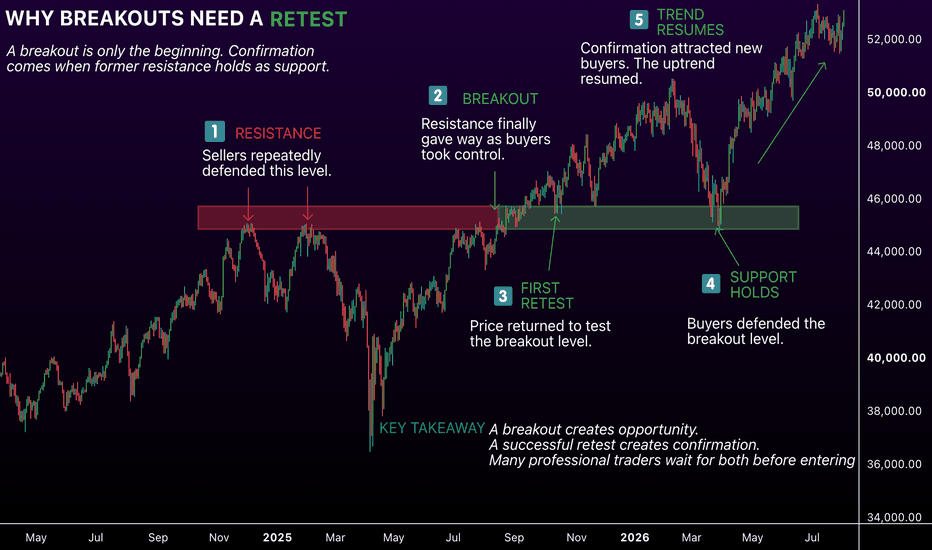
The chart above illustrates this process using the US30 (Dow Jones Industrial Average).
Price spent months struggling beneath a well-defined resistance zone before eventually breaking higher. Rather than continuing in a straight line, the market returned to test the breakout level. Buyers stepped in, defended the area, and prevented a deeper pullback. Only after that confirmation did the uptrend resume, leading to fresh highs.
Of course, not every breakout behaves this way. Some trends continue without offering a clean retest, while others fail completely and fall back below resistance. That is exactly why patience matters. Waiting for confirmation may mean missing the very first part of a move, but it can also help traders avoid chasing false breakouts and entering positions with poorly defined risk.
No pattern guarantees success, and every market behaves differently. However, understanding the relationship between breakouts and retests can improve decision-making by encouraging traders to wait for evidence rather than acting purely on emotion.
Instead of asking whether resistance has been broken, consider asking a different question:
Has the market confirmed the breakout yet?
Sometimes the highest-probability opportunity isn't the breakout itself—it's the retest that proves the breakout was real.
Question for discussion:
Do you usually buy the breakout, or do you prefer waiting for the retest before entering a trade?
