UAMY Setup
Integrated thesis
Stage 1 Explosion Thesis: UAMY’s real five-year Defense Logistics Agency antimony contract, operating North American smelters, strategic-material scarcity, and renewed government policy support can reactivate the former runner from a deeply reset valuation and chart base.
The contract is worth up to $245 million and is a sole-source five-year agreement to provide antimony metal for the national defense stockpile. The maximum contract amount is not guaranteed recognized revenue, but it is materially stronger evidence than a memorandum or exploratory project.
The broader theme strengthened after Stage 1. Current reporting described accelerating U.S. efforts to secure minerals required for weapons and defense systems, while a July 30 executive action sought to retain critical-mineral-bearing scrap inside the United States. A countervailing risk is that hedge funds have increased bearish bets against parts of the government-backed critical-mineral sector because of financing, execution, and China-competition concerns.
Situation and flow
Current move phase: Former-runner reactivation from a capitulation base.
Best-fitting strategy: Contract repricing plus critical-mineral policy continuation plus failed-breakdown recovery.
Credibility: Stronger than most early-stage mineral runners. UAMY has operating smelting facilities and an existing government contract. The business remains capital intensive, and equity financing has been used repeatedly, but it is not simply an undeveloped exploration narrative.
Current likely supply: Approximately 148 million basic shares, prior ATM issuance, recent equity financing, and trapped holders accumulated during the decline from $12–$13.
Expected demand: Critical-mineral and defense-theme traders initially; longer-horizon strategic-material investors if contract deliveries and plant expansion translate into stronger revenue.
Demand absorption: Demand probably exceeds immediate supply below approximately $6.50, but the balance becomes less favorable near $7.80–$8.20 because of the falling long-term moving average and trapped-holder inventory.
Attention: Stocktwits showed approximately 96.8% bullish posts but only low normalized immediate message volume, roughly 20,000 watchers, and a trending rank around 17. That is favorable because the narrative is active without being as crowded as BLZE.
Short contribution: Current borrow cost and short interest could not be verified. Sector shorting may add future covering demand, but it was not included as a core probability input.
Daily and 1-hour structure
The Daily chart remains beneath its longer-term falling moving average and therefore has not completed a full trend reversal. However, the current trade does not require a complete Daily bull market.
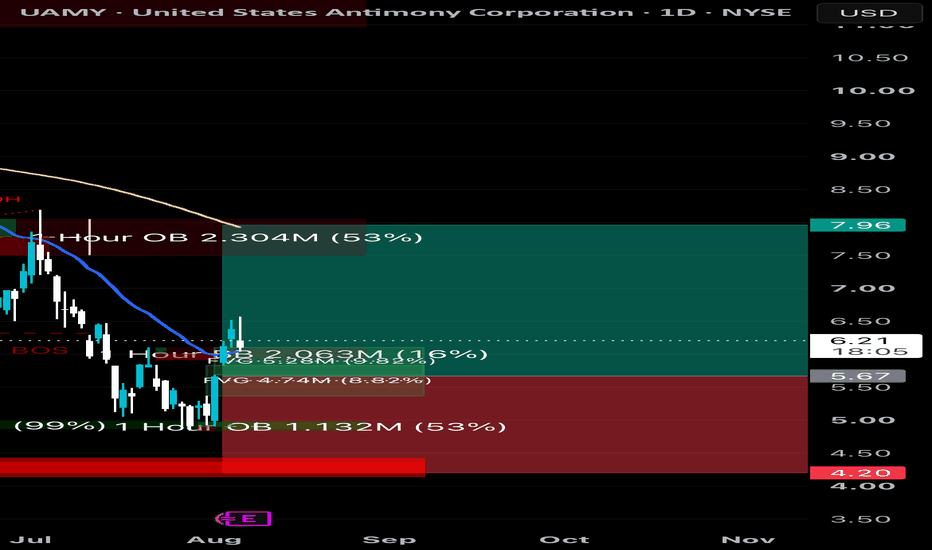
The controlling structure is the January-to-August decline into a broad demand region extending approximately from $4.25 to $5.00. Price repeatedly tested this region, failed to produce sustained continuation downward, and today displaced from $4.90 to $5.68 while closing close to the high.
Important evidence includes:
* A failed breakdown beneath the recent $5 area
* Strong hourly displacement through $5.35 and $5.50
* The heaviest buying appearing late in the session rather than only at the open
* Hourly price holding above the approximately $5.46 session VWAP
* A current challenge of local supply around $5.65–$6.10
* Larger 1-hour resistance around $6.30–$6.70
* Major combined Daily/1-hour supply around $7.70–$8.20
Stop frameworks considered
Local tactical invalidation: Approximately $4.85–$4.90. Rejected because it sits directly beneath today’s low and the obvious recent liquidity pool. A routine sweep could hit it while the broad demand region remains intact.
Combined Daily/1-hour invalidation: $4.38, selected. This lies beneath the recent hourly base and near the lower edge of the broad demand shelf. A sustained loss of $4.38 would demonstrate that today’s failed-breakdown recovery had failed and that demand could not defend the catalyst-cycle base.
Deep Daily invalidation: Approximately $1.85–$2.10. Rejected because it belongs to a much longer positional thesis and would be disproportionate to the realistic $7.80 target.
Targets considered
Near target: Approximately $6.25–$6.50. Rejected because the percentage reward is insufficient relative to a legitimate structural stop.
Major target: $7.80, selected. This corresponds with a prior breakdown shelf, a large 1-hour supply/order-block area, and the approaching declining long-term moving average.
Explosive target: Approximately $11.50–$12.80. Rejected because it requires absorption of a much larger trapped-holder block and probably needs a new company-specific contract, earnings, or production catalyst.
Intermediate-resistance absorption
The route to $7.80 crosses:
1. $5.65–$6.10 local supply
2. Approximately $6.30–$6.70 hourly imbalance and former support
3. Approximately $7.20–$7.80 trapped-holder and moving-average supply