Why Price Hesitates Before a Major Move
One of the most common questions traders ask is:
"Why does the market pause before making a big move?"
You identify a strong trend.
Price approaches an important level.
Everything looks ready for a breakout.
But instead of moving decisively, the market slows down.
Candles become smaller.
Momentum fades.
Price starts moving sideways.
Many traders become frustrated during these periods. Some enter too early, expecting the breakout to happen immediately. Others assume the trend is over and exit their positions.
Yet these moments of hesitation often tell us something important.
They reveal that the market is preparing for its next decision.
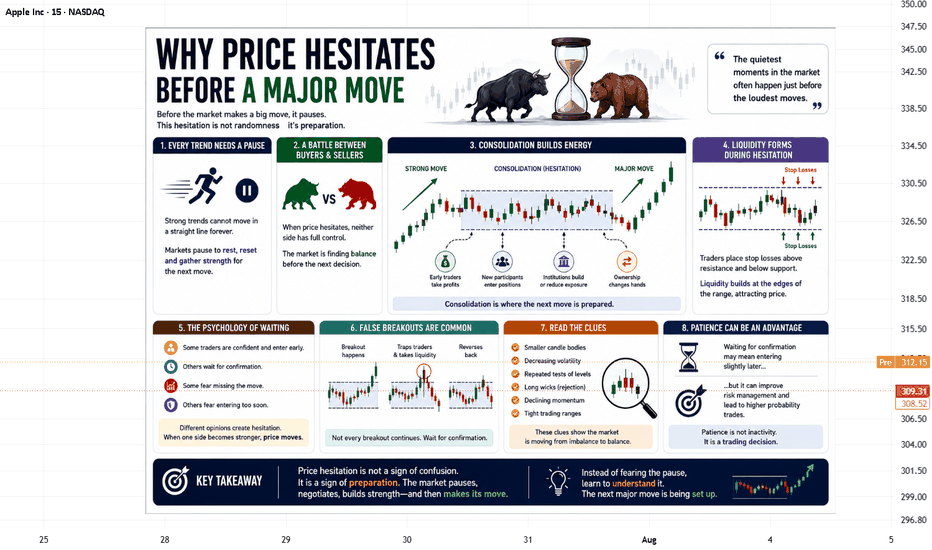
Every Trend Needs a Pause
No market moves in a straight line forever.
Even the strongest trends need time to pause.
Think of a marathon runner.
They cannot sprint for the entire race without slowing down to manage their energy.
Markets behave in a similar way.
After a strong rally, buyers begin taking profits.
Some traders who missed the move hesitate to buy at higher prices.
Sellers test whether demand is weakening.
The result is a temporary balance between buyers and sellers.
Price stops trending and begins consolidating.
This pause doesn't necessarily signal weakness.
Often, it is simply the market catching its breath.
A Battle Between Buyers and Sellers
When price hesitates, it usually means neither side has complete control.
Buyers still believe the trend can continue.
Sellers believe the move has gone too far.
Both groups become active around the same price area.
This creates smaller candles, overlapping price action, and slower momentum.
The market is searching for a new balance.
Eventually, one side gains the upper hand.
That is when the next major move begins.
Consolidation Builds Energy
Many traders dislike sideways markets because they appear unproductive.
In reality, consolidation can be one of the most important phases of a trend.
During consolidation:
- Early traders take profits.
- New participants enter positions.
- Institutions gradually build or reduce exposure.
- Buyers and sellers exchange ownership.
-
The longer the market remains balanced, the more significant the breakout can become once that balance is broken.
Liquidity Often Forms During Hesitation
Sideways markets also attract liquidity.
As price moves within a narrow range, traders begin placing stop losses above resistance and below support.
Breakout traders prepare for a move in either direction.
Swing traders defend their existing positions.
Over time, a large number of orders gather around the edges of the range.
These areas become attractive to the market because they contain liquidity.
This is one reason price may briefly move beyond the range before revealing its true direction.
The Psychology of Waiting
Not every trader is acting at the same time.
Some traders are confident and enter early.
Others wait for confirmation.
Some fear missing the move.
Others fear entering too soon.
This difference in behavior creates hesitation.
The market slows because participants are making different decisions based on the same information.
Eventually, one opinion becomes stronger than the other.
The balance shifts.
Price responds.
Why False Breakouts Are Common
A market that has been consolidating for a long time attracts attention.
Everyone begins watching the same support and resistance levels.
When price finally breaks out, many traders enter immediately.
But not every breakout continues.
Sometimes price briefly moves beyond the range, triggers stop losses and breakout orders, and then reverses.
This is why experienced traders often focus on confirmation rather than excitement.
The first move isn't always the real move.
Reading the Clues
Price hesitation is not random.
It often leaves clues about the market's condition.
Watch for:
- Smaller candle bodies
- Decreasing volatility
- Repeated tests of support or resistance
- Long wicks showing rejection
- Declining momentum
- Tight trading ranges
These signals suggest the market is moving from imbalance toward balance.
The next question becomes:
Which side will win the battle?
Patience Can Be an Advantage
Many traders feel uncomfortable when the market slows down.
They believe they always need to be in a trade.
Professional traders often think differently.
Sometimes, the highest-probability trade is the one that comes after the market finishes hesitating.
Waiting for confirmation may mean entering slightly later.
But it can also reduce emotional decisions and improve risk management.
Patience is not inactivity.
It is a trading decision.
Final Thoughts
Price hesitation is not a sign that the market is confused.
It is often a sign that buyers and sellers are negotiating value.
During these periods, positions change hands.
Liquidity builds.
Confidence shifts.
The market prepares for its next move.
Instead of seeing consolidation as wasted time, try viewing it as an important chapter in the story of price.
Because major trends rarely begin without first passing through a period of uncertainty.
And sometimes, the quietest candles appear just before the loudest move.