Chandelier Exit: Concept, Mechanics, and Strategic Insights
● 📊 Overview and Conceptual Origin
- The Chandelier Exit stands among the most enduring volatility-based trailing stop methodologies in modern technical analysis, conceived by Chuck Le Beau, a systems developer whose entire professional identity was built around a single, often-neglected question in trading literature: not how to enter a position, but how to remain in a winning trade without surrendering it prematurely to the market's natural noise. Le Beau's work was later popularized to a broader trading audience through Alexander Elder's writings, which situated the Chandelier Exit within a larger philosophy of disciplined trade management rather than treating it as a standalone entry signal.
- The naming convention itself is deliberately evocative. Le Beau conceived of the stop level as something suspended from a fixed point above, much as a chandelier hangs from a ceiling, descending only as far as structural volatility dictates rather than being nailed to an arbitrary fixed distance from the entry price. This metaphor carries real analytical weight, because it encodes the core philosophical departure this method makes from earlier, cruder stop-loss conventions that relied on fixed percentage moves or arbitrary point counts irrespective of the instrument's actual behavior.
- At its economic root, the Chandelier Exit exists because markets do not move at constant velocity or constant amplitude. A stop-loss distance appropriate for a quiet, low-volatility instrument will be tragically insufficient for a violently trending one, and vice versa. The indicator's genius lies in outsourcing the decision of "how far is far enough" to the market itself, via the Average True Range, rather than to the trader's intuition or an arbitrary convention borrowed from an unrelated instrument or timeframe.
● 📉 Narrative Technical Analysis
- Structurally, the Chandelier Exit is built from three interacting components: a lookback period that defines a structural extreme (the highest high for long positions or the lowest low for short positions), a volatility measurement derived from the Average True Range calculated over that same lookback window, and a multiplier that scales the distance between the structural extreme and the resulting stop line. The long stop is calculated by subtracting the ATR multiple from the highest high achieved within the lookback window, while the short stop is calculated by adding the ATR multiple to the lowest low within that same window.
- What separates this from a naive trailing stop is the behavior of the structural anchor itself. The highest high used in the calculation is a ratcheting reference; it can only move upward as new extremes are printed, never downward, which means the resulting stop line inherits this one-directional bias. In an uptrend, the Chandelier line rises in staircase fashion each time a fresh high is registered, but during subsequent consolidation or pullback it holds steady rather than retreating, since the highest high anchor itself hasn't been violated. This creates an asymmetric protective mechanism that tightens naturally as the trend matures without ever loosening on its own.
- Consolidation box mapping becomes a particularly relevant lens through which to view Chandelier Exit behavior. During range-bound conditions, the highest high and lowest low anchors oscillate within a compressed structural corridor, and because ATR values compress alongside price during genuine consolidation, the resulting stop distance narrows considerably. This narrowing is a double-edged narrative: it protects capital more tightly during indecisive price action, but it simultaneously raises the probability of a premature stop-out on a volatility spike that occurs before a decisive breakout confirms direction.
- Volume profile anomalies interact with the Chandelier framework in a more indirect but still meaningful way. When price marks a new structural high on conspicuously thin volume, the resulting upward shift in the Chandelier anchor may reflect a fragile extension of the trend rather than genuine accumulation-driven strength, meaning the trailing stop is being recalculated against a high that lacks the participation to be considered structurally significant. Traders who layer volume-based context atop the raw Chandelier calculation are, in effect, asking whether the ratcheting anchor deserves the confidence the indicator implicitly grants it.
- Structural regression milestones, in the sense of identifying where price has decisively broken from its prior directional channel, tend to coincide with Chandelier Exit violations more often than with arbitrary support and resistance breaks, precisely because the indicator's ATR-scaled distance is calibrated to the instrument's own historical behavior rather than to a subjectively drawn trendline. This gives the Chandelier violation a certain statistical legitimacy that discretionary structural analysis alone cannot always claim.
● 🏛️ Institutional vs. Retail Perspective
- Institutional desks that incorporate ATR-based trailing mechanisms tend to view them as one input within a broader portfolio-level risk management architecture, where position sizing, correlation exposure across a book, and liquidity constraints on exit execution are all weighed simultaneously alongside the raw stop calculation. For a desk managing significant size, the Chandelier Exit's structural high or low anchor is rarely acted upon mechanically; instead it serves as an alert threshold that triggers a broader review of the trade thesis, since unwinding a large position instantaneously at a single stop trigger can itself move the market against the very exit being sought.
- Retail participants, by contrast, frequently adopt the Chandelier Exit as a literal, mechanical exit signal precisely because its calculation is transparent and its logic is intuitively graspable without requiring access to order flow data or institutional-grade execution infrastructure. This democratization is part of its appeal, but it also means retail application often strips away the contextual judgment that a professional desk would layer on top, applying the indicator with a rigidity its own designer likely never intended for illiquid or thinly traded instruments.
- A further asymmetry exists in how each participant class treats the multiplier setting. Institutional risk frameworks tend to derive their ATR multiplier from historical drawdown tolerance calibrated against the specific instrument and strategy, essentially reverse-engineering the multiplier from an acceptable capital-at-risk figure. Retail traders, absent this rigorous calibration process, more commonly adopt the default multiplier settings popularized in retail-facing platforms and educational material, without necessarily validating whether that default is appropriate for the volatility regime of the specific instrument being traded.
- The two groups also diverge meaningfully in their tolerance for whipsaw. Institutional participants, often operating with longer holding horizons and more diversified exposure, can absorb an occasional premature stop-out as a cost of doing business within a broader statistical edge. Retail traders, frequently under-capitalized relative to the position sizes they run, experience the same whipsaw event as a disproportionately damaging blow to both account equity and psychological composure, which materially changes how the same technical signal is subjectively experienced by each class of participant.
● ⚙️ Strategic Variance Across Market Regimes
- In a genuinely trending regime, the Chandelier Exit performs closest to its conceptual ideal. Directional persistence with only shallow counter-trend retracements allows the ratcheting structural anchor to advance steadily, and the ATR-scaled buffer is generally sufficient to absorb the retracements without triggering an exit, letting the position capture the bulk of the extended directional move that Le Beau originally designed the tool to protect.
- In a ranging or sideways regime, the calculus shifts unfavorably. The absence of a decisive structural extreme means the highest high and lowest low anchors oscillate within a narrow band, and because the underlying ATR compresses during range conditions, the resulting stop distance can become uncomfortably tight relative to the essentially random, non-directional price churn characteristic of consolidation. This is the regime in which the Chandelier Exit is most prone to generating a string of frustrating, low-conviction stop-outs.
- High-volatility regimes, particularly abrupt volatility expansions following a period of compression, introduce a distinct kind of strategic tension. The ATR component of the calculation is inherently lagging, since it is derived from realized price ranges over a historical lookback window rather than from any forward-looking volatility estimate. This means that in the earliest phase of a volatility spike, the Chandelier stop distance may not yet have widened sufficiently to reflect the new regime, exposing the position to an outsized adverse excursion before the indicator's own protective buffer catches up to the changed conditions.
- The choice of lookback period and multiplier therefore cannot be treated as a static, set-and-forget decision if the trader intends to operate across multiple regimes. A parameter set calibrated for trending behavior in one volatility environment may prove poorly suited to a market that transitions abruptly into consolidation or into a volatility shock, which is why many experienced practitioners treat the underlying settings as something to be periodically reassessed against the prevailing character of the instrument being traded, rather than as a permanent, universal constant.
● 🧠 Psychological Architecture
- The Chandelier Exit's deeper value is arguably psychological rather than purely mathematical, because it externalizes a decision that traders are notoriously unreliable at making under emotional pressure: when, precisely, to relinquish a position that has moved favorably. Left to discretionary judgment in the heat of an open trade, most traders exhibit a well-documented tendency toward loss aversion, where the psychological discomfort of realizing a smaller profit than a peak unrealized gain becomes distorted into an irrational reluctance to exit at all, hoping the peak will return.
- Because the Chandelier line is calculated mechanically from objective price and volatility data, it removes the trader from the moment-to-moment temptation to rationalize holding past a legitimate structural signal. This is not a minor convenience; it addresses one of the most consistently destructive behavioral patterns identified across trading psychology literature, namely the asymmetric emotional weighting between gains and losses that causes traders to cut winners short while letting losers run, precisely the inverse of sound risk management.
- There is a subtler cognitive trap embedded in the tool's very reliability, however. Traders who become accustomed to a mechanical exit signal can develop an over-reliance that substitutes for genuine trade management judgment, treating every Chandelier violation as an automatic, unquestionable signal to exit regardless of the broader context, such as an earnings event, a macro catalyst, or a liquidity gap that might warrant a different response than the indicator alone would suggest. Discipline without discernment can itself become a liability.
- The staircase-like, one-directional nature of the ratcheting anchor also produces a specific psychological phenomenon worth naming directly: as the stop level locks in progressively higher floors during a strong uptrend, the trader experiences a gradual transformation of the position from "at risk" to "increasingly protected," which can foster a healthier emotional detachment from the outcome of any single trade, since the worst-case scenario becomes better defined and less catastrophic with each incremental advance of the trailing stop.
● 🎲 Risk and Probability Sagas
- Every trailing stop methodology, the Chandelier Exit included, is fundamentally a wager on the trade-off between premature exit risk and excessive drawdown risk, and no parameter configuration can eliminate this tension entirely; it can only shift where along that spectrum the trader chooses to sit. A tighter multiplier reduces the capital surrendered in any single failed trade but increases the frequency with which genuinely valid trends are prematurely abandoned, while a wider multiplier does the reverse, sacrificing more capital per failure in exchange for a higher probability of remaining in a trade through its full potential extension.
- The philosophical foundation of this trade-off rests on an acceptance that no individual stop placement decision can be judged as correct or incorrect in isolation. A stop that is triggered immediately before a dramatic reversal in the trader's favor was not, in retrospect, a poor decision merely because that particular outcome occurred; probabilistic thinking in trading requires evaluating the expected value of a rule applied consistently across a large sample of occurrences, rather than judging the rule by any single instance of hindsight-driven regret.
- This distinction between outcome and process is where much of the enduring difficulty in adopting any systematic exit methodology resides. A trader who evaluates the Chandelier Exit, or any comparable framework, purely on the basis of its most recent result is engaging in a fundamentally different cognitive exercise than one who evaluates it on the basis of its long-run statistical behavior across varied market regimes, and only the latter approach is philosophically coherent with how probability actually governs trading outcomes over time.
- Position sizing considerations remain inseparable from the stop-distance question, since the same ATR-derived stop distance implies a dramatically different capital-at-risk figure depending on how many units, shares, or contracts are committed to the position. A trader who calculates the Chandelier stop distance correctly but then sizes the position without reference to that distance has effectively rendered the entire risk framework meaningless, because the quantitative discipline embedded in the stop calculation is only as protective as the position sizing decision that accompanies it.
- Ultimately, the Chandelier Exit should be understood not as a predictive tool promising any particular win rate or performance outcome, but as a disciplined framework for managing the unavoidable uncertainty inherent in any position held over time. Its value lies entirely in the consistency of its application and the behavioral discipline it imposes, not in any claim about future market behavior, which by its nature remains fundamentally unknowable regardless of how sophisticated the underlying volatility calculation may be.
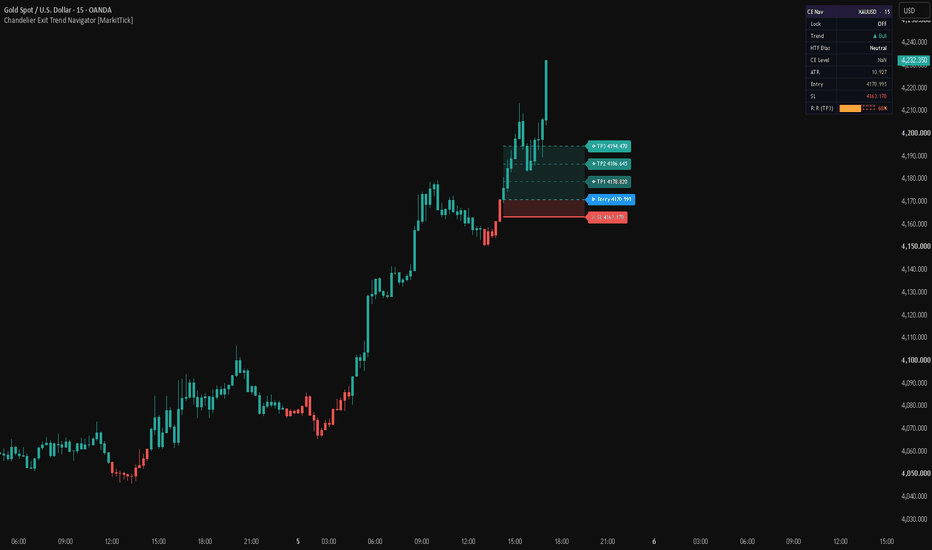
Based on the concepts previously discussed, the Chandelier Exit Trend Navigator indicator was developed to reflect the academic and technical principles outlined in this article.
● ⚠️ Risk Warning
- Trading and investing involve substantial risk of loss and are not suitable for every investor. The information presented in this article is intended for educational and informational purposes only and does not constitute financial, investment, or trading advice. Past performance of any indicator, strategy, or methodology discussed here is not indicative of future results. All trading decisions should be made based on the individual's own research, risk tolerance, and, where appropriate, consultation with a licensed financial professional.