The U.S. Dollar at a Turning Point: August Could Decide the Next
The U.S. Dollar: The Trend Is Changing, but August Will Decide the Next Major Move
A follow-up to my previous analysis: "The U.S. Dollar Finished Its Upward Cycle"
A month ago, I argued that the U.S. Dollar Index (DXY) had likely completed its medium-term bullish cycle. At the time, the combination of war-driven energy inflation and increasingly hawkish market expectations temporarily supported the dollar, but I believed those factors would eventually fade.
Since then, the market has largely validated that view.
The dollar initially strengthened as investors priced in the possibility of higher interest rates for longer. However, after the July FOMC meeting, the narrative has begun to change. Rather than providing the market with explicit guidance about future rate decisions, the Federal Reserve has adopted a noticeably different communication strategy.
That shift may prove to be more important than the rate decision itself.
A New Federal Reserve
The July FOMC meeting marked an important transition in the Fed's communication.
Instead of attempting to guide markets months into the future, Chairman Kevin Warsh emphasized that future decisions will remain entirely data dependent. The Fed is deliberately reducing forward guidance, allowing financial markets to price interest-rate expectations based primarily on incoming economic data rather than central bank forecasts.
In practical terms, this means:
- every major inflation report matters;
- every labor market release matters;
- every unexpected macroeconomic surprise has a greater ability to move markets than it had under the previous communication regime.
-
For traders, uncertainty has increased—but so has opportunity.
Why This Matters for the Dollar
Historically, the dollar performs best when markets continuously reprice toward tighter monetary policy.
The problem today is that investors no longer receive a clear roadmap from the Fed.
Instead, each data release effectively becomes its own mini-FOMC meeting.
That increases short-term volatility but also makes sustained trends harder to maintain unless the macro data consistently points in the same direction.
August: Most Important Months of the Quarter
Several high-impact economic releases arrive during August.
The market will primarily focus on:
- Non-Farm Payrolls (Employment Report) — August 7
- Consumer Price Index (CPI) — August 12
- Producer Price Index (PPI) — August 13
- Retail Sales — August 14
- Personal Income, Spending and Core PCE Inflation — August 26
- Second estimate of Q2 GDP — August 26
- Jackson Hole Symposium later in the month, where investors will closely analyze every comment from Federal Reserve officials for clues about policy.
What the Chart Is Telling Us
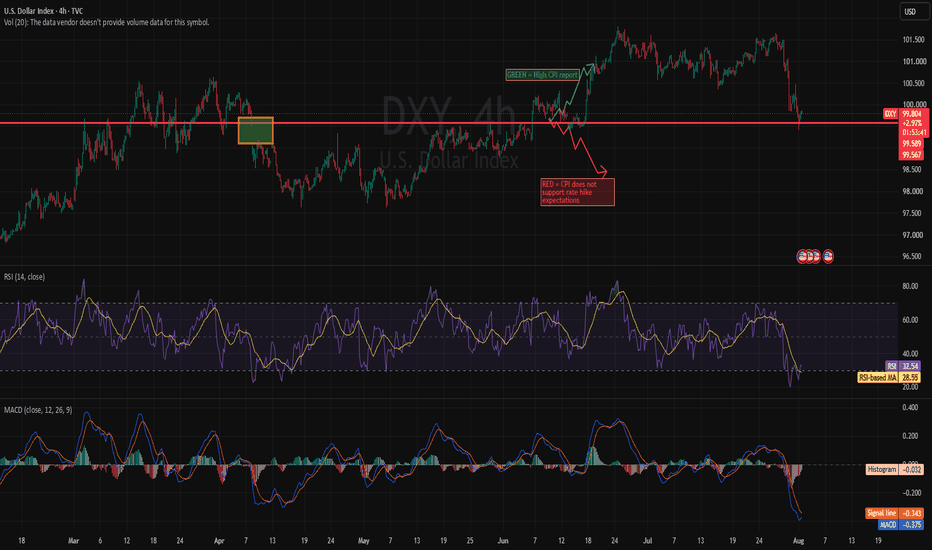
Technically, the DXY has reached an important decision area.
The red horizontal level shown on the chart has repeatedly acted as both resistance and support over the past several months.
The market is now testing this zone once again.
The scenario remains relatively straightforward:
Bullish Dollar Scenario
If upcoming CPI reports remain elevated and labor markets stay resilient, investors could once again price a more hawkish Federal Reserve.
That would likely push the DXY higher toward the recent highs.
This is the green path illustrated on the chart.
Bearish Dollar Scenario
If inflation continues to normalize while economic growth gradually slows, expectations for future tightening should fade.
In that environment, the dollar would likely resume the broader downtrend that I discussed in my previous analysis.
This corresponds to the red path.
My View
My longer-term thesis has not changed.
I still believe the structural direction for the U.S. dollar is lower.
However, I no longer expect a straight-line decline.
The Fed's new communication framework means markets will likely react much more aggressively to every important economic release. Instead of following central bank forecasts, investors will continuously reprice probabilities based on fresh macroeconomic data.
That creates a market driven less by speeches and more by evidence.
For now, I remain neutral in the short term.
The next major move in the dollar will likely be determined not by what the Federal Reserve says—but by what inflation and labor-market data actually show over the coming weeks.
As always, if my assumptions prove incorrect, I'll update my view. Markets reward flexibility, not stubbornness.
ElGatoTrade