
SMC + Liquidity Masterclass
Gold/US Dollar SAXO:XAUUSD
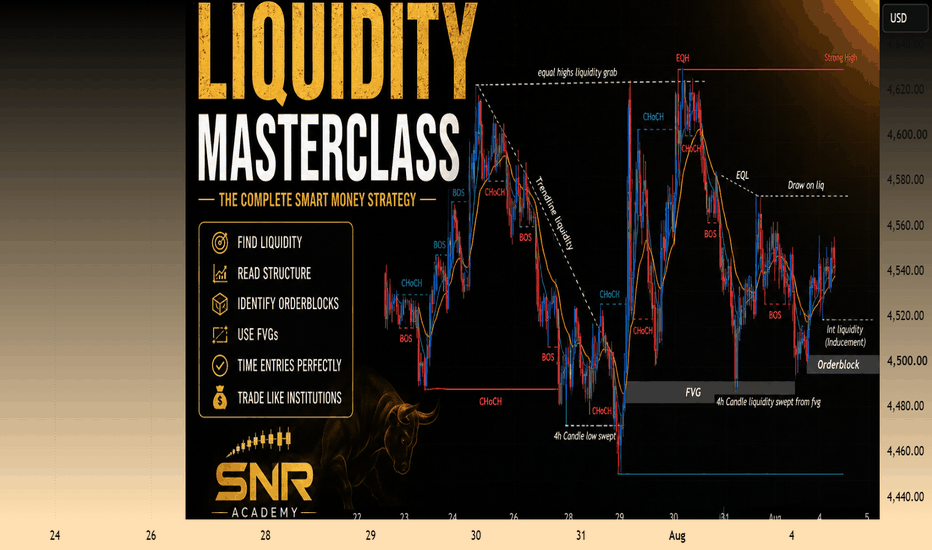
In this complete masterclass, we'll build this concept from the ground up. You'll learn what liquidity is, where it forms, how institutions seek execution around it, and how concepts like BOS, CHoCH, Order Blocks, Fair Value Gaps (FVGs), and inducement fit together into a structured market analysis framework.

CHAPTER 1
Understanding Price
Most traders think price moves because buyers are stronger than sellers.
This explanation is incomplete.
- Price moves because orders must be matched.
- Every buy order requires a seller.
- Every sell order requires a buyer.
- Without enough opposite-side orders, institutions cannot execute large positions efficiently.
- This is why the market constantly searches for liquidity.
Key Takeaway
Price is not searching for direction.
Price is searching for liquidity.
CHAPTER 2
What is Liquidity?
Liquidity is simply where many orders are waiting.
These orders include:
- Stop losses
- Pending buy orders
- Pending sell orders
- Breakout entries
- Limit orders
Institutions need these orders because they cannot enter massive positions instantly without causing large price movements.
Imagine trying to buy 5,000 houses in one city in a single day. Prices would rise immediately because there are not enough sellers.
Financial markets work similarly.
Institutions look for areas where many traders have placed orders so they can execute large trades more efficiently.
Rule #1
Liquidity is fuel for price movement.
CHAPTER 3
Why Liquidity Matters
Retail traders usually ask:
"Where is price going?"
Professional traders ask:
"Where are the orders?"
- The second question often provides more useful context.
- Large participants frequently target areas where many stop losses or pending orders are concentrated.
- This does not mean every move is intentionally engineered. It means markets often react strongly around areas with abundant liquidity.
CHAPTER 4
Buy-Side Liquidity
Buy-side liquidity exists above recent highs.
Examples include:
- Equal highs
- Swing highs
- Previous day's high
- Previous week's high
- Range highs
Many traders place buy stops or breakout orders above these levels.
When price reaches these areas, volatility often increases because many orders are activated.
CHAPTER 5
Sell-Side Liquidity
Sell-side liquidity exists below recent lows.
Examples include:
- Equal lows
- Swing lows
- Previous day's low
- Previous week's low
- Session lows
These areas often contain sell stops, stop-loss orders from buyers, and breakout sell orders.
CHAPTER 6
External vs Internal Liquidity
External Liquidity
- Major swing highs and swing lows.
- These define the outer boundaries of the market.
- They are often where the next significant move begins.
Internal Liquidity
- Smaller highs and lows inside a range.
- These are often used to guide price toward larger liquidity pools.
- Understanding the relationship between internal and external liquidity helps explain many intraday movements.
CHAPTER 7
- Market Structure
- Markets generally form:
- Higher Highs
- Higher Lows
or
Lower Highs & Lower Lows
- This sequence provides a framework for identifying trends.
- Never trade solely because liquidity has been reached.
- Structure helps determine whether the market is continuing or potentially changing.
CHAPTER 8
Break of Structure (BOS)
A Break of Structure indicates that the prevailing trend has continued by breaking a significant swing point in the trend direction.
For example:
- In an uptrend, price creates a new higher high.
- In a downtrend, price creates a new lower low.
BOS is generally viewed as a continuation signal rather than a reversal signal.
CHAPTER 9
Change of Character (CHoCH)
CHoCHoccurs when price breaks an important swing in the opposite direction of the prevailing trend.
- This can be an early indication that momentum is changing.
- However, CHoCH alone is not enough to justify a trade.
- Wait for additional confirmation such as liquidity interaction and a valid entry zone.
CHAPTER 10
Liquidity Sweep
A liquidity sweep occurs when price briefly trades beyond a well-known liquidity area and then quickly returns.
- A typical sequence is:
- Price approaches equal highs.
- Stops and breakout orders are triggered.
- Price fails to continue.
- Market reverses.
-
Not every break is a sweep. Confirmation is important.
CHAPTER 11
Inducement
- Markets often create intermediate structures that attract traders into early positions.
- These areas can become liquidity themselves.
- After inducement is collected, price may continue toward a larger liquidity objective.
- Think of inducement as a smaller liquidity pool that forms on the path to a larger one.
CHAPTER 12
Order Blocks
An Order Block is commonly defined as the final opposing candle before a strong impulsive move.
Rather than treating every Order Block as important, focus on those that occur:
- After liquidity has been taken.
- With a clear BOS or CHoCH.
- Near meaningful market structure.
⚠️Context matters more than the label.
CHAPTER 13
Fair Value Gap (FVG)
- A Fair Value Gap represents a price imbalance created by a strong displacement.
- Markets sometimes revisit these imbalances before continuing.
- Not every FVG will be revisited, and not every revisit creates a trade.
- Use them alongside liquidity and structure.
CHAPTER 14
Building the Strategy
Your workflow should be consistent:
- Determine the higher-timeframe bias.
- Mark external liquidity.
- Identify internal liquidity.
- Wait for a liquidity interaction.
- Observe BOS or CHoCH.
- Find the relevant Order Block or FVG.
- Enter only after confirmation.
- Define stop-loss placement.
- Set realistic profit targets.
- Manage risk throughout the trade.
CHAPTER 15
Entry Model
A simple framework:
- Higher-timeframe bias aligns.
- Liquidity is reached or swept.
- Structure confirms.
- Price returns to a high-quality Order Block or FVG.
- Enter with predefined risk.
CHAPTER 16
Trade Management
- Consider partial profits at predefined levels.
- Move stop-loss only according to your plan.
- Avoid emotional adjustments.
- Let the market confirm your decisions.
CHAPTER 17
Risk Management
A strong strategy can still fail without risk management.
Guidelines:
- Risk a small, consistent percentage per trade.
- Accept losses as part of trading.
- Focus on consistency rather than perfection.
CHAPTER 18
Common Mistakes
- Trading every liquidity level.
- Ignoring higher-timeframe context.
- Confusing every breakout with a continuation.
- Entering before confirmation.
- Moving stop-loss emotionally.
- Risking too much on a single trade.
CHAPTER 19
Complete Trade Walkthrough
- Identify the overall trend.
- Mark buy-side and sell-side liquidity.
- Highlight the liquidity sweep.
- Explain the CHoCH or BOS.
- Show the Order Block.
- Explain the FVG.
- Describe the entry.
- Show stop-loss placement.
- Explain the profit targets.
- Review the outcome and what can be learned.
CHAPTER 20
Final Checklist
Before every trade, ask yourself:
- What is the higher-timeframe bias?
- Where is the nearest external liquidity?
- Has liquidity been reached or swept?
- Is there a valid BOS or CHoCH?
- Is the Order Block supported by context?
- Is there a Fair Value Gap nearby?
- Is my stop-loss logical?
- Does the reward justify the risk?
- Am I following my plan?
- Closing Thought
Successful trading is not about predicting every move. It is about consistently recognizing high-quality market conditions, managing risk responsibly, and executing a repeatable process with discipline.
Final Thoughts
If you've made it this far, you now understand that liquidity is the foundation of institutional trading. Every concept in this guide—from Market Structure and BOS/CHoCH to Liquidity Sweeps, Order Blocks, and Fair Value Gaps—works best when viewed as part of a complete framework, not as isolated signals.
Master one concept at a time, practice on historical charts, and focus on developing consistency rather than chasing perfect trades. The market rewards preparation, patience, and disciplined execution.
Enjoyed this lesson?
If this guide helped you see the market from a new perspective:
👍 Boost this idea if you found it valuable.
💬 Share your questions or insights in the comments—I'd be happy to discuss them.
⭐ Follow SNR_Academy for more in-depth Smart Money Concepts, institutional trading education, and professional XAUUSD market analysis.
This is just the beginning.
Upcoming Masterclasses:
- Market Structure Explained
- BOS vs CHoCH
- Order Blocks: Myth vs Reality
- Fair Value Gaps (FVG)
- Premium & Discount Arrays
- Inducement & Liquidity Engineering
- High-Probability Entry Models
- Risk Management for Consistent Traders
- Complete Smart Money Trading Blueprint
Learn. Analyze. Execute.
SNR_Academy
Precision Over Prediction.
