

The Science of Price Discovery: Why Markets Move the Way They D
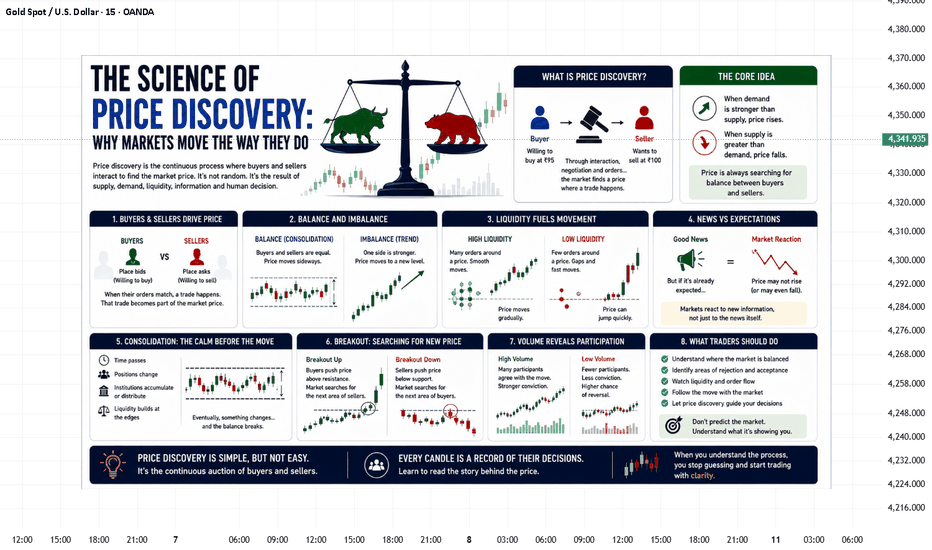
Have you ever watched a stock trade around ₹1,000 for hours and then suddenly jump to ₹1,020?
Nothing magical happened.
The market was simply trying to answer one question:
What is the price buyers and sellers are willing to accept right now?
This process is called price discovery.
It is happening every second the market is open. Buyers are placing orders, sellers are responding, and price keeps moving until the market finds an area where enough participants are willing to trade.
Understanding this process can completely change the way you look at a chart.
Instead of asking only, "Where will price go next?", you start asking:
"What is the market trying to discover?"
What Is Price Discovery?
Price discovery is the process through which buyers and sellers arrive at a market price.
Think about a simple auction.
A seller wants ₹100 for an item.
A buyer is willing to pay ₹90.
They haven't agreed on a price yet.
Maybe another buyer offers ₹95.
Another offers ₹98.
Eventually, someone is willing to pay ₹100.
A transaction happens.
Financial markets work on the same basic idea, just at a much larger and faster scale.
Millions of orders can interact across different prices, creating continuous changes in supply and demand.
The price on your screen is simply the latest point where buyers and sellers agreed to trade.
Price Is Always Searching for Balance
Markets are constantly moving between balance and imbalance.
When buyers and sellers are relatively balanced, price often moves sideways.
You may see small candles, overlapping ranges, and repeated tests of the same area.
The market is comfortable there.
But when one side becomes more aggressive, that balance changes.
If buyers are willing to pay increasingly higher prices, sellers may raise their asking prices.
Price moves higher.
If sellers become more aggressive and buyers are no longer willing to pay the current price, sellers begin accepting lower prices.
Price moves lower.
This is why markets trend.
A trend is essentially a period where the market is repeatedly searching for a new level of agreement.
Why Price Moves So Quickly Sometimes
Not every price move happens at the same speed.
Sometimes price moves slowly.
Other times, it seems to explode in seconds.
Why?
Because liquidity and order flow are constantly changing.
Imagine there are many sellers around ₹500.
Buyers can easily find someone willing to sell at that price.
Trading happens smoothly.
Now imagine those sellers suddenly disappear or get bought up.
The next available sellers might be at ₹505.
Buyers who still want to enter must now pay more.
Price jumps.
This is one reason markets can move quickly when liquidity is thin.
The market is searching for the next available area where transactions can occur.
The Order Book and the Battle for Price
Behind every market price is a collection of buy and sell orders.
Buyers typically place bids.
Sellers place offers or asks.
The difference between the highest bid and lowest ask is known as the spread.
When buyers and sellers agree, a transaction takes place.
That transaction becomes part of the market's price history.
Thousands of these interactions create the chart we see.
A candlestick may look simple, but behind it are countless decisions.
Someone decided to buy.
Someone else decided to sell.
Their agreement created another piece of price information.
## Why Price Doesn't Always Go Where the News Suggests
This is where price discovery becomes particularly interesting.
Suppose a company releases excellent earnings.
You might expect the stock to rise.
But instead, it falls.
How can that happen?
Because the market isn't reacting to the news in isolation.
It is reacting to how the news compares with expectations.
If traders were expecting even better results, the announcement may disappoint them.
Perhaps investors had already bought the stock in anticipation of the results.
Once the news arrives, they sell to take profits.
The information may be positive.
But the price discovery process may still push the stock lower.
Markets care about expectations, positioning, and new information—not simply whether a headline sounds good or bad.
The Role of Supply and Demand
Supply and demand are at the heart of price discovery.
When demand exceeds available supply, buyers compete for the available shares.
They may need to offer higher prices.
Price rises.
When supply exceeds demand, sellers compete to find buyers.
They may need to accept lower prices.
Price falls.
This process continues until the market reaches another area where enough buyers and sellers are willing to transact.
That is why price is always moving.
The market is constantly searching for agreement.
Why Markets Consolidate
Have you ever wondered why price sometimes stays trapped in a narrow range for hours, days, or even weeks?
This is often a sign of balance.
Buyers aren't aggressive enough to push price significantly higher.
Sellers aren't aggressive enough to push it significantly lower.
Both sides are comfortable trading within a particular area.
This creates consolidation.
But eventually, something changes.
New information arrives.
Large orders enter.
Sentiment shifts.
Liquidity changes.
One side becomes more aggressive.
The balance breaks.
Price begins searching for a new level.
This is why consolidation can often appear before a major move.
The market is building a new area of agreement—or preparing to leave the old one.
What Happens During a Breakout?
A breakout occurs when price moves beyond an area where the market previously found balance.
Imagine a stock has traded between ₹100 and ₹110 for several weeks.
Buyers repeatedly defend ₹100.
Sellers repeatedly defend ₹110.
The market has established a range.
Then buyers become aggressive enough to absorb the available selling around ₹110.
Price breaks above the range.
Now the market must discover where the next group of sellers is willing to participate.
Maybe ₹115.
Maybe ₹120.
Maybe much higher.
The market keeps moving until it finds enough supply to slow the advance.
The same process happens during a breakdown.
## Price Discovery and Market Structure
This is where price discovery connects directly with technical analysis.
Higher highs and higher lows show that buyers are repeatedly accepting higher prices.
Lower highs and lower lows show that sellers are successfully pushing the market toward lower prices.
Support and resistance show areas where the market previously found agreement or experienced strong rejection.
Consolidation shows temporary balance.
Breakouts show the market searching for a new area of value.
When you understand price discovery, these patterns stop looking like isolated technical formations.
They become different stages of the same process.
The Importance of Volume
Volume can provide additional clues.
When a large amount of trading occurs around a particular price, it tells us that many participants were willing to transact there.
That area may become important in the future.
On the other hand, when price moves rapidly through an area with relatively little trading, the market may be moving quickly toward the next area where buyers and sellers are willing to engage.
This is why tools such as volume profiles can be useful.
They help traders see where the market spent time trading and where it moved through quickly.
Price Does Not Move Because It "Wants" Something
Traders often say:
"Price wants to go higher."
Or:
"The market wants to take the liquidity below those lows."
These phrases can be useful shorthand, but they shouldn't be taken literally.
Price doesn't have intentions.
It responds to orders, liquidity, expectations, information, and the decisions of market participants.
The market isn't thinking.
People are thinking.
And their collective decisions create the movement we see on the chart.
The Real Advantage of Understanding Price Discovery
You don't need to predict every move.
In fact, trying to predict everything can make trading unnecessarily complicated.
Instead, focus on what the market is currently showing you.
Ask:
- Where are buyers accepting higher prices?
- Where are sellers becoming aggressive?
- Where is the market balanced?
- Where has price been rejected?
- Where is liquidity concentrated?
- Is the market searching for a new area of value?
- Is the current move being accepted or rejected?
These questions help you understand what is happening rather than simply guessing what might happen next.
Final Thoughts
Price discovery is one of the most fundamental processes in financial markets.
Every tick, every candle, every breakout, and every reversal is part of the same ongoing process.
Buyers and sellers are constantly negotiating.
Sometimes they agree.
Sometimes they strongly disagree.
When they agree, price tends to stabilize.
When they disagree, price moves until a new agreement is found.
That is the science behind price movement.
So the next time you look at a chart, don't just see a series of candles.
Think of it as a continuous auction.
Every candle represents another round of negotiation between buyers and sellers.
And every move tells you something about where the market is willing—or unwilling—to trade.
Price discovery isn't just something that happens in the market.
It is the market.
