The New Zealand Dollar Is About to Test Its Own Story
The New Zealand dollar’s recovery is easy to dismiss as another episode of broad U.S. dollar weakness.
That explanation is becoming incomplete.
In July, the Reserve Bank of New Zealand raised the Official Cash Rate by 25 basis points to 2.50% and indicated that some further removal of monetary stimulus could be required. New Zealand’s annual inflation then reached 4.1% in the June quarter, remaining above the central bank’s 1–3% target range. The currency is therefore recovering while the domestic policy narrative has become more restrictive—not because the RBNZ has begun preparing the market for easier conditions.
The U.S. side of the equation is not straightforward either. The Federal Reserve held its target range at 3.50–3.75% on July 29, but the decision passed by a 9–3 vote, with three policymakers preferring a 25-basis-point increase. This was not a clearly dovish decision that automatically justified selling the dollar.
That makes the current move more interesting.
The market is no longer asking whether the New Zealand dollar can produce a rebound. It is asking whether the domestic economy is strong enough to justify the policy expectations now supporting that rebound.
Trend Analysis
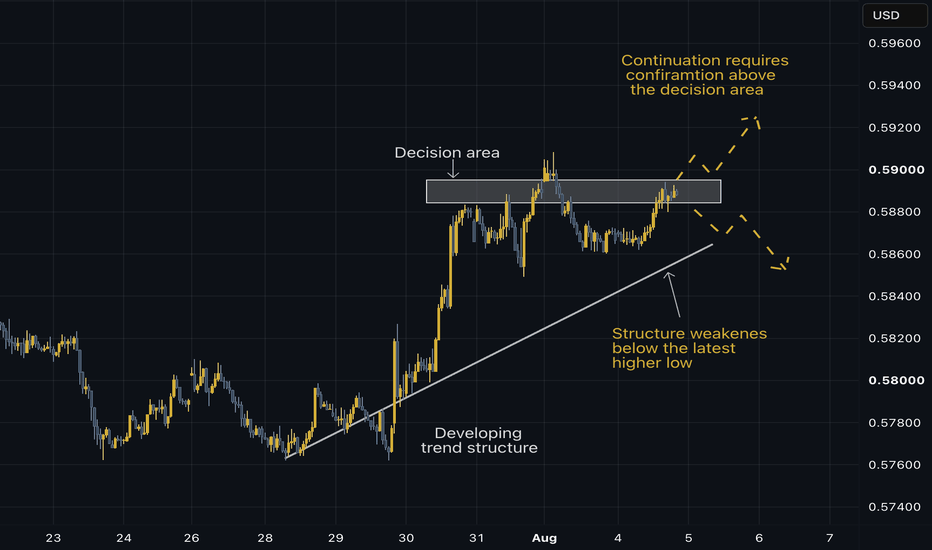
The broader structure remains mixed, but the direction since the late-June low has shifted into a weak bullish trend.
The previous sequence of lower lows has been interrupted. Buyers have established several higher lows, corrections have become shallower, and the latest advance reached the upper boundary of the recovery without first threatening the rising structure.
Buyers therefore retain short-term control.
However, this is not yet a confirmed medium-term reversal. Price is testing an area that combines the previous July swing highs, the psychologically important region below 0.5900 and the upper boundary of the current recovery. The market has reached the point where continuation requires more than another brief spike.
It requires acceptance above resistance.
Momentum Assessment
Momentum has improved considerably from the June low, but it is no longer accelerating.
The latest bullish impulse was strong enough to challenge resistance, yet the immediate reaction shows that sellers remain active there. This does not invalidate the recovery. Healthy trends frequently pause after an impulsive advance.
The quality of the next pullback will matter more than the initial rejection.
A shallow correction that remains above the latest higher low would suggest that buyers are absorbing supply and preparing another attempt. A deeper decline through the rising structure would show that the rally depended on momentum that is no longer available.
The rally has already priced a more credible RBNZ. The incoming data now has to earn that confidence.
Primary Scenario
The constructive scenario requires the latest higher-low sequence to remain intact while price consolidates beneath resistance.
A renewed push through the upper zone, followed by the ability to hold above it, would confirm that buyers have moved beyond a temporary relief rally. That would strengthen the probability of a broader bullish transition and place the previous June highs back into focus.
The next New Zealand labour-market report is scheduled for August 5, making it a natural test of this thesis. A resilient employment picture or persistent wage pressure could reinforce expectations that the RBNZ must maintain a restrictive stance.
Alternative Scenario
The bearish alternative begins with another failed attempt at resistance, but rejection alone would not be sufficient.
Sellers would need to push price below the most recent higher low and break the rising recovery structure. That would indicate that the New Zealand dollar had priced a stronger domestic policy outlook without receiving enough economic confirmation to sustain it.
In that case, the advance from the June low would be better classified as a corrective recovery within the broader bearish structure.
Risk Factors
The main risk is that both sides of the currency pair currently carry hawkish policy narratives.
The RBNZ is responding to inflation above its target range, while the Federal Reserve’s latest vote revealed meaningful support for tighter U.S. policy. The absolute yield advantage still belongs to the U.S. dollar, so the New Zealand dollar cannot rely indefinitely on policy expectations alone.
A weak labour-market report would challenge the assumption that the domestic economy can absorb additional restraint. Conversely, strong data could increase confidence in the recovery but also raise concerns about how restrictive policy may affect future growth.
Conclusion
The New Zealand dollar has done enough to end the previous one-sided decline, but not enough to confirm a durable reversal.
Buyers control the recovery while the sequence of higher lows remains intact. Momentum is constructive, although increasingly dependent on confirmation from both price and domestic data.
Invalidation: A confirmed break below the latest higher low would invalidate the developing bullish structure and return control to sellers.
Central banks establish the narrative. Economic data determines whether the market continues to believe it.