Why Didn’t the Trump - Iran War Tensions Push Gold Higher?
Hey Everyone,
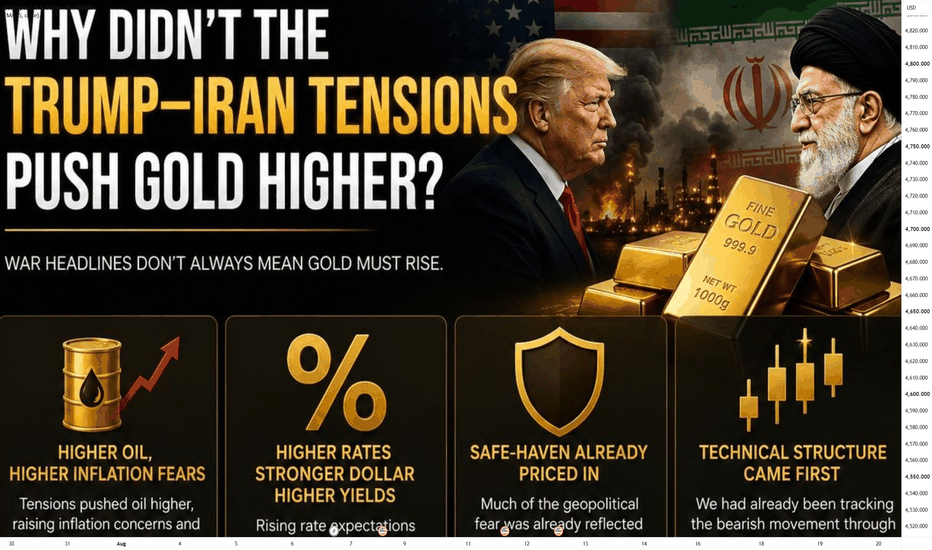
A question many traders have been asking is why Gold failed to rally during the recent escalation in tensions between President Trump and Iran.
Traditionally, geopolitical uncertainty creates safe haven demand, which can support Gold. However, this does not mean every war headline will automatically send the market higher. The reaction depends on how that conflict affects the wider economic environment, particularly oil, inflation, interest-rate expectations, the US dollar and bond yields.
This time, the market was not simply trading fear.
War Tensions Created an Inflation Problem
The escalating conflict pushed oil prices sharply higher due to concerns surrounding supply routes and the Strait of Hormuz. Higher energy prices increase inflationary pressure across the global economy.
Instead of immediately buying Gold as a safe haven, markets began pricing in the possibility that the Federal Reserve would need to keep interest rates higher or potentially raise them further to control inflation.
This is important because Gold does not pay interest. When bond yields and interest-rate expectations rise, holding Gold becomes less attractive compared with yield-producing assets.
This explains why there were several occasions when tensions intensified, oil moved higher, yet Gold continued to fall. Reuters reported similar reactions during June and July, when renewed US–Iran tensions pushed oil higher, increased inflation fears and strengthened expectations of higher-for-longer US interest rates.
The Safe Haven Flow Was Already Priced In
Gold had already experienced a substantial long-term bullish run before the latest escalation. A large amount of geopolitical fear and global uncertainty had therefore already been reflected in the price.
Markets move on new information, not simply because a headline sounds serious.
Once traders realised that the conflict was not immediately producing a completely new economic shock, the market had little reason to continue paying increasingly higher prices for Gold. This opened the door for profit-taking and the deeper bearish correction we had already been tracking through our charts.
Gold subsequently traded significantly below its earlier 2026 peak and remained lower even after the Iran conflict began, demonstrating that geopolitical fear alone was not strong enough to override the broader macroeconomic and technical pressures.
The Dollar and Yields Remained More Important
During periods of serious global uncertainty, capital does not only move into Gold. It can also flow into the US dollar and US government bonds because they are among the world’s most liquid defensive assets.
A stronger dollar usually places pressure on Gold because Gold is priced in dollars. At the same time, elevated Treasury yields increase the opportunity cost of holding a non-yielding asset.
Therefore, Gold was caught between two opposing forces:
Geopolitical fear created potential safe-haven demand, but higher oil prices created inflation fears, stronger rate expectations and pressure from the dollar and bond yields.
During much of the recent bearish movement, the interest-rate and inflation narrative carried greater weight.
Why Gold Rose When Tensions Began to Ease
The most interesting part of this entire move is that Gold eventually produced one of its strongest rallies when the immediate threat of further strikes began to ease.
At first, that may appear contradictory. However, the potential diplomatic progress pushed oil prices lower, reduced inflation concerns and caused markets to reconsider how aggressively the Federal Reserve might need to raise rates.
Lower yields and a weaker dollar then provided Gold with the conditions required to rally. Gold’s strong move on August 5 was driven largely by falling Treasury yields, dollar weakness and reduced rate-hike expectations not simply by war-related safe-haven demand.
This is another reminder that Gold does not always rise because geopolitical tensions increase. Sometimes the economic consequences of war especially higher oil, inflation and interest rates can initially be bearish for Gold.
The Technical Structure Came First
Most importantly, we had already been tracking the bearish movement through our Goldturn structure over the previous weeks.
The geopolitical headlines did not invalidate the chart. They simply created volatility within the route map that was already developing.
This is why we do not trade Gold by reacting emotionally to every news headline. News may accelerate a move, create volatility or temporarily disturb the market, but price will often continue following the larger technical structure once that volatility settles.
Those following our analysis will know that we had already highlighted the bearish ranges and used them to buys dips from strategic support levels.
Final Thoughts
War does not automatically mean Gold must rise.
We must understand whether the event is creating:
Genuine new safe haven demand
A stronger US dollar
Higher oil prices and inflation
Rising bond yields
Changing Federal Reserve expectations
Or simply volatility within an existing technical trend
This time, inflation and interest-rate concerns outweighed the initial safe haven demand. That allowed the bearish technical structure we had been tracking for several weeks to continue.
As always, we remain committed to the bigger Gold direction, but we also respect short-term bearish swings. Rather than constantly changing our long-term bias, we use these deeper movements to identify stronger levels from which we can buy the dips and eventually fall back into the larger wave.
Mr Gold
GoldviewFX