
The sizing step everyone skips
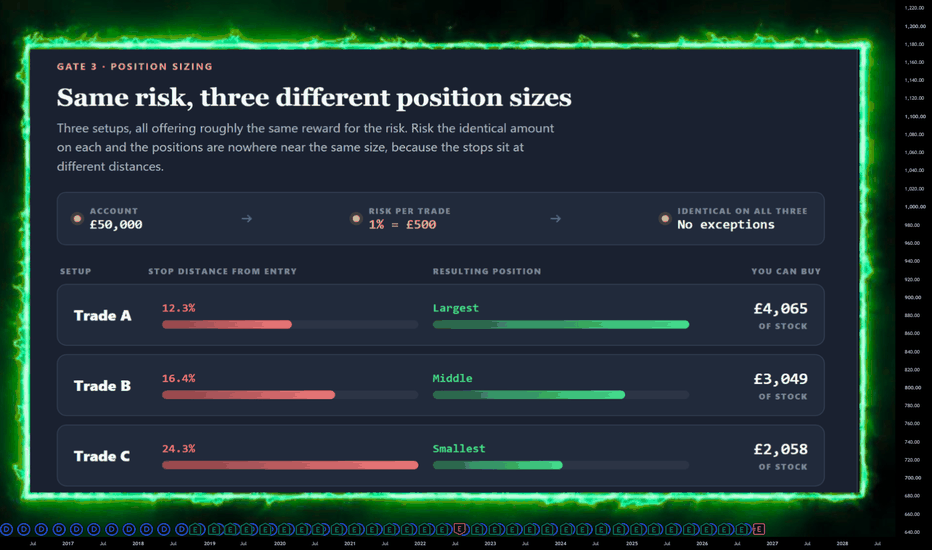
Three setups. All cleared my checks, all offering roughly the same reward for the risk, somewhere around 2 to 2.5 times.
On paper, three versions of the same trade. They aren't, and the difference is arithmetic rather than analysis.
The invalidation levels sit at different distances. One about 12% from entry, one 16%, one a bit over 24%. Same reward ratio, very different distance between being in and being wrong.
That distance decides the size.
What you hold constant is the money at risk, not the number of shares. Fixed 1% of a 50k account is 500 on the line every time. The sizing falls straight out:
Stop 12.3% away → 500 ÷ 0.123 → about 4,065 of stock
Stop 16.4% away → 500 ÷ 0.164 → about 3,049
Stop 24.3% away → 500 ÷ 0.243 → about 2,058
Identical risk on all three. The largest position is nearly double the smallest.
Buy three equal chunks instead and you've made the trade with the worst-defined exit your biggest risk on the book. Equal size at those stop distances means the widest one risks roughly double the tightest. Nobody decides to do that. It happens because the step got skipped.
A wide stop is not a bad trade. Some setups need room, and if the reward scales with the risk the trade can be perfectly sound. The stop distance isn't a quality score, it's a sizing input. Treat it as a quality score and you'll systematically avoid volatile instruments, which removes a whole category of large winners from your results over time.
You want that trade. You want it small.
The expensive variant: sizing it correctly, then feeling short-changed because the biggest target on the board has the smallest position, and rounding it up. The big target is why the stop is wide. Same fact twice. Using the reward to justify more size double-counts the exact thing that made the position small.
Work out the money first, then the shares. Starting from "I want about three grand in this" lets a round number set your risk.
Go and look at your largest position from the last month. Not the best performer, the biggest. Did it earn that size with a tight, well-defined invalidation, or did it get there because you liked it most?
Those feel identical at the moment you click. They are not the same thing.
