The Psychology Behind Every Market Cycle
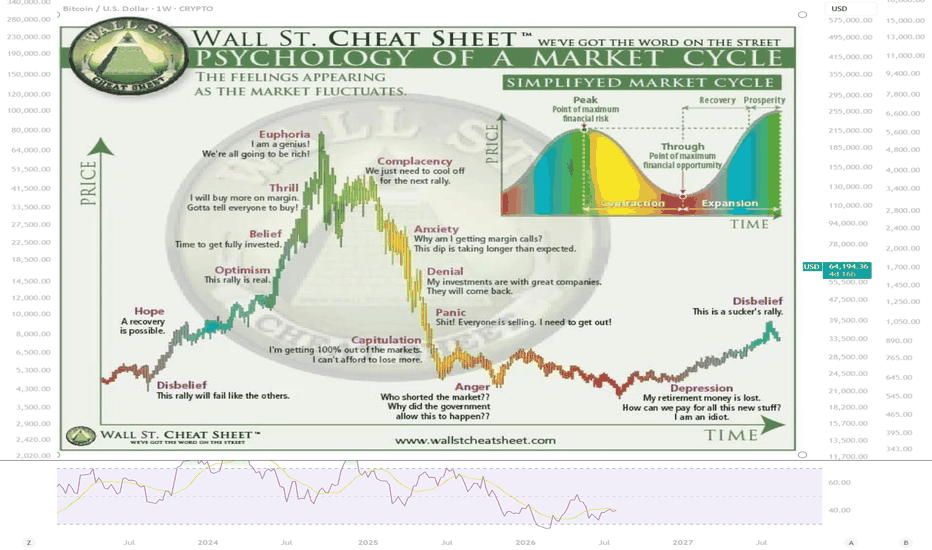
Most people think markets are driven by news. They're not. News changes every day. Market psychology doesn't.
For more than a century, every major financial bubble has followed almost the exact same emotional pattern. Different assets. Different headlines. The same human behavior.
Understanding this cycle is one of the biggest advantages any investor can have.
Stage 1 — Optimism 🚀
A new trend begins. Prices start rising, but most people don't believe it yet. Investors tell themselves:"Maybe this time it's different."
Smart money quietly accumulates while public interest remains low.
Stage 2 — Belief 🙏
The trend becomes obvious. Positive news appears. Analysts begin raising price targets. People who ignored the first rally finally start paying attention. Confidence grows.
Stage 3 — Thrill 🥹
Now everyone feels like a genius. Every dip gets bought. Social media is filled with screenshots of massive profits. Friends and family suddenly become "market experts." Greed starts replacing logic.
Stage 4 — Euphoria 📈
This is where the biggest mistakes happen. People stop asking:"Is this asset expensive?"
Instead they ask:"How high can it go?" Leverage explodes. Risk management disappears. Nobody wants to hear bearish opinions. The market feels unstoppable.
Ironically, this is often where the largest players begin taking profits.
Stage 5 — Anxiety 😡
The first sharp correction arrives. Most investors aren't worried.
They call it:"Just another healthy pullback." Many even buy more. They still believe new all-time highs are just around the corner.
Stage 6 — Denial 🤬
The market keeps falling. People refuse to admit the trend has changed. They blame manipulation, bad news, or temporary panic.
"This is just another dip."
Stage 7 — Panic 📉
Losses become painful. Confidence disappears. Investors stop talking about profits. Instead, they constantly check their portfolios hoping for a recovery. Emotion replaces analysis.
Stage 8 — Capitulation 💸
This is where panic reaches its peak. People sell simply because they can't handle the stress anymore. Many liquidate near the bottom after holding through most of the decline.
Ironically, this is often where long-term investors quietly begin buying.
Stage 9 — Depression 😭
Nobody wants to hear about crypto or stocks anymore. Financial media declares the market dead. Retail investors disappear. Trading volume dries up. This is usually when assets become truly undervalued.
Stage 10 — Hope 📈
The market begins recovering. Almost nobody notices. People are too emotionally exhausted to buy again. They promise themselves:"Next time I'll buy the bottom."
But very few actually do. And then... A new cycle begins.
✔️ Why This Matters
The biggest profits rarely come from buying the hottest asset. They come from buying when everyone else is too afraid to do so. Likewise, the biggest losses rarely happen during bear markets. They happen when investors become convinced prices can only go higher.
Markets change. Technology changes. News changes. Human psychology doesn't. That's why every cycle looks different on the chart—but almost identical in people's minds.
The traders who understand psychology don't just follow the market. They understand the crowd.
_____
👉 If you want to trade like a professional and not like a gambler — follow for real insights and strategies 🚀