$SOXX vs $SPX What is Next?
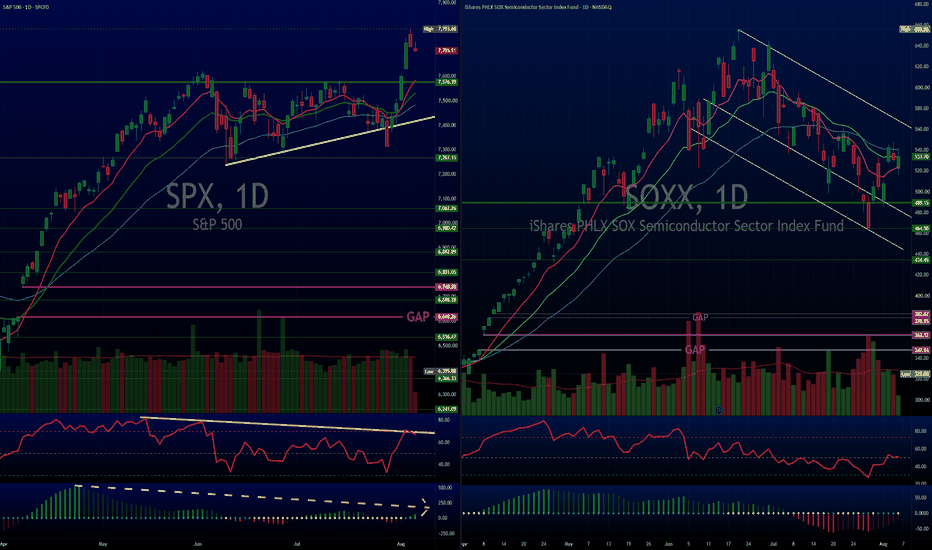
SOXX: Ideal Entry
Setup: While price is still printing lower highs and lower lows inside that white trend channel, the momentum indicators (RSI curling up, TTM bars shrinking red toward zero) are clearly resetting.
Strategy: Waiting for that one last retest (higher low within the channel or a test of the lower support I the channel) before pulling the trigger is the smart play.
Confirmation: If price retests that lower support zone and holds while RSI makes a higher low, it confirms that the aggressive selling pressure is exhausted. A breakout of that top white trendline will be the green light.
SPX: Strong Price Action vs. Fading Momentum
Setup: SPX is showing a classic bearish divergence (higher highs in price, lower highs in RSI and TTM). This indicates momentum is slowing down, but price is king.
Trigger: As long as
 SPX
holds above its breakout support level (green horizontal line), the trend remains intact.
SPX
holds above its breakout support level (green horizontal line), the trend remains intact.
Takeaway: Divergence alone isn't a sell signal, it's a caution flag. SPX can easily "cool off" momentum by grinding sideways instead of dumping, letting RSI reset without giving back price gains.
Bad News vs. Bull Market Paradox
The enemy of stock investing is euphoria. The more we're focused on all the bad news, the higher the odds the market can keep climbing.
Denise Chisholm, Director of Quantitative Market Strategy at Fidelity Investments
Wall of Worry: Markets rarely top out when everyone is complaining about economic news, interest rates, or inflation. They top out when the average retail investor feels invincible and leverages at the peak.
We’ve already seen flashes of this leverage risk (look at South Korea’s retail ETF boom, or recent comments from Fink and Dimon on market leverage and
 BTC
flushing out over-leveraged traders to form a base).
BTC
flushing out over-leveraged traders to form a base).
We’ll be dropping a full article breaking down this exact retail vs. institutional leverage cycle shortly!
Smart Money Positioning: Institutional capital accumulates during periods of maximum headlines and bad news because earnings growth and balance sheets remain structurally sound. By the time retail finally capitulates and buys back in near the top, the smart money is already looking for the exit.