

Motive Waves – Impulse and Diagonal Patterns
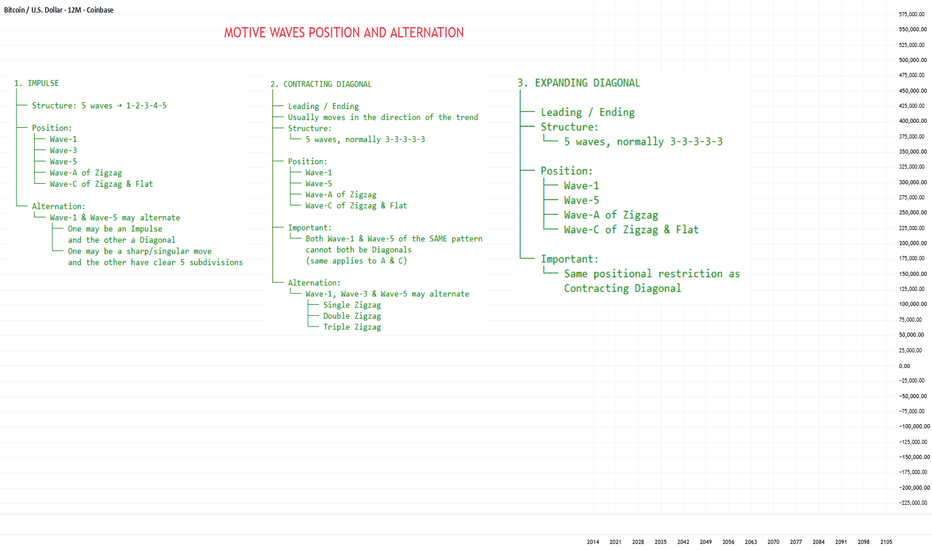
The attached chart summarizes the three major Motive Wave patterns in Elliott Wave Theory: Impulse, Contracting Diagonal, and Expanding Diagonal.
Impulse: Consists of five waves—1-2-3-4-5—and generally moves in the direction of the larger trend. It can occur as Wave-1, Wave-3, Wave-5, Wave-A of a Zigzag, and Wave-C of a Zigzag or Flat. Wave-1 and Wave-5 may also show alternation in their structure.
Contracting Diagonal: A five-wave motive pattern, normally subdividing 3-3-3-3-3, and can appear as either a Leading or Ending Diagonal. It can occur in Wave-1, Wave-5, Wave-A of a Zigzag, or Wave-C of a Zigzag/Flat. Its internal waves may also alternate between different corrective structures.
Expanding Diagonal: Similar to a Contracting Diagonal in its Leading/Ending role and 3-3-3-3-3 internal structure, but its trendlines expand rather than contract. It can occupy the same positions as a Contracting Diagonal.
In short: Motive Waves consist of Impulse and Diagonal patterns, and these patterns help identify whether the market is progressing in the direction of the larger trend and where a particular wave structure can occur.
