Lennar (LEN): Looking at a Homebuilder 48% Off Its High
The company first
Lennar is the second largest homebuilder in the United States by homes sold. Its fiscal year ends November 30, so what they call “Q2 2026” is the quarter that ended May 31.
The balance sheet is not up for debate. Net homebuilding debt to total capital is 9.4%. The credit agreement caps leverage at 60% and they are running at 14.7%. Cash sits at $1.8 billion with zero drawn on a $3.1 billion revolver. This company is not going bankrupt. That is the first thing I screen for in a cyclical, and Lennar clears it easily.
The bull case rests on one number
CEO Stuart Miller said it plainly on the June call. Sales incentives on deliveries are currently running at 12.9%, while normalized levels are 4% to 6%. That gap is narrowing for the first time in three years.
Work through the math. They are giving away an average of $55,200 per home right now. At 5% incentives that drops to roughly $21,000, so about $34,000 per home comes back. Multiply by 82,000 annual deliveries and you get $2.8 billion pretax. After tax, divided by the share count, that is roughly $8.60 per share.
Current earnings run about $5 per share. If incentives normalize, EPS goes to $13 or $14. At $84.56 that is a six times multiple.
The trend has started: 14.5%, then 14.1%, then 12.9%. Backlog is sitting at 12.5%.
The operations genuinely work
It would be unfair not to give credit here. Cycle time is 121 days, the lowest in company history. Construction cost per square foot is down 13% over two years. Inventory turn went from 1.8x a year ago to 2.5x. Completed unsold homes per community dropped from 3 to 2.1. Only 2% of their land sits on the balance sheet, with 98% controlled through options.
The jump in inventory turn is the least discussed metric and I think the most valuable one. When margins normalize, the same profit will produce a much higher return on equity than it used to.
Management also changed policy quietly. For years the line was “we are a volume company, we use price as the lever.” This quarter, instead of cutting price further, they pulled full year delivery guidance from 85,000 down to 82,000 to 83,000 If I do not write down the things that weaken my own thesis, this analysis is worthless.
The book value discount is not what it looks like. Book value per share is $89.75, so 0.94x. That sounds cheap. But there is $3.63 billion of goodwill on the balance sheet. Strip it out and tangible book drops to $74.67 per share, which means at $84.56 you are paying 1.13 times tangible book. There is no discount. Homebuilders historically bottom at 0.7 to 0.9 times tangible book.
The margin decline may be structural. The company’s own language: gross margins fell due to lower revenue per square foot and higher land costs, partially offset by lower construction costs. Construction costs are down 7% while land costs are rising. That is the bill for going asset light. Land came off the balance sheet but came back as a recurring option maintenance fee. That line ran $555 million over six months, roughly $1.1 billion annualized. Net income over the same six months was $534 million.
The margin recovery is coming from one region. The regional table shows what the consolidated number hides. East improved from 18.9% to 19.1%. South Central slipped from 17.5% to 17.3%. Central fell from 18.7% to 15.4%. West collapsed from 16.7% to 12.6%. West is 36% of revenue and lost 410 basis points. East is the only region pulling the total up.
Impairment signals are increasing. Communities showing indicators of potential impairment went from 102 to 151 year over year. The fair value of affected assets went from $35.5 million to $143.8 million. That is not the profile of a company turning off the bottom.
Cash is draining. Over six months: $718 million used in operations, $737 million in buybacks, $247 million in dividends. Cash fell from $3.44 billion to $1.82 billion. Net debt to capital went from 2.8% to 9.4%.
No insider buying, but the company is buying
There has not been a single open market insider purchase in 2026. Every Form 4 filing is compensation mechanics.
I do not read much into that, because it never happens at this company. Total insider buying since 2005 is $3.9 million against $252.8 million of selling. The Miller family already holds 21.6 million Class B shares. An additional purchase would be meaningless to them.
One filing did catch my attention. In March, Miller forfeited 55,490 shares back to the company from a 2023 performance based grant, because the financial targets were only partially achieved. That is an objective dent in the “the macro is bad but we are executing beautifully” narrative.
The real buyer is the company itself. In Q2 they repurchased 5 million shares for $447 million at an average of $89.35. The May average was $85.17. Remaining authorization is $1 billion, roughly 5% of the market cap at today’s price.
The technical picture
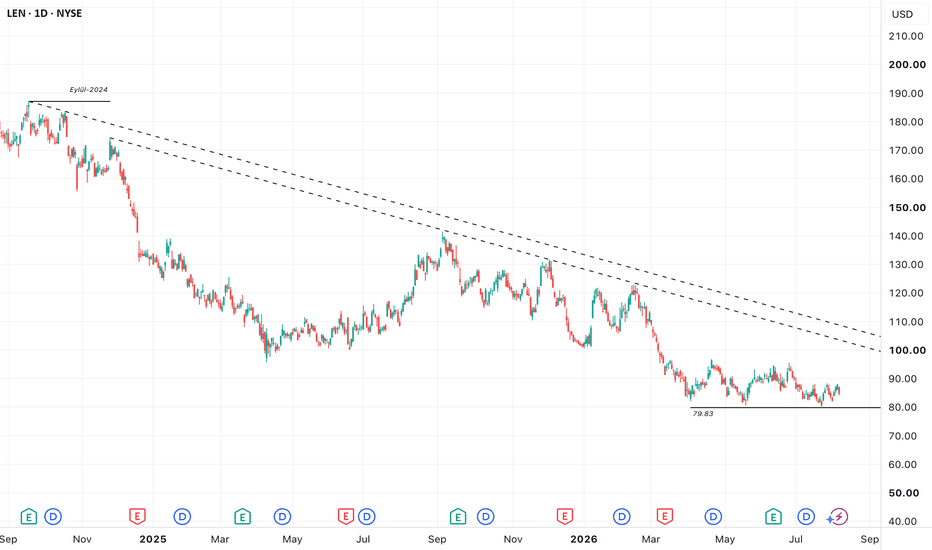
The descending channel that had been in place since September 2024 broke to the downside in March and April. Normally that means the decline accelerates. It did not. The stock has traded sideways between 80 and 96 for four months.
$79.83 has been tested three times and held every time. More importantly, the highs have stopped falling over these four months. For the previous eighteen months every high was lower than the last. That pattern broke.
Where I stand
I see the 84 to 85 range as a reasonable entry. My reasoning is simple: getting meaningfully below this level requires fresh bad news, and I think the worst of the cycle is largely priced in already.
I know the counterargument. There is no discount on tangible book, and if incentives keep compressing at the current pace, normalization does not arrive until 2027. So I am treating this as a cycle position that requires patience, not a value purchase.
I am building it in tranches rather than all at once, and I am doing it through the Class A shares.
What would kill the thesis
Writing this down now so I do not fool myself three months from now while the price is falling. If West gross margin drops below 12.6%, if incentives turn back above 12.9%, or if $79.83 breaks on a closing basis, the thesis weakens.
If two of those happen, my assumption that the worst is priced in is wrong. At that point the right move is to exit, not to average down.
The next test is the third quarter report on September 17.