How Can One Institution Buy $1 Billion Without Moving the Market
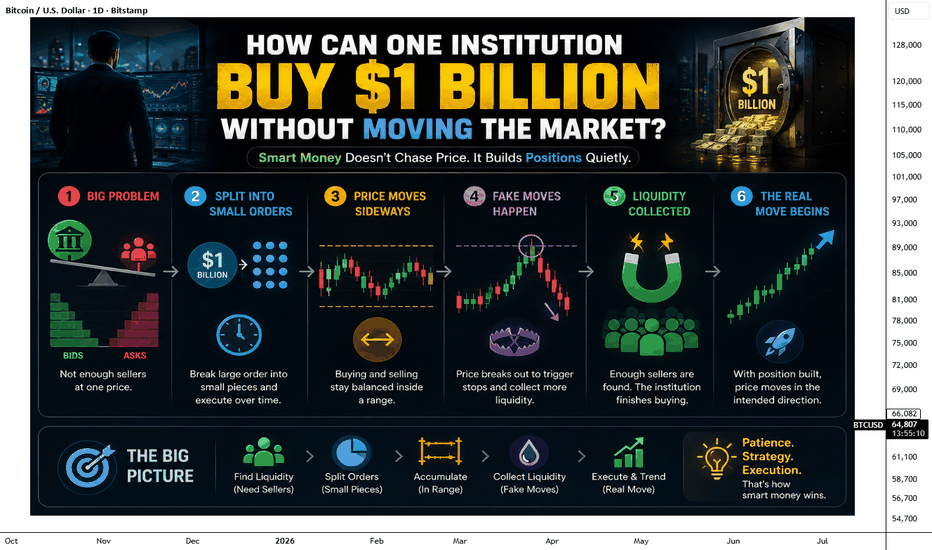
When a retail trader buys one lot of EUR/USD or a few shares of a stock, the market barely notices. The order is so small that it gets matched almost instantly. But what happens when a large institution wants to buy $1 billion worth of an asset? Surely placing such a massive order should send the price soaring. Surprisingly, it usually doesn't.
The reason is simple. Institutions cannot afford to move the market against themselves. If they bought everything at once, they would push the price higher with every order, forcing themselves to pay more and more. Instead of rushing into the market, they use a completely different approach, one that is built on patience, planning, and liquidity.
Every Big Trade Has a Big Problem
The biggest challenge for an institution is not deciding what to buy. The real challenge is finding enough sellers.
Every trade needs two sides. If an institution wants to buy $1 billion worth of an asset, someone else must be willing to sell the same amount. At a single price level, there are usually not enough sell orders available. If the institution keeps buying aggressively, it quickly consumes all the available liquidity and forces the price higher.
For this reason, the goal is not just to buy. The goal is to buy without significantly changing the market price.
Why Institutions Never Buy Everything at Once
Imagine trying to fill a swimming pool using one huge bucket of water. It would create a massive splash and waste a lot of water. Using a smaller bucket repeatedly is much more controlled.
Institutions think the same way. Instead of placing one enormous order, they divide it into hundreds or even thousands of smaller orders. These orders are executed over time, allowing them to build a large position while keeping the market relatively stable.
To retail traders, nothing unusual seems to be happening. Behind the scenes, however, billions of dollars may already be changing hands.
Why the Market Suddenly Stops Moving
Many traders become impatient when price starts moving sideways. They assume the market has become weak or directionless.
In reality, a ranging market is often where institutions do most of their work. While price moves back and forth within a relatively small range, large buyers and sellers continue exchanging positions. This allows institutions to accumulate their positions without causing dramatic price movements.
What appears to be a quiet market is often one of the busiest periods for institutional activity.
Why False Breakouts Happen
Sometimes there simply isn't enough liquidity inside the range. Institutions still need more sellers before completing their buying.
As price moves above resistance or below support, many retail traders react immediately. Some enter breakout trades, while others have their stop losses triggered. These new market orders provide fresh liquidity for institutions to continue executing their positions.
To retail traders, this looks like a genuine breakout. But in many cases, it is simply a temporary move created by the market searching for additional liquidity. Once enough orders have been filled, price may return back into the range before eventually moving in its intended direction.
The Real Move Begins
By the time the market finally breaks out and starts trending strongly, institutions have often completed most of their buying. Retail traders see the breakout as the beginning of the move, but for institutional traders, the important work happened much earlier during the accumulation phase.
This is why experienced traders often pay close attention to consolidation rather than only focusing on breakouts. The strongest trends are frequently built during the quietest period
My Thoughts
Institutions do not have a secret button that allows them to buy billions without affecting price. Instead, they solve a liquidity problem through patience, order splitting, and careful execution. They accumulate positions gradually, take advantage of periods of consolidation, and sometimes wait for liquidity to appear before completing their trades.
The next time you see a market moving sideways, don't assume nothing is happening.
Sometimes, the quietest charts are where the biggest players are making their biggest decisions.
@BrightRally_Research on @TradingView