
Toyota - The Retest Held. We Entered.
 TM
TM
Toyota - Five-Year Channel, 200-Day EMA Reclaimed, Position Opened Today.
Toyota is the world's largest automaker by volume, 9.595 million vehicles sold in FY2026, with electrified models surpassing 5 million units for the first time in company history. With $318.76 billion in trailing twelve-month revenue, $24.2 billion in net income, a P/E of 8.75x, and a dividend yield of 3.16% growing at 9% annually for a decade, this is one of the most underloved large-cap businesses in global equities. The tariff headwind, a ¥1.38 trillion operating income impact in FY2026, is real and has suppressed earnings materially. But it is a known, quantified, and likely peaking pressure, not a structural deterioration of the franchise. Toyota's hybrid dominance, its new battery plant in Liberty, North Carolina, and a share buyback programme of up to 500 million shares running through August 2027 all speak to a management team allocating capital with discipline and conviction in the company's long-term trajectory.
The valuation at 8.75x earnings for the world's largest automaker is not a trap. It is an opportunity created by sentiment, tariff noise, and a chart that has not yet broken out.
The Technical Structure
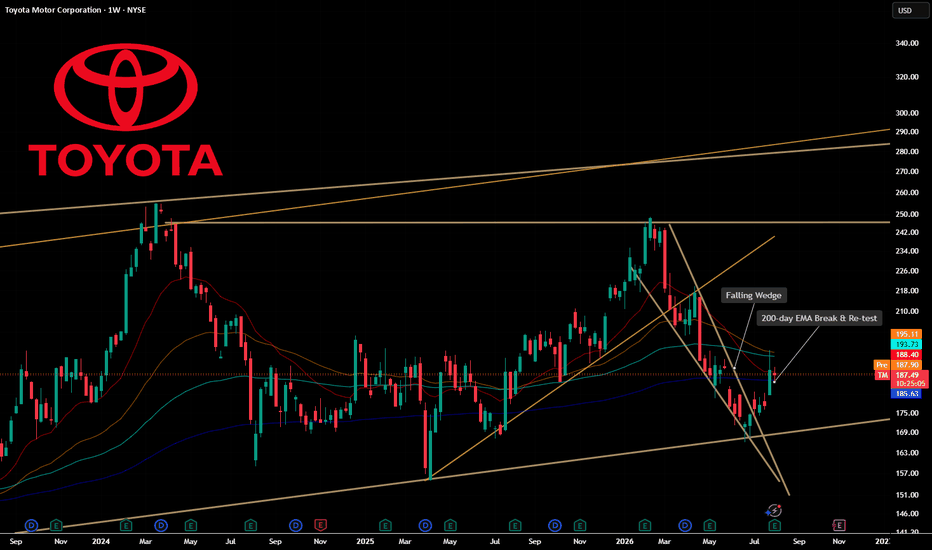
Toyota has been operating within a well-defined ascending channel since March 2020, a five-year structure that has contained every significant move in both directions and has never been sustainably violated on either boundary.
After retesting the channel support in April 2025, the stock attempted to recover but failed to reclaim the previous high, getting rejected at that resistance level and rolling over into a corrective structure. That correction took the form of a falling wedge, a pattern characterised by converging downward-sloping trendlines, where the lower support falls faster than the upper resistance. Falling wedges are among the most reliably bullish reversal patterns in technical analysis. They signal exhaustion in selling pressure, with each successive low requiring less momentum than the last.
The wedge completed with a test of the channel support in June 2026, the second touch of the five-year channel lower boundary, precisely where structural buyers have consistently emerged. In July 2026, price broke out of the falling wedge to the upside, and in the week of July 27th, reclaimed the 200-day EMA on the weekly timeframe, one of the most significant moving averages in institutional analysis.
This Week - The Confirmation We Were Waiting For
In the current week beginning August 3rd, Toyota pulled back to retest the 200-day EMA, the exact behaviour one would want to see following a genuine breakout. False breakouts do not retest and hold. Genuine breakouts retest and find support. As of today, Friday August 8th, the 200-day EMA is holding as support.
We are opening a position today, assuming this level holds into the close. This is our entry signal, not the initial breakout, but the successful retest of a reclaimed moving average. The distinction matters. Entries on retest carry better risk definition than entries on initial breakout, because the level at which we are wrong is clearly defined: a weekly close back below the 200-day EMA invalidates the thesis and we exit without hesitation.
Targets
Our first target is the horizontal resistance at the previous high, the level that rejected price in the recovery attempt following the April 2025 channel support test. That level represents the first significant supply zone the market must absorb before continuing higher.
Our second and more ambitious target is the channel resistance, the upper boundary of the five-year ascending channel that has acted as the ceiling of every major rally since March 2020. If the breakout from the falling wedge and the reclaim of the 200-day EMA mark the beginning of the next major leg within this channel, the resistance is a natural and well-defined objective.
We do not set targets and immediately plan to sell at them. We set targets and plan to become alert, observing how price interacts with each level before deciding whether the structure supports continuation or distribution.
The Risk
A weekly close back below the 200-day EMA is the invalidation. We do not rationalise breaches of defined structure. We exit and reassess. The tariff environment remains a headwind for reported earnings, and any escalation beyond current levels could weigh on sentiment independent of the technical picture. We are aware of this and size accordingly.
Capital preservation first. Confirmation before conviction.

