TEAM: Monthly BUY Setup After a 77% Collapse — Wait for Confirm
 TEAM
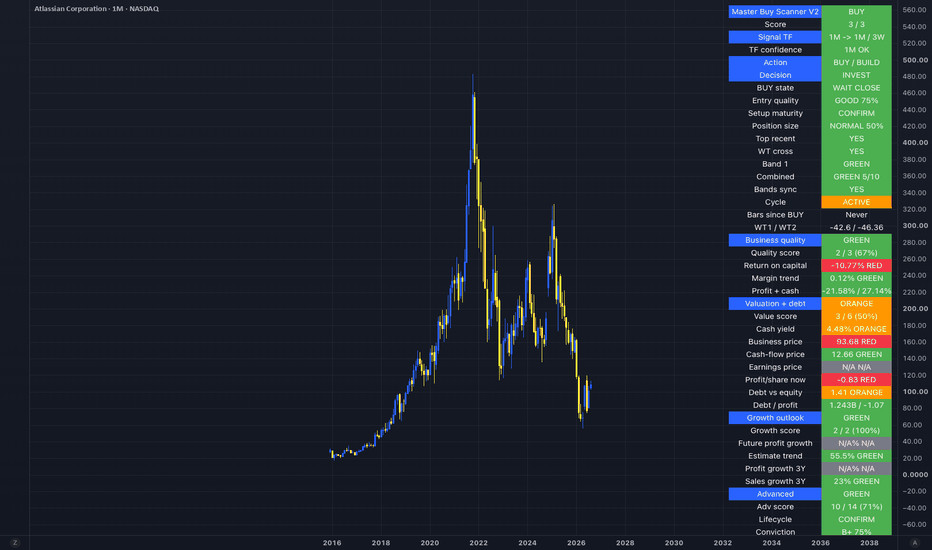
has fallen from approximately $480 at its 2021 peak to around $109, erasing roughly 77% of its market value.
TEAM
has fallen from approximately $480 at its 2021 peak to around $109, erasing roughly 77% of its market value.
The stock recently rebounded from the $65–$75 area, but it remains far below its previous highs and within a damaged long-term structure.
The Master Buy Scanner V2 now identifies a developing monthly BUY setup with good entry quality, confirmed momentum alignment and a recommended 50% position size.
One important condition remains:
The monthly candle still needs to close.
Master Buy Scanner V2 — Monthly
Score: 3/3
Signal: BUY
Signal timeframe: 1M → 1M / 3W
Timeframe confidence: 1M OK
Action: BUY / BUILD
Decision: INVEST
BUY state: WAIT CLOSE
Entry quality: GOOD — 75%
Setup maturity: CONFIRM
Position size: NORMAL — 50%
Top recent: YES
WT cross: YES
Band 1: GREEN
Combined band: GREEN 5/10
Bands synchronized: YES
Cycle: ACTIVE
Bars since BUY: Never
WT1 / WT2: -42.60 / -46.36
The monthly momentum curves have entered the scanner’s lower accumulation region and produced a bullish WT cross.
Band 1 is green, the lower bands are synchronized and the broader cycle remains active. The setup maturity is also classified as CONFIRM, making this more developed than an early speculative signal.
However, the combined-band score is only 5/10, and the formal BUY event has never been completed. The current monthly configuration must therefore survive until the candle closes.
The scanner’s NORMAL 50% position size is meaningful: it supports a material allocation after confirmation, but not immediate full exposure.
Growth remains exceptionally strong
Atlassian’s latest reported quarter was fundamentally much stronger than its share-price performance suggests.
During Q3 FY2026:
Total revenue increased 32% to $1.787 billion.
Cloud revenue increased 29% to $1.132 billion.
Remaining performance obligations increased 37% to approximately $4 billion.
Customers generating more than $10,000 in Cloud ARR increased 10% to 55,913.
Service Collection surpassed $1 billion in ARR and continued growing above 30%.
These figures show that Atlassian is not experiencing a collapse in customer demand.
Cloud adoption is accelerating, enterprise customers are making larger and longer commitments, and Atlassian continues expanding beyond its traditional Jira and Confluence products into service management, strategic planning and broader collaboration.
The profitability picture depends heavily on which numbers investors use
Atlassian reported a GAAP operating margin of -3% and a GAAP net loss of $98.4 million during Q3.
The operating loss included $223.8 million of restructuring charges, but stock-based compensation was also extremely significant at approximately $408 million, equivalent to 23 percentage points of quarterly revenue.
On a non-GAAP basis, the picture was dramatically stronger:
Operating income reached $607.2 million.
Operating margin increased from 26% to 34%.
Non-GAAP diluted EPS increased from $0.97 to $1.75.
Free cash flow reached $561.3 million.
Free-cash-flow margin was approximately 31%.
This explains the apparent contradiction within the scanner.
Atlassian generates substantial cash, but GAAP returns remain weak because of stock-based compensation, restructuring costs and continued investment.
The company is therefore economically stronger than its GAAP loss suggests, but not as profitable as its non-GAAP margin implies.
Business quality is positive, but not perfect
The scanner assigns Atlassian a 2/3 business-quality score:
Return on capital: -10.77% — RED
Margin trend: +0.12% — GREEN
Profitability measure: -21.58%
Cash-generation measure: 27.14%
The cash-generation score is attractive, while the negative return-on-capital reading reflects the lack of consistent GAAP profitability.
This prevents Atlassian from qualifying as a conventional high-quality compounder today. The business is growing rapidly and generating cash, but shareholders must accept significant stock-based compensation and a substantial gap between GAAP and adjusted results.
Rovo and the Teamwork Graph could become a genuine AI advantage
Atlassian’s AI thesis is based less on owning a frontier language model and more on controlling the context surrounding how companies work.
Its Teamwork Graph connects information from Jira, Confluence, Loom and external applications. Atlassian says the graph now contains more than 150 billion connections.
Rovo is already used by 75% of the Fortune 500 and more than 90% of Atlassian’s enterprise customers. The company reported more than 14 million Rovo-assisted actions during a single recent month.
The strategic advantage is clear:
Jira contains project and workflow data.
Confluence contains institutional knowledge.
Loom contains asynchronous communication.
Service Management contains operational and support data.
Rovo can search, reason and act across that context.
Atlassian is also allowing first- and third-party AI agents to work directly inside Jira, with permissions, audit trails and governance controls. This could make Jira the orchestration layer through which companies manage work performed by both humans and AI agents.
That is a credible long-term opportunity—but monetization remains less certain than adoption.
AI adoption could increase costs before it increases revenue
Atlassian currently provides many of its AI capabilities at no additional cost or at relatively low cost for Cloud customers.
The company acknowledges that this strategy may increase hosting and infrastructure expenses without producing corresponding near-term revenue.
The bullish interpretation is that inexpensive AI accelerates adoption, increases product engagement and strengthens the overall Atlassian ecosystem.
The bearish interpretation is that Rovo becomes an expensive feature required to defend existing subscriptions rather than a significant independent revenue source.
Atlassian must eventually demonstrate that AI produces at least one of the following:
Higher subscription prices
More seats per customer
Greater adoption of Collections
Improved customer retention
Lower operating costs
New usage-based revenue
Until then, strong AI usage alone does not guarantee stronger shareholder returns.
The Cloud transition remains both a catalyst and a risk
Atlassian is accelerating the migration of customers away from Data Center products through its Atlassian Ascend initiative.
The company stopped selling term licences to new Data Center customers in March 2026. It plans to stop selling term licences and expansions to existing customers in March 2028, with most maintenance and support ending in March 2029.
Successful migrations should increase recurring Cloud revenue and allow Atlassian to unify customers around its AI-powered platform.
However, the transition also creates several risks:
Some regulated or security-sensitive customers may not migrate.
Cloud revenue can initially be lower than equivalent Data Center revenue.
Hosting costs can reduce margins.
Migration incentives may affect pricing.
Purchasing and renewal patterns may become more volatile.
The transition strengthens the long-term platform thesis, but it may continue creating near-term volatility in revenue and profitability.
The valuation is mixed—not clearly cheap
The scanner assigns Atlassian a 3/6 valuation score:
Cash yield: 4.48% — ORANGE
Business-price multiple: 93.68 — RED
Cash-flow multiple: 12.66 — GREEN
Current profit per share: approximately -$0.83 — RED
Debt-to-equity: 1.41 — ORANGE
The cash-flow valuation appears attractive relative to Atlassian’s growth rate. However, the earnings-based valuation remains difficult to assess because current GAAP earnings are negative.
This is not a conventional deep-value investment.
The valuation thesis depends on Atlassian preserving strong revenue growth while gradually converting more of its free cash flow into genuine per-share earnings.
Continued high stock-based compensation would weaken that conversion, even if reported non-GAAP earnings continue growing.
The growth outlook remains the strongest component
The scanner gives Atlassian a maximum 2/2 growth score:
Estimate trend: +55.5% — GREEN
Three-year sales growth: approximately 23% — GREEN
Atlassian’s Q3 guidance called for full-year FY2026 revenue growth of approximately 24% and Cloud revenue growth of approximately 26.5%.
That level of growth would normally justify a premium valuation, particularly for a business with high gross margins, recurring subscriptions and substantial free cash flow.
The question is whether Atlassian can maintain growth above 20% as it becomes larger—without relying indefinitely on heavy stock-based compensation and adjusted profitability metrics.
Advanced confirmation is constructive
The scanner’s advanced section supports the setup:
Advanced score: 10/14 — 71%
Lifecycle: CONFIRM
Conviction: B+ — 75%
This is a solid reading, but not a maximum-conviction configuration.
The technical bottom appears increasingly credible, yet the stock must still complete the monthly signal and establish a durable higher-low structure.
Key technical levels
Immediate support: $100–$105
Secondary support: $85–$90
Major long-term support: $65–$75
First resistance: $115–$120
Initial recovery confirmation: $135–$145
Major resistance: $160–$175
Structural recovery zone: $200–$220
Higher macro resistance: $250–$275
Holding above approximately $100 would preserve the current rebound.
A monthly close above $110–$115 would complete the current scanner configuration more convincingly. A subsequent move through $120, followed by a higher low, would provide further evidence that a durable reversal is developing.
A move above $135–$145 would represent the first substantial repair of the long-term structure.
A return below $85 would increase the risk that the recent recovery is only a temporary bear-market rally.
Q4 earnings are the immediate catalyst
Atlassian is scheduled to report its fourth-quarter and full-year FY2026 results on August 6 at 5:00 p.m. ET.
The report could materially change the setup, particularly through:
FY2027 revenue guidance
Cloud-growth expectations
Data Center migration trends
Rovo and Collections adoption
Free-cash-flow guidance
Stock-based compensation
Progress toward sustainable GAAP profitability
With the monthly signal still marked WAIT CLOSE, the earnings reaction could determine whether the BUY event completes or disappears.
My classification: GROWTH BUY / BUILD — WAIT FOR THE MONTHLY CLOSE
Atlassian currently offers:
A maximum 3/3 technical score
Good 75% entry quality
Confirmed monthly setup maturity
A bullish WT cross
Synchronized lower bands
A 50% recommended position size
Revenue growth above 30% in the latest quarter
Accelerating Cloud adoption
Strong enterprise and service-management momentum
Substantial free-cash-flow generation
A credible AI distribution advantage
The main risks remain significant:
No completed monthly BUY event
Negative GAAP operating income
Very high stock-based compensation
Negative return on capital
Only a 3/6 valuation score
Unproven direct AI monetization
Execution risk around the Data Center transition
Q4 earnings immediately ahead
The scanner’s NORMAL 50% recommendation appears reasonable after confirmation, but the WAIT CLOSE status remains decisive.
Current verdict: BUY SETUP — WAIT FOR THE MONTHLY CLOSE, THEN BUILD.
What would you do?
A) Start a partial position around $109
B) Wait for earnings and the confirmed monthly close
C) Wait for a recovery above $120
Master Buy Scanner V2:

This is not financial advice. Technical signals can fail, and high-growth software companies can remain under pressure when valuation, dilution or profitability expectations deteriorate.