SpaceX vs Meta is one of those matchups everyone keeps circling back to right now, since both companies are chasing the same $2 trillion mark and neither one has fully settled the question. SpaceX briefly got there in June, not long after its IPO, and Meta has also come close, peaking at $1.988 trillion without ever quite crossing over. Line up SpaceX vs Meta revenue growth next to SpaceX stock valuation and the two companies are doing this in almost opposite ways, and that gap is really what the SpaceX vs Meta $2 trillion race comes down to. At the time of writing, plenty of people are also asking whether SpaceX is a buy right now, or if Meta is the steadier pick instead.
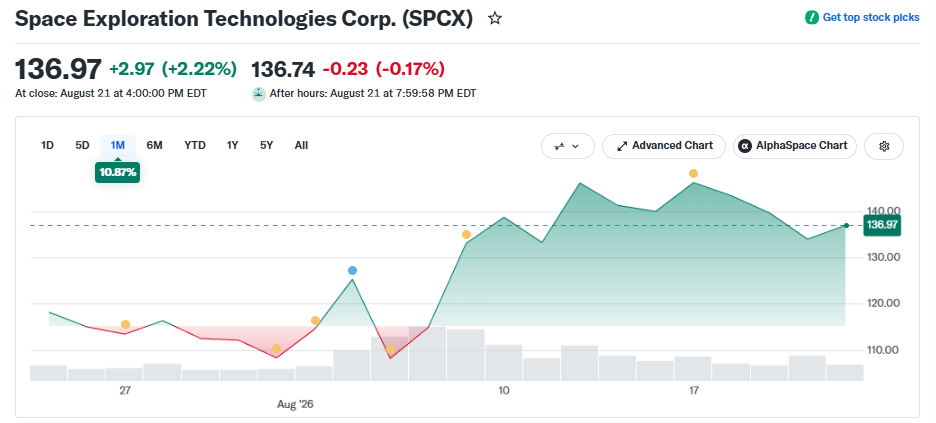
Also Read: SpaceX Stock Price Prediction: BofA, Arete, and Wall Street Set 12-Month Targets
SpaceX vs Meta: Revenue, Valuation And The $2 Trillion Race
Two Businesses That Overlap More Than People Realize
Meta’s business is mostly advertising, spread across Facebook, Instagram, Threads, WhatsApp and Messenger, and that side of things still brings in most of the profit. Meta is also spending a lot to build out AI right now, and on the company’s Q2 2026 earnings call, CEO Mark Zuckerberg pointed to strong demand for the extra compute Meta has been buying up.
Mark Zuckerberg, CEO of Meta Platforms, had this to say:
“We have quite a number of offers at a meaningful premium over what we paid for the compute.”
SpaceX, on the other hand, is a much wider operation. It owns xAI, maker of the Grok models that now go up against Meta’s own AI work, and xAI also owns the X platform, so the two companies actually overlap in more places than people tend to assume, on top of SpaceX’s rockets and its Starlink business. In the SpaceX vs Meta comparison on business scope alone, SpaceX comes out ahead just because it covers so much more ground, even though Meta is still the dominant, established name in social media.
SpaceX Vs Meta Revenue: Who Is Actually Growing Faster
On revenue, it isn’t much of a contest. SpaceX’s sales grew 92% year over year in its most recent quarter, and AI and connectivity demand drove most of that, though the company also posted a $541 million net loss for the same period. Meta’s revenue rose 28% year over year, a much slower pace, and it reported $15.8 billion in profit, down from $18.3 billion a year earlier. So the SpaceX vs Meta revenue picture really depends on what an investor wants out of it, since SpaceX is growing fast and still losing money, and Meta is growing slower but staying consistently profitable. That split is also a big part of why the SpaceX vs Meta $2 trillion race stays so close, as neither side settles the argument on its own.
SpaceX Stock Valuation Is Where Meta Pulls Ahead
This is the category that flips things around. Because SpaceX still posts losses, price to sales ends up being the more useful yardstick, and annualizing its Q2 revenue puts SpaceX at roughly 45 times sales, which is a pretty rich multiple by any measure. Meta, on the other hand, trades at about 6.6 times sales and 19 times forward earnings, a much cheaper SpaceX stock valuation by comparison, and that gap is a big reason some analysts think Meta could reach $2 trillion before SpaceX does, even with SpaceX growing faster. It is also the main reason so many people keep asking whether SpaceX is a buy at these levels rather than just assuming the bigger business always wins. Around SpaceX’s IPO, banker Lloyd Greif, CEO of Greif & Co., gave a pretty blunt read on how the stock actually got priced:
“This was not a deal that was priced based on market forces.”
So, is SpaceX a buy right now, or is Meta the smarter way into the SpaceX vs Meta $2 trillion race? SpaceX wins on business scope and also on growth, Meta wins on valuation, and valuation is usually the thing that ends up deciding which stock actually crosses the line first. A faster growing business does not always mean a better price today, and that gap is pretty much the whole story separating SpaceX vs Meta right now.