Weekly Bias — 3 August
Invesco QQQ Trust Series I BATS:QQQ
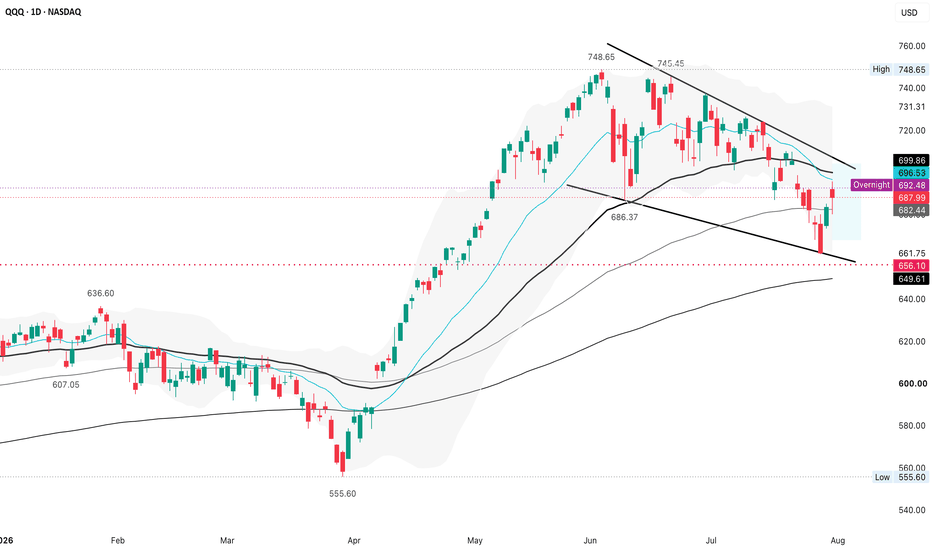
QQQ is attempting to transition from a liquidation rebound into a tradable recover
- Neutral-bullish early in the week & conditional
- Still in a daily downtrend
- Relief bid tests $690–$700, helped by lower oil & modestly positive Sunday futures
- AMD & SPCX determine whether the semi/AI rebound broadens or fails
The QQQ range is approximately $668–$704, matching both the 7 August option-implied move & the major technical boundaries
- A weekly close above $700–$703 would materially improve the outlook & a daily close below $674–$675 would indicate the rebound is failing
- $688 → $693 → $699–$704
- $675–$700
- $696–$700 rejection → $680 → $668/$661
- 10:00 AM — ISM Manufacturing PMI
- The most market-sensitive components will be prices paid, employment & new orders
- Strong headline + elevated prices — yields higher, initially negative for QQQ & supportive of SPY cyclicals
- Weak headline + falling prices — yields lower, supportive of duration & QQQ
- Weak growth + high prices — stagflationary, the worst combination for equities
- After the close — PLTR earnings
- Given its AI exposure & valuation, the result will affect AI sentiment, but AMD remains the more important index-level semi catalyst (link to full analysis in bio)
- The post-FOMC market is highly sensitive to policy interpretation, any emphasis on inflation persistence or labor-market strength in Lisa Cook's speech could move yields
- 10:00 AM — JOLTS job openings
- This matters because the market is currently interpreting strong labor data as potentially hawkish
- Hot JOLTS — upside pressure on yields; likely QQQ headwind
- Softer JOLTS without a collapse in hiring — best outcome for growth stocks
- Abrupt deterioration — yields may fall, but recession risk could pressure IWM
- After the close — AMD & SPCX (link to full analysis in bio)
- This is the most important earnings window for QQQ this week
- AMD will determine whether the recent semi liquidation was an exhaustion event that created value, or the start of a broader AI hardware de-rating
- For QQQ, AMD’s guidance, data-center growth, margins & accelerator demand matter more than the headline EPS beat
- SPCX adds another high-beta AI/capital-expenditure read-through
- 10:00 AM — ISM Services
- Services prices & employment are particularly important because the Fed remains concerned about inflation persistence
- LLY earnings
- This is more important for SPY than QQQ due to its index weight & healthcare exposure
- Wednesday could produce the week’s largest gap because it combines AMD/SPCX reactions with ISM Services
- 8:30 AM — Preliminary productivity & unit labor costs
- Higher productivity & contained labor costs would be a favorable combination
- Supports earnings margins, reduces inflation pressure & helps cap yields
- Weak productivity with high unit labor costs would be negative for both bonds & growth multiples
- 8:30 AM — July employment report
- Current published consensus is approximately +83,000 nonfarm payrolls & unemployment around 4.2%–4.3%
- This is the most important macro event of the week
- 40K–100K, unemployment stable — yields↓, QQQ bullish
- Above 150K with firm wages — yields↑, QQQ vulnerable, SPY may initially outperform
- Negative/near-zero jobs with unemployment jump — yields fall sharply, initial QQQ bounce possible, then growth scare
- Soft payrolls with contained wages — yields lower. most favorable for duration/growth
- The Fed’s recent hold was interpreted as hawkish & inflation remains elevated, so an upside payroll surprise risks reviving rate-hike expectations
- Oil is falling sharply amid signs of possible US–Iran de-escalation & reports that Washington paused contemplated military action
- Gulf markets also responded positively Sunday
- That is supportive because lower oil reduces near-term inflation anxiety, removes pressure from long-duration assets, improves the odds that yields stabilize & helps rate-sensitive small caps
- However, Iran has disputed parts of the reported diplomatic progress, so oil remains an event-driven risk rather than a resolved catalyst
- QQQ is above its rising weekly averages, well above the prior major breakout near $637 & approximately 8% below the $748.65 high
- The weekly chart is undergoing an intermediate correction vs secular trend reversal
- $661–$675 correction demand
- $637–$650 major weekly support & rising intermediate average
- $700–$713 is former value & structural resistance
- A weekly close below $637–$641 would represent much more serious technical deterioration
- The bounce from $661 is a meaningful LTF reversal, but QQQ still must reclaim ~$697 or the 20d EMA
- ~$701 is the 50d & hourly long-term average
- $709–$713 is the prior breakdown area & volume-profile resistance
- The highest-volume overhead area is around $710–$713
- Even after reclaiming $700, QQQ would face another substantial supply area there
- Sell-side sweep at $661.14, displacement to approximately $692, higher low near $682–$684 & short MA turning upward, but Friday’s rally stalled below $692–$700
- Means the hourly MSS is intact while above $680–$682, but the larger hourly trend isn't bullish until QQQ accepts above $693 & then $700
- It closed above the 20d average near $743, the 50d average near $739 & back inside its former value region
- SPY’s main resistance is $747–$750
- Support $739–$743, then $732–$734 → $725
- SPY’s structure argues against an immediate broad-market breakdown
- It also means that if QQQ receives a positive AMD & payroll reaction, SPY can provide index-level stability
- Friday’s close near $290 was below the 20d average near $293, near the 50d average & accompanied by meaningful downside put positioning
- IWM needs to reclaim $291–$293, then $295–$297
- A break below $288 exposes $285, where the largest 7 August put OI sits
- If Sunday’s RTY strength holds Monday & IWM accepts above $293, that would be an important breadth improvement
- If RTY’s overnight gain fades & IWM loses $288–$290, the market remains narrow & defensive
7 August
- QQQ ±18 or ±2.6% → $668–$704
- SPY ±10 or ±1.3% → $735–$755
- IWM ±6 or ±1.9% → $285–296
- QQQ ±25 or ±3.6% → $661–$711
- SPY ±15 or ±2% → $730–$760
- IWM ±8 or ±2.8% → $282–$298
- Traders continue to pay materially more for downside protection than upside exposure
- The rebound has reduced panic, but the options market hasn't accepted that the low is secure
- $690 is the immediate pin
- $700 is the primary upside wall
- $710 is the next upside target if $700 breaks
- $660 is the principal downside wall
- $645–$650 contains substantial crash-protection interest
- Failure below $685 increases the probability of faster movement toward $675–$670
- Below $660, dealer hedging could amplify downside movement toward $650–$645
major calls at $750 & $760, major downside puts at $730, $720 & $710
- SPY is likely to act as a stabilizer unless the employment report produces a major yield shock
- $295–$300 is upside resistance
- $285 is the likely downside magnet/support
- Loss of $285 opens a more volatile downside regime
- The most likely Monday path is a gap or early push toward $690–$693
- Bullish confirmation requires hold above $685 after the open, break $690 & hourly acceptance above $693
- A gap above $690 that immediately loses $685 would be a warning that Sunday’s move was primarily geopolitical short covering
- QQQ may gravitate toward $690–$700 ahead of AMD because of the large $690 & $700 call concentrations
- I'd expect reduced intraday follow-through, choppier price action & IV remaining supported into the close
- A strong AMD guide could produce QQQ gap through $700, SMH-led continuation & a $707–$713 test
- An inadequate guide could create rejection from $696–$700, gap back toward $680–$675 & renewed semi underperformance
- Likely consolidation as the market positions for payrolls
- The jobs report can drive QQQ to either weekly expected-move boundary
- Bullish data interpretation $700–$704
- Hawkish/negative interpretation $668–$675