Trading Roadmap | Wave Analysis · Lesson 05 — Wave Personality
Bitcoin / TetherUS BINANCE:BTCUSDT
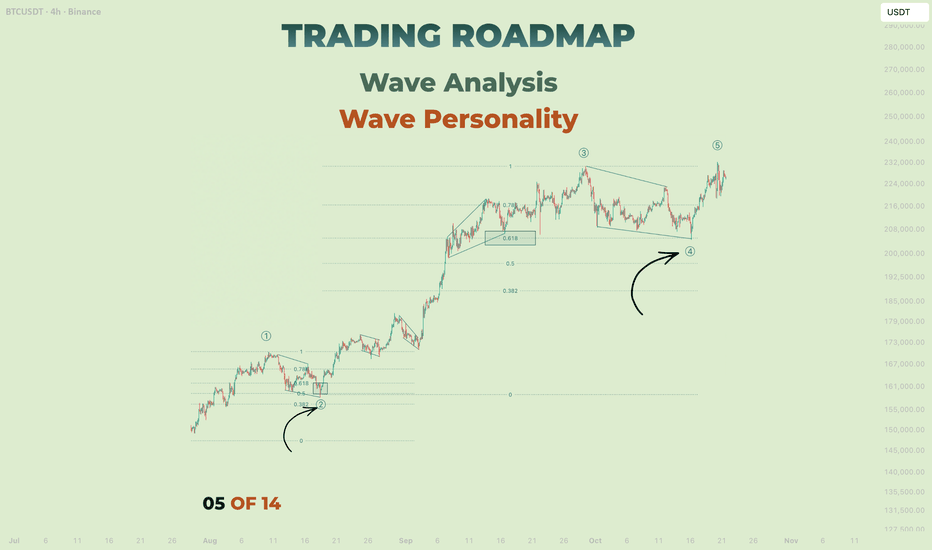
Lesson 5 - Wave Personality
Difficulty: (Intermediate)
The three rules tell you whether a count is allowed. They cannot tell you whether it feels right. Each wave in an Elliott sequence tends to carry its own character — its own sentiment, its own participation, its own way of moving — and learning that character is often what turns a count from guesswork into something you can read.

The same five-wave structure, labeled by character instead of by number. Doubt, disbelief, recognition, complacency, enthusiasm — the sequence repeats often enough across markets and timeframes to be worth recognising.
🔵 QUICK RECAP FROM LESSON 4
Three rules define whether an impulse count is valid: Wave 2 stays inside Wave 1's origin, Wave 3 is not the shortest of the motive legs, and Wave 4 stays clear of Wave 1's territory.
Those are pass-or-fail tests. This lesson adds the softer layer on top of them — the one that helps you choose between two counts that both pass.
🔵 1. WHAT "PERSONALITY" MEANS
Elliott's original observation was not only about shape. It was that each wave tends to form under a different emotional backdrop, and that the backdrop leaves a footprint on the chart: in the size of the candles, in the volume, in how momentum behaves.
Personality is a guideline layer, not a rule layer. A wave that behaves out of character does not invalidate a count — but it is a signal worth noticing.
- Rules answer: is this count permitted?
- Personality answers: does this count look like what it claims to be?
- When two valid counts compete, personality is often the tie-breaker
🐳 Pro Tip: Never use personality to override a broken rule. Use it to rank counts that all remain valid.
🔵 2. WAVE 1 — THE MOVE NOBODY TRUSTS
Wave 1 usually begins while the previous trend still dominates the conversation. Sentiment is generally still negative at the bottom (or still positive at a top), and the move is commonly read as a bounce inside the old trend rather than the start of a new one.
- Participation is often modest — the move can look unimpressive relative to what follows
- News flow tends to lag; the story has not changed yet
- Wave 1 is frequently only identifiable in hindsight, after Wave 2 holds
This is the wave that is hardest to trade in real time, and there is no way around that. It is normal for a Wave 1 to be labeled only once Wave 3 is already underway.
🐳 Pro Tip: If you find yourself confidently labeling a Wave 1 the moment it starts, you are probably labeling a bounce. Waiting for the Wave 2 to hold costs you some of the move but removes a lot of guesswork.
🔵 3. WAVE 2 — DISBELIEF AND THE DEEP PULLBACK
Wave 2 tends to be sharp and emotionally convincing. It commonly retraces a large share of Wave 1 — 50%, 61.8%, sometimes 78.6% — and by the time it ends, most of the market has concluded the old trend never stopped.
- Volume often contracts as the pullback matures
- Sentiment typically returns to where it was before Wave 1 started
- The structure is usually a zigzag — sharp rather than sideways
A deep Wave 2 that retraced most of Wave 1 and still held above the origin of Wave 1 — the level that would have invalidated the count. Note how the pullback looks like trend continuation while it is happening — that is characteristic, not accidental.
🐳 Pro Tip: A Wave 2 that barely pulls back is worth a second look. Shallow second waves happen, but they are less typical, and a shallow retracement can sometimes mean you are actually inside a Wave 3 of a smaller degree.
🔵 4. WAVE 3 — RECOGNITION
Wave 3 is where the market catches up. Participation usually broadens, volatility expands, and the move often extends well beyond what Wave 1 covered.
- Volume commonly reaches its highest level of the entire sequence here
- Gaps and large-bodied candles appear more often in Wave 3 than elsewhere
- Wave 3 is frequently the extended wave, often reaching 1.618 of Wave 1 or more
- Pullbacks inside Wave 3 tend to be shallow, and can be frustrating for anyone waiting for a cleaner entry
The volume panel tells the story that the price labels only imply. Activity expanded through Wave 3 and faded through the correction that followed — a pattern that shows up often enough to be a useful sanity check on a count.
🐳 Pro Tip: If the leg you have labeled Wave 3 shows less participation than Wave 1, the count may need re-examining. It does not break any rule, but it is out of character.
🔵 5. WAVE 4 — COMPLACENCY
Wave 4 is usually the most frustrating part of the sequence. After the expansion of Wave 3, price commonly moves sideways rather than sharply, and it can consume far more time than its size suggests.
- Flats and triangles appear more often here than in Wave 2
- Volatility and volume typically contract
- The guideline of alternation applies: when Wave 2 is sharp, Wave 4 tends to be sideways, and vice versa
Alternation in one frame. Wave 2 on the left resolved in hours as a tight vertical drop; Wave 4 on the right spent days grinding sideways inside a range. Two corrections in the same impulse, behaving in completely different ways. The dashed line marks the Wave 1 high — Wave 4 stayed clear of it throughout, so the count from Lesson 4 still holds.
🐳 Pro Tip: Wave 4 often ends near the territory of the fourth wave of one smaller degree inside Wave 3. It is a rough zone rather than a precise level, but it can help you frame where a Wave 4 may be finishing.
🔵 6. WAVE 5 — ENTHUSIASM WITHOUT BREADTH
Wave 5 usually makes a new extreme, but frequently does so with less force behind it than Wave 3 had. Sentiment is commonly at its most confident precisely when participation is thinning.
- Momentum divergence between Wave 3 and Wave 5 is one of the more common characteristics of this wave
- Volume often stays below the Wave 3 peak
- Wave 5 can extend — that is permitted, and Lesson 7 covers extensions in detail
Price made a higher high into Wave 5 while momentum did not follow. Divergence is not a timing tool on its own, but when it lines up with a completed count it adds context that the price labels alone do not provide.
🐳 Pro Tip: Divergence by itself signals very little — it can persist for a long time. It becomes more useful when a count is already complete and the three rules still hold.
🔵 7. THE CORRECTION — A, B AND C
Corrections carry personality too, and the three legs are quite different from each other.
- Wave A is commonly mistaken for a routine pullback inside the old trend. Sentiment is usually still aligned with the previous direction
- Wave B is typically the weakest leg — low participation, unconvincing structure, and it often traps traders expecting the trend to resume
- Wave C tends to behave like a Wave 3 in the opposite direction: broad, decisive, and the point where sentiment finally flips
🐳 Pro Tip: When a rally shows unusually weak volume and a messy internal structure, treating it as a possible Wave B rather than a trend resumption is often the more cautious read.
🔵 8. USING PERSONALITY IN PRACTICE
Personality tends to be most useful as a filter applied after the rules, rather than as a standalone method.
1. Check the three rules first — discard anything that fails
2. Compare the surviving counts against the expected character of each wave
3. Prefer the count where the most waves behave as they typically would
4. Keep the invalidation levels from Lesson 4 on the chart regardless
It is common to find waves that behave out of character inside a count that remains entirely valid. That is normal. Personality shifts the odds between interpretations — it does not decide them.
🔵 COMMON MISTAKES
- Treating personality guidelines as if they were rules, and discarding valid counts over them
- Labeling a leg Wave 3 purely because it is large, without checking participation
- Expecting every Wave 4 to be sideways, when alternation only makes it more likely
- Reading momentum divergence as a reversal signal on its own
- Forcing a Wave 5 label when the structure is still building
🔵 QUICK SELF-CHECK
- Describe the sentiment backdrop of each wave from 1 to 5 in one sentence each
- Explain why Wave 2 and Wave 4 rarely take the same shape
- Open a chart with a completed impulse and check whether volume peaked in Wave 3
- Find one correction and identify which leg was the weakest
🔵 WHAT IS NEXT
Lesson 6 — Fibonacci with Elliott: we bring the two frameworks together. Which retracement levels tend to matter for Wave 2 and Wave 4, which extensions are commonly used to project Wave 3 and Wave 5, and how to keep the tool from turning into a level-hunting exercise.
Drop a comment: which wave do you find hardest to identify in real time — and why?
Full Trading Roadmap | Wave Analysis Course
Trading Roadmap | Wave Analysis · Lesson 01 — Wave Analysis Foundations
Trading Roadmap | Wave Analysis · Lesson 02 — Impulse Waves (5-Wave Structure)
Trading Roadmap | Wave Analysis · Lesson 03 — Corrective Waves (A-B-C)
Trading Roadmap | Wave Analysis · Lesson 04 — The Rules of Elliott
Best Regards, BigBeluga 🐳