what the all-time high really represents.
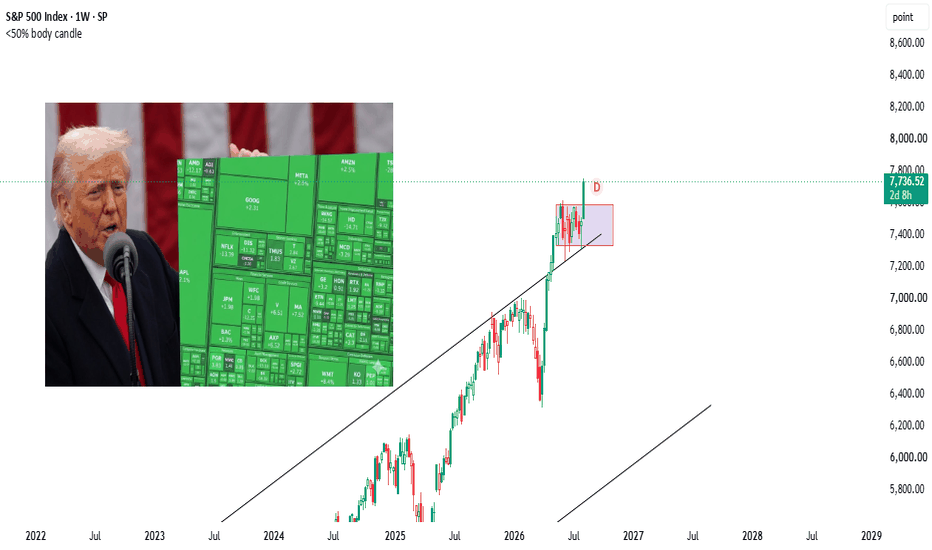
The S&P 500 just made history again.
On August 4, 2026, the index closed at 7,736.52, a new all-time closing high but what does that actually tell us about the American economy?
The answer is more interesting than simply saying “the economy is doing well.”
The Market Is Not the Economy
The S&P 500 is an index designed to measure the performance of 500 leading U.S. companies. Its price reflects what investors are willing to pay for ownership in those businesses.
The economy is much larger.
It includes households, private companies, government activity, workers, consumers, investment, production and trade. GDP measures the value of final goods and services produced over a period of time. The S&P 500 measures the market value assigned to a specific group of companies.
One measures economic activity, the other measures financial valuation. They are connected, but they are not interchangeable.
What Is Actually Rising?
When the S&P 500 reaches an all-time high, the immediate change is in price.
Market capitalization is broadly:
Share price × shares outstanding
If investors reprice a company higher, its market capitalization rises, that does not mean an equivalent amount of cash entered the company.
A company can gain billions in market value simply because investors are now willing to pay more for its shares. This is why a record market capitalization should be understood as a record valuation, not a pile of cash.
Why Can Stocks Rise Faster Than the Economy?
Because stocks price the future. Investors are not buying a company's shares only for what it earned yesterday. They are paying for expected future earnings and cash flows.
Those expectations are influenced by:
economic growth, corporate profitability, productivity, interest rates, technology
risk and valuation
If investors expect stronger future profits, they can bid prices higher today.
That means the stock market can reach a record even when economic growth is nowhere near a comparable record.
The market is looking forward.
Most economic statistics describe current or recently measured economic activity, while stock prices incorporate expectations about what comes next.
A Record Is Not a Verdict
An all-time high does not prove that the market is overvalued. It also does not prove that it is fairly valued. Price must be considered against what investors are receiving for that price.
The Federal Reserve's latest financial stability assessment noted that equity valuations remained elevated, with the S&P 500's forward price-to-earnings ratio in the upper part of its historical range.
So the important question is not simply whether prices are at records but what expectations are embedded in those prices?
If today's valuation assumes years of strong earnings growth, investors eventually need that growth to materialize.
What Does the Record Tell Us About America?
It tells us that investors are assigning a record valuation to a major group of American companies. That is economically meaningful.
Corporate profits are connected to consumers, workers, investment, technology and productivity.
But the record does not mean every American is becoming richer, it does not mean every business is thriving, it does not mean GDP has risen by the same amount and it does not mean the S&P 500 is a complete measure of America's economic condition.
It tells us something narrower but extremely important:
the market's collective price for ownership in these companies has reached a new high.
The Connection
The relationship can be simplified:
Economic activity → Revenue → Earnings → Expected future cash flows → Valuation → Stock price
The chain explains why the market matters to the economy but it also explains why the two can diverge.
The Real Meaning of an All-Time High
An all-time high is not a declaration that the economy is perfect. It is not a measurement of every household, business or worker. It is a market record.
At that moment, investors have collectively established the highest price ever recorded for the assets represented by the index.
That price contains a view of the future.
So when the S&P 500 makes another record, the most useful question is not:
“How high can it go?” It is - “What does today's price assume about tomorrow's economy?”
That is what an all-time high really represents.
put together by : Pako Phutietsile as @currencynerd