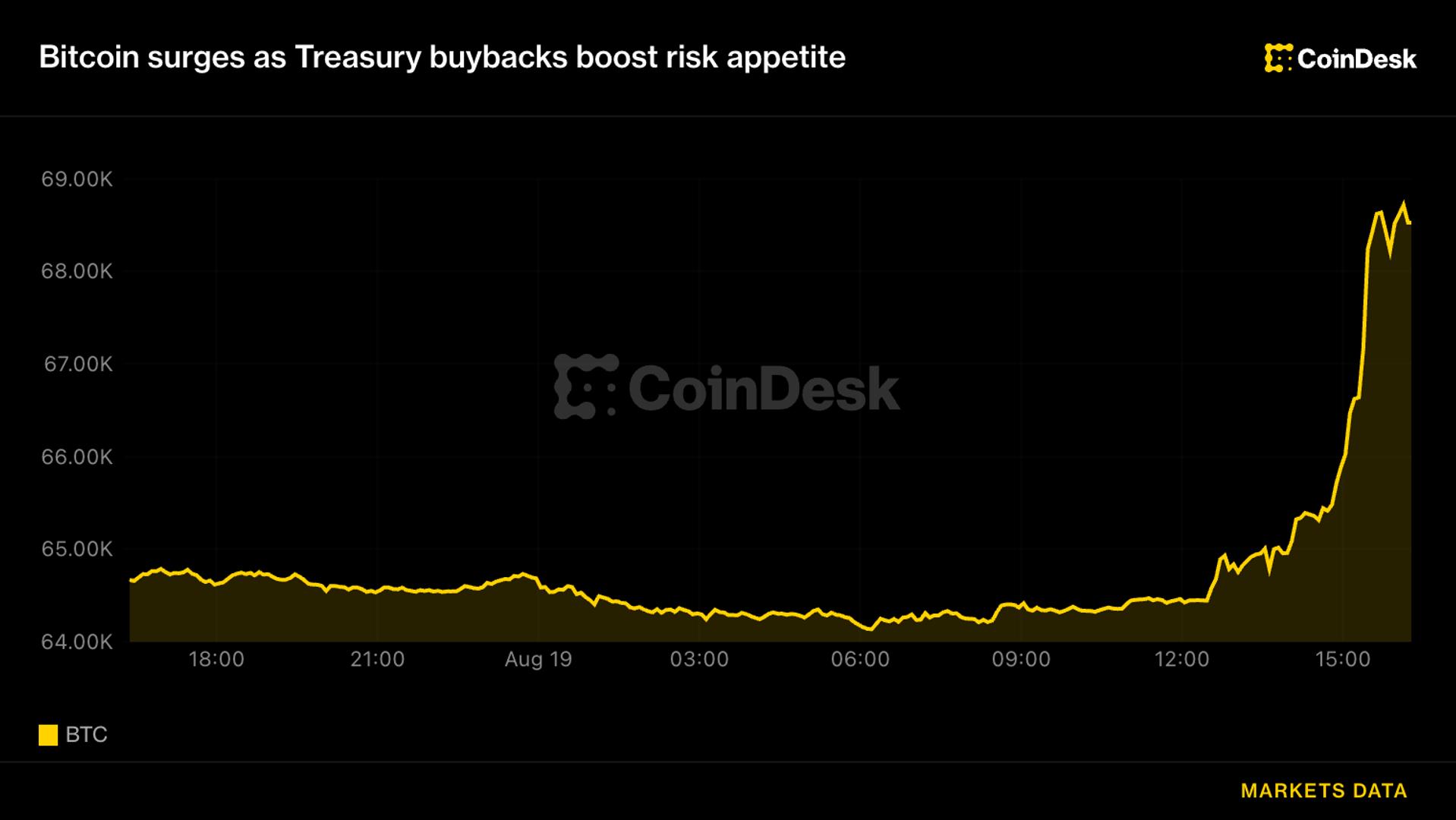

Wall Street institutions increased their exposure to Strategy's MSTR in the second quarter, just before Michael Saylor’s Bitcoin accumulation machine began redirecting capital toward STRC.
On Aug. 18, Strategy said 12 of its 15 largest institutional shareholders increased their MSTR positions through June 30. The company said those additions lifted combined holdings by $1.2 billion.
However, its own chart shows the 12 buyers added about $1.3 billion to their positions, while three firms reduced positions by roughly $609 million. This leaves a net increase of about $695 million across the top 15.
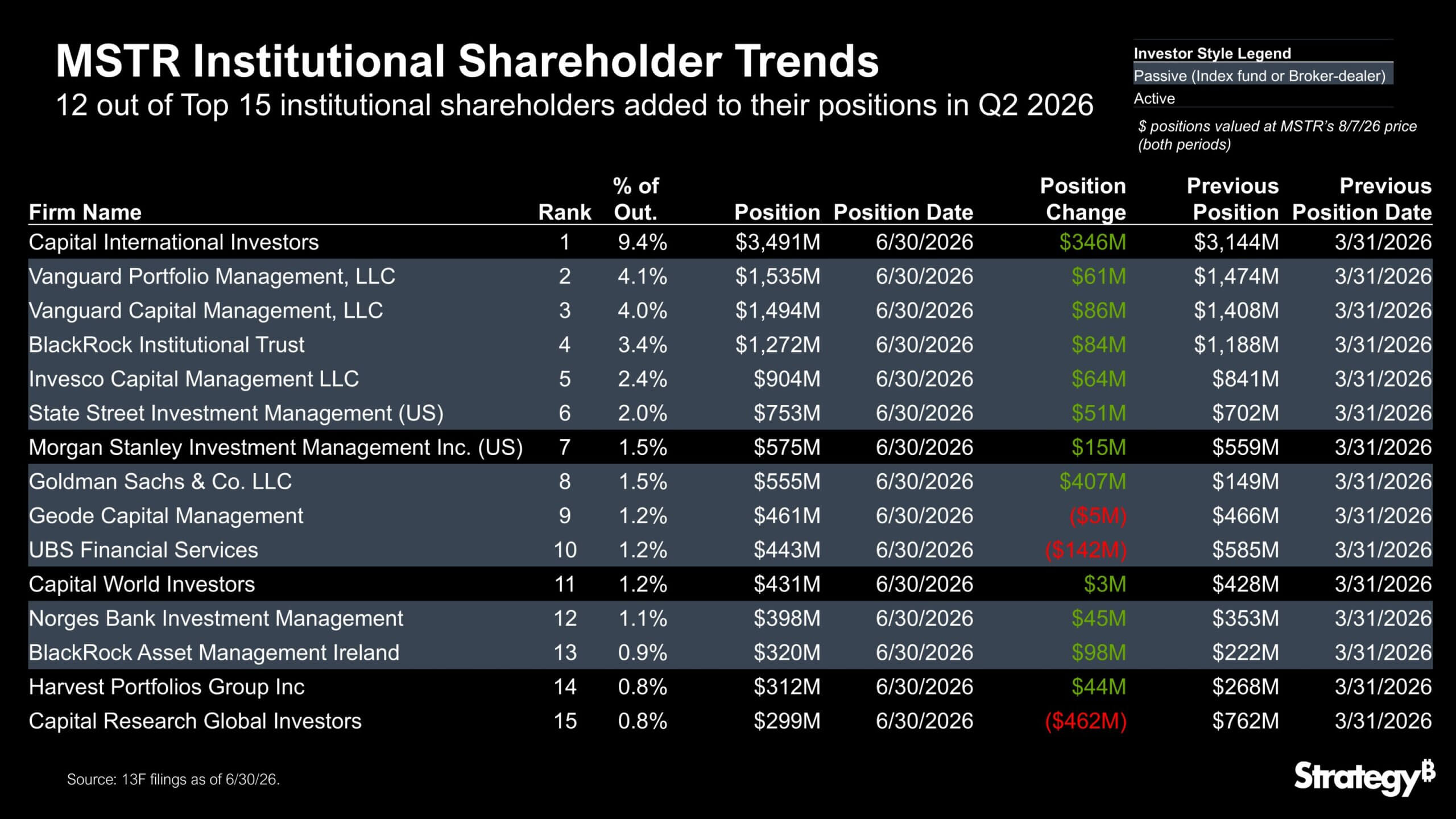
Notable additions came from Goldman Sachs & Co., whose reported stake rose by about $407 million; Capital International Investors added $346 million, while two BlackRock-related firms increased their holdings by more than $170 million combined.
Meanwhile, not all of the increase necessarily reflected an active bet on Strategy or Bitcoin. Vanguard, BlackRock, State Street and other major holders manage passive and index-linked products whose positions can move with fund flows and benchmark weights.
Interestingly, these firms' accumulation came during a turbulent quarter. MSTR rallied toward $195 before reversing sharply and ending June at $86.93, leaving investors who held through the period exposed to one of the stock’s steepest swings of the year.
STRC’s discount forces Strategy to spend to defend it
The timing of Wall Street's second-quarter buying has become increasingly consequential as Strategy undergoes an abrupt shift in capital allocation, leaving major institutional investors exposed to a different financing model.
During Q2, institutions piled into MSTR while Strategy was still operating primarily as the market's largest corporate Bitcoin accumulation engine. But as those asset managers increased their stakes, the machinery supporting that strategy began to weaken.
STRC, a preferred stock launched as a supplementary funding channel for Bitcoin purchases, soon became another pressure point. By issuing STRC near its $100 stated amount, Strategy could raise capital without leaning as heavily on MSTR and direct the proceeds into Bitcoin.
That model worked best while MSTR traded at a sizable premium to its underlying Bitcoin holdings. As that premium narrowed, the broader financing machine became less efficient, while STRC subsequently slid below $80.
Strategy responded by raising STRC’s annual dividend from 9% to 12%, shifting to twice-monthly payments and building a larger dollar reserve. Still, the shares remained well below par, forcing the company to buy them directly in the open market.
This is where the flywheel began running in reverse. Over the past several weeks, Strategy has sold more than $2 billion in MSTR and Bitcoin, repurchased roughly $347 million of STRC, and lifted its dollar reserve to $4.8 billion.
Despite the higher dividend and hundreds of millions in buybacks, STRC remained below $95 this week. Nevertheless, the firm's management remains committed to restoring par.
For institutions that increased their MSTR positions in the second quarter, that commitment changes the investment equation. They bought into Strategy while preferred securities were helping finance additional Bitcoin purchases. They now hold common equity being issued while portions of the Bitcoin treasury and other capital are being directed toward supporting those same preferred shares.
MSCI could put another source of MSTR demand at risk
Meanwhile, the shift in Strategy’s capital allocation comes as another pillar of MSTR demand faces pressure from the index industry.
MSCI is considering a methodology for identifying “non-operating companies” that could exclude Strategy and other asset-heavy firms from its global equity indexes. Applying the proposed financial-ratio test to May data would have removed Strategy, Metaplanet and uranium investor Yellow Cake.
Strategy executives have estimated that this exclusion could create selling pressure equivalent to as much as 4% of MSTR shares, as funds tracking affected benchmarks rebalance their holdings.
While the company has opposed the proposal, the risk is more significant given how much MSTR those asset managers hold.
Using Strategy’s Aug. 7 reference price, Vanguard Portfolio Management held about $1.54 billion at the end of June, Vanguard Capital Management held $1.49 billion, BlackRock Institutional Trust roughly $1.27 billion, and State Street Investment Management about $753 million.
Not all of those positions are tied directly to MSCI benchmarks, and an exclusion would not force every institutional holder to sell. But it could weaken a source of passive demand at a time when Strategy is relying heavily on common-stock issuance.
This is particularly important considering the Q2 filings were already less uniformly bullish than Strategy’s headline suggested. Capital Research Global Investors cut its reported position by about $462 million, UBS Financial Services reduced its stake by roughly $142 million, and Geode Capital Management trimmed about $5 million.
While those reductions were outweighed by buying elsewhere, institutions that increased MSTR exposure in Q2 now face two changes at once: Strategy is deploying capital differently, while a potential index exclusion could put part of the stock’s institutional demand under pressure.
The post Wall Street piled $1.2 billion into MSTR in Q2 before Strategy turned its Bitcoin flywheel toward rescuing STRC appeared first on CryptoSlate.